It Takes Dealers Two Years To Sell This Car

This post may contain links from our sponsors and affiliates, and Flywheel Publishing may receive compensation for actions taken through them.
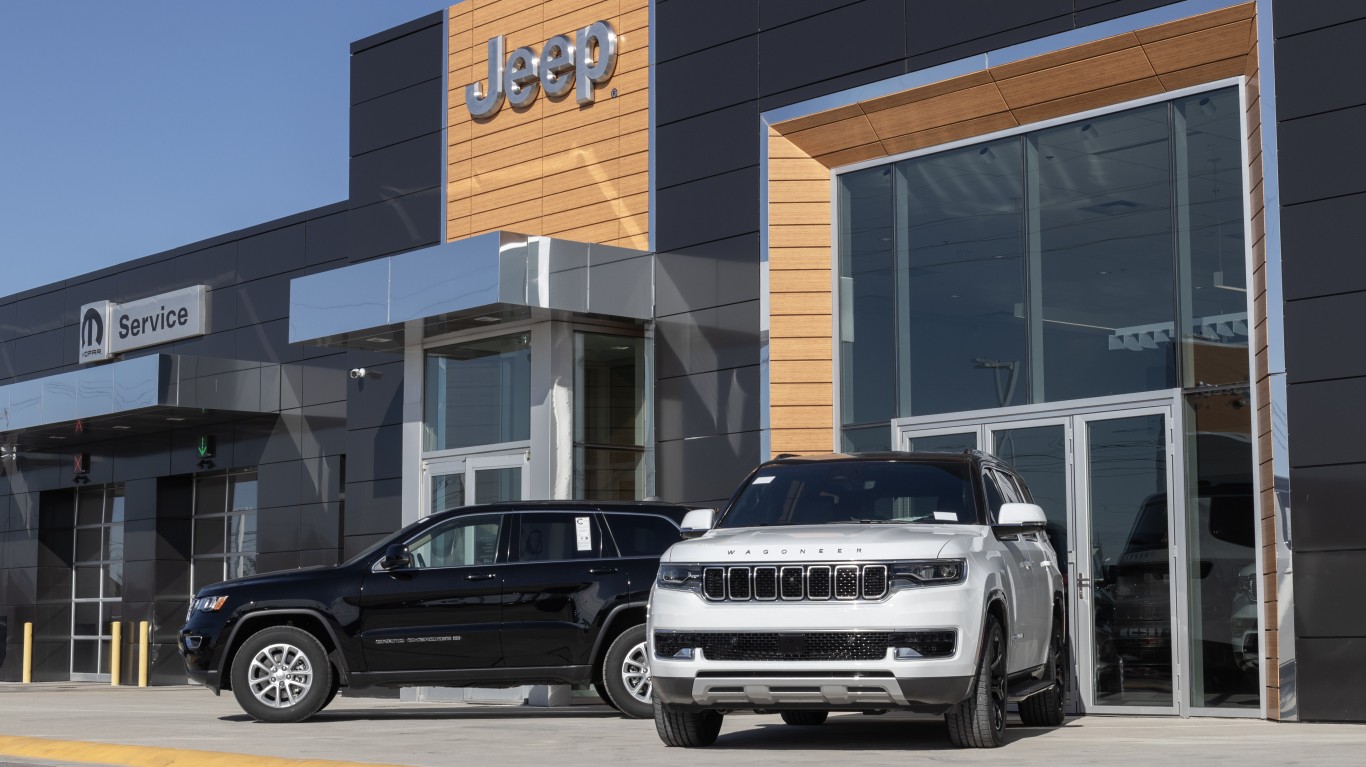
Days on lot (or market day supply) means dealers have more inventory to sell. The industry average is about 60 days. The Jeep Recon’s figure is 621, or nearly two years. Jeep is in trouble. Of the five vehicles with the highest market day supply, three are Jeeps. The figure for the Wagoneer is 273 days, about three-quarters of a year, and the figure for the Grand Wagoneer L is 252. The three have another thing in common. They are expensive. The Recon costs $72,000. The Wagoneer is $77,000, and the Wagoneer L is $83,000. The overall problem signals a broader challenge for the decades-old brand.
The early Jeeps are a relic of WWII and were first introduced in 1943. An early four-wheel-drive vehicle, it has gone through a handful of owners from Willys to Kaiser to American Motors, to Chrysler, to Fiat Chrysler, to Stellantis, which is one of the largest car companies in the world.
Jeep’s reputation for quality is awful. It ranks last in Consumer Reports’ Owner Satisfaction Survey, putting it at the bottom of 26 brands. Only half of Jeep owners would buy one again. For brands at the top of the list, which include BMW, Subaru, and Tesla, the figure is 69%.
Stellantis recently announced third-quarter sales figures. Jeep sales dropped 20% to 128,542. For the same period, sales across all Stellantis brands in the US were flat at 324,277. Stellantis CEO Antonio Filosa last month said the company would start a “very significant new Jeep product offensive.” This will include a new Wagoneer. Stellantis will also launch a new version of its less expensive products–the Gladiator and Wrangler.
It is hard to put a finger on Jeep’s problem. Obviously, one is that, across some surveys, it has a poor reputation. But that is not enough.
What is enough is that the SUV market is among the most crowded segments in the US car industry. Jeep has eight products, from the lowest-priced Compass at $30,000 to the most expensive $67,000 Recon.
Across Chevy, GMC, Ford, BMW, Mercedes, Hyundai/Kia, Genesis, Toyota, Honda, Subaru, and Nissan, there are dozens of SUV models. The American SUV shopper could go from dealer to dealer for days.
Jeep is in a tough spot. Even it releases more models, and improves that current ones, it has no change of elbowing itself to the top of the list.
Contact [email protected] for any questions or corrections.
Douglas A. McIntyre is the co-founder, chief executive officer and editor in chief of 24/7 Wall St. and 24/7 Tempo. He has held these jobs since 2006.
McIntyre has written thousands of articles for 24/7 Wall St. He is an expert on corporate finance, the automotive industry, media companies and international finance. He has edited articles on national demographics, sports, personal income and travel.
His work has been quoted or mentioned in The New York Times, The Wall Street Journal, Los Angeles Times, The Washington Post, NBC News, Time, The New Yorker, HuffPost USA Today, Business Insider, Yahoo, AOL, MarketWatch, The Atlantic, Bloomberg, New York Post, Chicago Tribune, Forbes, The Guardian and many other major publications. McIntyre has been a guest on CNBC, the BBC and television and radio stations across the country.
A magna cum laude graduate of Harvard College, McIntyre also was president of The Harvard Advocate. Founded in 1866, the Advocate is the oldest college publication in the United States.
TheStreet.com, Comps.com and Edgar Online are some of the public companies for which McIntyre served on the board of directors. He was a Vicinity Corporation board member when the company was sold to Microsoft in 2002. He served on the audit committees of some of these companies.
McIntyre has been the CEO of FutureSource, a provider of trading terminals and news to commodities and futures traders. He was president of Switchboard, the online phone directory company. He served as chairman and CEO of On2 Technologies, the video compression company that provided video compression software for Adobe’s Flash. Google bought On2 in 2009.