Vanguard’s VXUS Falls 7% and VWO Drops 8.5% This Week as Taiwan’s Stock Market Posts Its Worst Week Since 1991. Here’s the Loss on a $1 Million IRA and What Rebalancing Rules Say to Do

This post may contain links from our sponsors and affiliates, and Flywheel Publishing may receive compensation for actions taken through them.

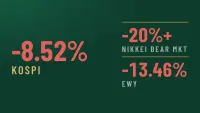
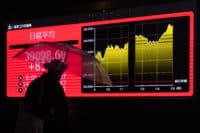
Vanguard’s Total International Stock ETF (NASDAQ: VXUS) is down 7% this week and its emerging markets fund (NYSEARCA: VWO) is down 8.5%, counting Friday’s pre-market trades, after Taiwan’s stock market fell 6.2% on Friday to finish its worst week since 1991. South Korea’s KOSPI closed down 5.2% and Japan’s Nikkei 225 dropped 5.1% as the selloff in AI chip stocks ran through Asia.
Take a 67-year-old retiree who runs her own $1 million IRA in three index funds. At last Friday’s close she had 40% in U.S. stocks, 20% in international stocks and 40% in bonds. Her $200,000 international slice was worth $188,601 at Thursday’s close and about $185,915 at Friday’s pre-market price, a loss of $14,085 in a week.
By two widely used rebalancing rules, a week like this reads as too small to act on: the international slice slipped from 20% of her account to 19.4%, and both rules wait for 15%. That reading has a limit. Thursday’s closing prices were set before Friday’s session in Asia, pre-market trading is thin, and the funds will find a firm price only after the opening bell at 9:30 a.m. Eastern.
What $100,000 in each international index fund lost this week
The table runs from last Friday’s close to Thursday’s close, then adds Friday’s pre-market price as of about 8 a.m. Eastern.
| Fund | Week through Thursday | Friday pre-market | $100,000 is now | Loss |
|---|---|---|---|---|
| Vanguard Total International Stock (VXUS) | down 5.7% | down 1.4% | $92,957 | $7,043 |
| Vanguard FTSE Developed Markets (VEA) | down 5.4% | down 1.1% | $93,606 | $6,394 |
| Vanguard FTSE Emerging Markets (VWO) | down 6.6% | down 2.1% | $91,486 | $8,514 |
| iShares Core MSCI Emerging Markets (IEMG) | down 6.7% | down 2.7% | $90,775 | $9,225 |
The gap between the funds follows Taiwan, where the main index lost 17.5% this week. Taiwan is about a third of the Vanguard emerging markets fund and more than a quarter of the iShares fund, which also keeps 17.51% in South Korea. The total international fund has 8.69% in Taiwan, and the developed markets fund has none. On Thursday night I walked through what a target-date fund holds in these markets.
What the rebalancing rules say
Vanguard tells individual investors that rebalancing once a year is optimal for many of them, and its example of a trigger is an allocation that is off target by 5 percentage points or more. The investment author Larry Swedroe’s 5/25 rule says to trade only when an asset class has moved 5 percentage points from its target or 25% of the target, whichever is less. On a 20% international target, both rules draw the same lines: act under 15% or over 25%.
Her account is far from either line. At Thursday’s close the IRA was worth $970,430, down $29,570 for the week. Her U.S. stock fund lost $20,156, her international fund lost $11,399 and her bond fund gained $1,984. U.S. stocks fell almost as much as international stocks, so the international share moved very little. To reach 15% with the other two funds flat, the international fund would have to fall about 27% more from Thursday’s close.
What she can do this week
The rules ask for no trade. If she wants her targets back anyway, the whole job is moving about $13,800 out of the bond fund: $5,485 into international stocks and $8,328 into U.S. stocks. Trades inside an IRA create no tax bill.
The more useful rule covers money coming out. Vanguard’s advice on withdrawals is to start with the asset class that is over its target. In her account that is the bond fund, now 41.4% of the total. At a 4% withdrawal rate she takes $3,333 a month, and the extra in the bond fund covers about four months of that. She can leave both stock funds alone after a down week.
If she holds the mutual fund versions, her balance still shows Thursday’s prices. Mutual funds price once a day, after the 4 p.m. close, so Friday’s losses in Asia reach her statement tonight along with whatever U.S. stocks do today. S&P 500 futures were down 0.9% and Nasdaq 100 futures down 1.8% at about 8 a.m. Eastern.
At Friday’s pre-market price, the total international fund’s shares are still about 2% above where they ended 2025.
Contact [email protected] for any questions or corrections.
I've spent more than 15 years inside enterprise software, working alongside the finance, sales operations, and HR leaders who run the revenue engines at some of the largest tech companies in the country.
My day job is helping enterprise executives make smarter decisions about retention, compensation, and growth. These are the same operational levers that show up in every earnings report investors actually read. That perspective shapes my writing for 24/7 Wall St.
The headline numbers are easy. The interesting stuff is underneath: how companies make money, what executives are worried about, and what any of it means for the person checking their 401(k) on a Sunday afternoon. I write about personal finance and business as someone who has spent her career inside the rooms where these decisions get made.