How 3 ETFs Turn Five Years of Deferred Compensation Checks Into a Retirement Plan at 63

This post may contain links from our sponsors and affiliates, and Flywheel Publishing may receive compensation for actions taken through them.

For years, part of your pay went into a nonqualified deferred compensation plan. Now, at 63, that money is coming back to you, one scheduled installment at a time, over five years. Each check lands, gets taxed as ordinary income, and then sits there waiting for a decision. Without a plan, installment money tends to drift into checking, get spent bit by bit, or wait for a “better time” that never comes.
Three Vanguard funds give every check a place to go. They are Vanguard Morningstar Total Stock Market ETF (NYSEARCA:VTI), Vanguard Total International Stock ETF (NASDAQ:VXUS), and Vanguard Total Bond Market ETF (NASDAQ:BND). Together they make up the classic three-fund portfolio of U.S. stocks, international stocks, and investment-grade bonds, and the combined cost is tiny.
Why Scheduled Checks Need a Plan
A lump sum forces one big decision. Installments force the same decision every time a payment comes, so set a target mix once, ideally with your advisor, and that recurring question becomes a routine. The three funds below cover the whole map, so you never have to improvise.
VTI Anchors Your Plan With the Entire U.S. Market
VTI holds essentially the whole investable U.S. stock market (large, mid, and small companies) in one fund that dates back to 2001. Its benchmark was long called CRSP and moved to the Morningstar name after Morningstar acquired CRSP. The expense ratio is about 0.03%, which works out to roughly $30 a year on every $100,000 invested. Quarterly distributions totaled about $3.95 per share over the past year. At a recent price near $372, that’s a yield of roughly 1.1%.
VTI is the growth engine. Its price rose 53.49% over five years and 239.35% over ten, before including dividends. The catch: you take every U.S. downturn at full strength. The fund slipped 2.37% over the past month, and its largest weights sit in mega-cap tech names.
VXUS Keeps Your Retirement From Riding on One Economy
VXUS holds thousands of stocks outside the U.S. across developed and emerging markets. Europe is the largest region, followed by the Pacific and emerging markets led by China, India, and Taiwan. Vanguard lists the expense ratio at 0.05%, or about $50 a year per $100,000. Trailing quarterly dividends of roughly $1.98 per share put the yield near 2.4%, though payouts vary widely from quarter to quarter.
Over the past year, VXUS gained 15.4% while VTI gained 12.94%. The catch: a stronger dollar reduces foreign returns, and international stocks can trail for long periods. Over ten years, VXUS rose 141%, well behind VTI.
BND Matters More With Every Birthday
BND holds the investment-grade U.S. bond market, including Treasuries, government-backed mortgage securities and high-quality corporate bonds, with the majority in Treasury and government-related debt. It launched in 2007 and charges 0.04%, about $40 per $100,000. The distribution comes monthly, most recently $0.256802 per share, and the trailing 12-month total of $2.95 works out to a yield near 4.1%. Payments vary, so treat them as income you can expect but not a guarantee. With the 10-year Treasury at 4.86% on November 6, new bond dollars earn real income.
The catch: rate sensitivity. Bond prices fall as rates rise. BND’s price is down 1.1% over five years, so nearly all of its return came from income.
Let Each Installment Rebalance Your Portfolio
This is where installments help you. Every check is a chance to top up whichever fund has fallen below its target share, so if stocks rallied, the next payment goes to BND. If international fell behind, VXUS gets it. Your mix stays on target without selling anything, which means no gains to realize.
Where You Hold These Funds Changes What You Keep
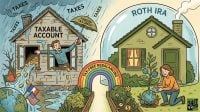
Your installments are already taxable when they come, so where you hold the funds matters. Investment income generally includes interest, dividends, capital gains, and other distributions. Those rules do not apply to investments held in IRAs, 401(k) plans, and other qualified retirement plans. Bond fund income is typically less tax-efficient in a taxable account. If you have room in an IRA or 401(k), BND often fits better there, with VTI and VXUS in taxable accounts.
Trade-Offs to Weigh Before the Next Check Arrives
Simplicity has limits. This setup has no tactical tilts, no dividend focus, and no dedicated inflation-protected bonds. That last gap matters because inflation for older households falls more heavily on housing and medical care. Getting the bond share right at 63 is harder than it looks.
Still, for a reader with five years of scheduled checks, the lineup solves the real problem: every payment has a destination, a purpose, and a low cost. Turning a lump sum into something that acts like a paycheck is its own discipline, and we laid out the mix, the payment calendar, and the withdrawal order here: The Paycheck Portfolio Method.
Contact [email protected] for any questions or corrections.
Ryne Mauck is an investment writer covering exchange-traded funds, retirement planning, and portfolio strategy. Through his work at 24/7 Wall St. and other investment platforms, including Seeking Alpha, he aims to provide clear, research-driven insights that help investors make more informed decisions while maintaining a long-term approach to investing.
Ryne holds a B.Sc. in Finance and an M.A. in Political Science. He is a formerly registered Municipal Advisor Representative and has passed the Series 50, Series 63, and Series 65 exams. His articles are not intended to be, nor should they be interpreted as, financial advice.