3 Machinery Dividend Stocks to Buy in December After a Brutal Selloff

This post may contain links from our sponsors and affiliates, and Flywheel Publishing may receive compensation for actions taken through them.
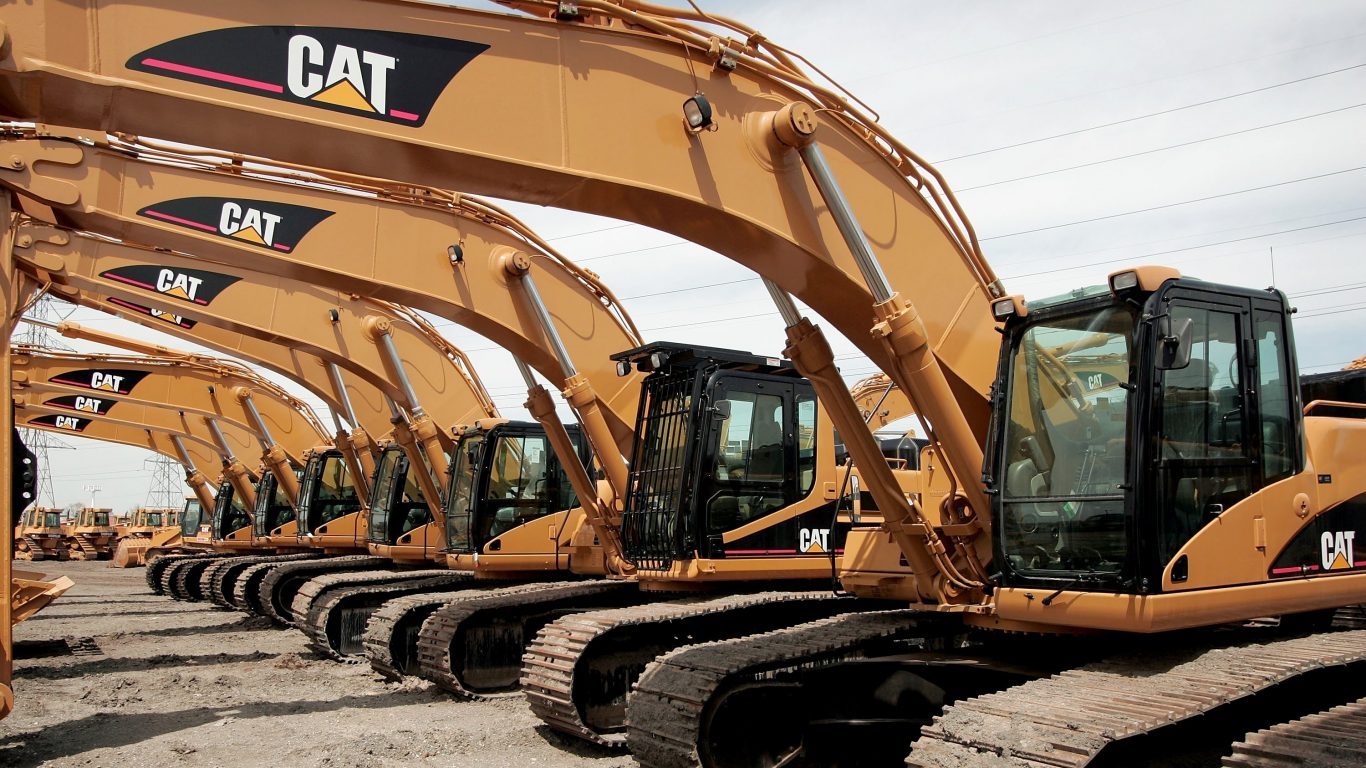
Three of America’s biggest machinery makers just sold off together, and the dividends underneath look stronger than the share prices. Over the past week, Caterpillar (NYSE:CAT | CAT Price Prediction) fell 14.89%, Deere (NYSE:DE) fell 9.55%, and Emerson Electric (NYSE:EMR) fell 9.27%. Over the same stretch, Caterpillar is sitting on a record $78 billion[1] backlog and Emerson is paying a newly raised dividend. These three yields are modest. So retirees get their reward from dividend growth: each company pays out well under half its earnings, and each has data center, infrastructure, or automation demand behind it.
Caterpillar: 33 Years of Higher Dividends and a Record Backlog
Yield: At $510.84, Caterpillar’s annualized forward dividend of $6.52 works out to a yield of about 1.28%. In 2026, the quarterly payout rose from $1.51 to $1.63, a roughly 7.9% increase, declared on June 10, 2026. Chief financial officer Kyle Epley put it in context on the third-quarter call: “Earlier this year, we announced our sixth consecutive year of a high-single-digit quarterly dividend increase, and this year will mark 33 consecutive years of paying higher annual dividends to our shareholders.”[1]
Dividend safety: Trailing dividends of $6.28 compare with trailing adjusted EPS of $26.07, a payout ratio of about 24%. Cash flow covers it just as easily. In the third quarter alone, Caterpillar generated $3.8 billion[1] in machinery, power and energy (MP&E) free cash flow and paid out nearly $750 million in dividends. As a result, the dividend took roughly 20% of that quarter’s free cash flow. The balance sheet held $7.9 billion[1] in enterprise cash plus $1.6 billion in liquid marketable securities, and management’s stated policy is to “return all of our MP&E free cash flow substantially to our shareholders through dividends and share repurchases over time.”
Bull case: Data centers need on-site power, and Caterpillar sells the turbines and big engines that supply it. Power generation sales to users grew 75%[1] in the third quarter, and the company is taking some large engine orders as far out as 2029 and turbine orders into 2030. Revenue rose 17.26%[2] to $20.682 billion, and adjusted EPS of $7.20 beat estimates. Even so, the stock has dropped 30.82% in a month, from $738.47. Investors are now paying a lot less for the same backlog.
Risk: Construction and mining are cyclical. Management expects a seasonal dealer inventory reduction of roughly $1.6 billion[1] in the fourth quarter, and expects tariff costs of around $2.2 billion for 2026. Excluding tariff recoveries, it sees margins near the bottom of its target range. If nonresidential building or mining spending cools, today’s orders could become tomorrow’s cancellations. The board announced the first-quarter dividend last year on December 10, 2025, so watch this month’s declaration.
Deere: A Flat Dividend Backed by Trough-Cycle Earnings
Yield: At $609.24, Deere’s annualized dividend of $6.48 yields about 1.06%. The dividend has been flat: Deere has paid $1.62 per quarter for every ex-dividend date from December 31, 2024 through September 30, 2026, after raising it from $1.47. The first $1.62 payment arrived on February 10, 2025, and the payout hasn’t moved since.
Dividend safety: The freeze came during a deep earnings downturn. Annual EPS fell from $35.17 in fiscal 2023 to $18.51 in fiscal 2025, but trailing EPS of $18 still puts the payout ratio at about 36%. Third-quarter net income was $1.379 billion[3], shareholders’ equity rose to $27.997 billion, and Deere still found $697 million for buybacks over nine months. Equipment operations earned a 14.4%[4] operating margin in what management calls a trough year.
Bull case: Chief executive John May said, “We continue to believe 2026 will mark the bottom of the current ag equipment cycle,”[3]. He pointed to early order trends and improving used-equipment inventories. Meanwhile, Construction & Forestry sales rose 18%[3] to $3.618 billion, thanks to infrastructure, data center, and pipeline work. Customer backlogs there extend “well into fiscal year 2027.”[4] If farm demand recovers on top of that, the dividend has room to start growing again. The market has already moved toward that view: shares are up 31.89% year to date.
Risk: Farm income drives tractor and combine sales. Production & Precision Ag sales fell 6%[3] in the third quarter, and management cited weak farm profitability, elevated input costs, and higher interest rates. Deere’s own ag marketing head expects “a measured recovery rather than a sharp rebound in 2027.”[4] Last year Deere declared its December-quarter dividend on December 3, 2025. This month’s declaration will show whether the freeze ends.
Emerson Electric: A Fresh 7% Raise Funded by Free Cash Flow
Yield: At $150.95, Emerson’s annualized forward dividend of $2.38 yields about 1.58%, the highest of the three. The quarterly payout went up 7%[5], from $0.555 to $0.595. That higher payment goes out December 10, 2026, but the ex-dividend date was November 13, 2026, so anyone buying now starts with the next payment. Chief financial officer Mike Baughman said, “We are entering our 71st consecutive year of increased dividends.”[6]
Dividend safety: Trailing dividends of $2.26 compare with fiscal 2026 adjusted EPS of $6.59[5], a payout ratio of roughly 34%. Fiscal 2026 free cash flow came in at $3.535 billion[5]. For fiscal 2027, Emerson plans about $1.3 billion[5] in dividends against free cash flow guidance of $3.8 billion to $3.9 billion, so the dividend would take about 34% of the low end. The company also plans $2.5 billion[5] in buybacks and still says there is “ample firepower for bolt-on acquisitions.”[6]
Bull case: Emerson supplies the automation software, valves, and sensors behind power, LNG, semiconductor, and life sciences plants. Fourth-quarter underlying orders rose 14%[6], backlog reached $8.2 billion, and the Control Systems & Software margin extended to 33.1%[5] from 27.0%. Management is guiding to fiscal 2027 adjusted EPS of about $7.25[5], which leaves room for more raises after this one.
Risk: Emerson depends on industrial capital spending, and two big regions are lagging. Chief executive Lal Karsanbhai said “the European and China markets… are concerning,”[6] and he expects them to weigh on growth throughout the year. If project spending stalls, orders could slow.
Why These Three Belong on a Retiree’s Watch List
Caterpillar and Emerson both raised their dividends in 2026 and pay out roughly a third of earnings or less, while Deere has held its payout flat through an ag downturn and still covers it comfortably. Together, they tie a growing income stream to data center power, infrastructure, and factory automation, and the latest sell-off has lowered the price of all three.
Contact [email protected] for any questions or corrections.
Chris Lange is a financial and geopolitical writer with more than a decade of experience covering a myriad of topics. He has published thousands of articles for 24/7 Wall St., with past coverage focused heavily on stocks, IPOs, healthcare, defense, global affairs, and technology.
His work has been quoted, or referenced by a number of outlets including Business Insider, USA Today, Yahoo Finance, MSN, The Motley Fool, and many other publications. A graduate of Southwestern University, he studied business with a focus on investments and has previous experience in banking and startups.
When not reading or writing the news, he is following his passion for Lacrosse, playing chess, or building solar projects with his dad.