4 High-Yield Industrial Stocks Retirees Should Buy Before Year-End

This post may contain links from our sponsors and affiliates, and Flywheel Publishing may receive compensation for actions taken through them.

Year-end is when retirees reset their income plans, and industrial stocks offer something many rate-sensitive income sectors lack: cash flow tied to defense budgets, freight volumes and factory floors. These four NYSE-listed industrials all beat Wall Street’s earnings estimates in their latest quarter. The group’s top yielder, United Parcel Service (NYSE:UPS | UPS Price Prediction), now pays a 5.95% dividend yield. Each pick below starts with how well the dividend is covered, because yield alone tells you nothing about whether the checks will keep coming.
United Parcel Service: Highest Yield in the Group, With Cash Coverage Improving
UPS pays $1.64 per quarter, or $6.56 annualized, for a yield of 5.95%. That puts it in high-yield territory, just under the ultra-high-yield line. The most recent ex-dividend date was November 16, 2026, so new buyers are positioned for the 2027 payments.
Dividend safety: Coverage is tight but improving. UPS expects dividend payments of around $5.4 billion[1] in 2026 against adjusted free cash flow of about $6.1 billion, a figure that already absorbs $1.4 billion[2] in Driver Choice Program payments this year. Trailing GAAP EPS of $5.19 sits below the annual dividend, but the raised adjusted EPS guide of about $7.28[1] covers it. The balance sheet gives UPS some room: it ended the third quarter with $6.8 billion in cash[2] and no outstanding commercial paper. Chief Executive Carol Tomé told analysts, "Our dividend is safe and secure."[2] The record available since 2000 shows no reductions, though the quarterly payout has been held at $1.64 through 2025 and 2026.
Bull case: The turnaround is showing up in the numbers. U.S. Domestic adjusted operating margin rose to 7.0% vs 6.4%[1] a year earlier, and management guided fourth-quarter domestic margin to about 10.5%[2]. The CFO said free cash flow should keep rising in 2027 and "improve our dividend coverage as we grow back into the dividend payout ratio that we’ve talked about for a long time."[2] At $109.45, shares trade at 14 times forward earnings, below the analyst target of $115.46.
Risk: Volume is still shrinking. U.S. Domestic average daily volume slipped to 15,621k pieces from 16,150k, and Supply Chain Solutions took a $182M[1] goodwill impairment. Until free cash flow widens, the dividend is likely to stay frozen.
MSC Industrial Direct: Fresh Raise and a Sharp Pullback
MSC Industrial Direct (NYSE:MSM) yields 3.02%. The board declared a quarterly dividend of $0.89 on October 14, 2026, payable November 25, 2026, which brings the forward annual rate to $3.56.
Dividend safety: Fiscal 2026 adjusted EPS of $4.69[3] covers the forward dividend, and trailing GAAP EPS of $3.82 covers it with less room to spare. The distributor generated $306.5M[3] in operating cash flow and $225.156M in free cash flow for the year. It spent only $13.967M[3] on buybacks, which leaves the dividend first in line for cash. For fiscal 2027, management guided free cash flow conversion of about 80% to 90% and interest and other expense of about $40M to $45M, a manageable load. The regular quarterly dividend has risen every year since 2022, from $0.75 in 2021 to $0.89 today.
Bull case: Core customer growth reached about 10%[3], the strongest in more than three years, and fiscal first-quarter guidance calls for average daily sales growth of 9.5% to 10.5%. The stock still fell 15.97% over the past month to $107.25, well below the analyst target of $134.62. That pullback raised the stock’s yield.
Risk: The CEO flagged inflationary headwinds and tougher comparisons ahead. Fiscal 2026 free cash flow fell 6.53%[3], and a $41.774M asset impairment cut fourth-quarter GAAP EPS to $0.85.
Lockheed Martin: Long Record of Raises Backed by a Record Backlog
Lockheed Martin (NYSE:LMT) yields 2.39% on an annual dividend of $13.80. The next ex-dividend date is December 1, 2026, with payment on December 31, 2026. That makes it the one name on this list where buying before year-end still captures a 2026 payment.
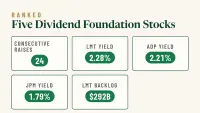
Dividend safety: Trailing EPS of $28.16 covers the $13.80 dividend about twice over. The company raised its 2026 free cash flow guidance to about $7.80 to $8.00 billion[4], and it held $5.960B in cash at quarter-end. In the third-quarter release, management said the results allowed it "to raise our dividend for the 24th year in a row."[4] Dividend history supports that record: the quarterly payout has climbed from $0.11 in 2002 to $3.45.
Bull case: Backlog hit a record $292B[4] after a $52.5B PAC-3 MSE multi-year award, and Missiles and Fire Control sales grew 24%. Lockheed raised 2026 EPS guidance to $30.35 to $30.75[4], its second guidance increase in a row. A beta of 0.081 adds the low volatility retirees want. Shares fell 5.33% over the past week to $571.87, about 17 times forward earnings, against an analyst target of $660.86.
Risk: F-35 Lot 20 costs are running above current contractual authorization, and fixed-price programs carry reach-forward loss risk. Third-quarter free cash flow also fell 10.4%[4] year over year.
Norfolk Southern: Low Payout Supported by Record Revenue
Norfolk Southern (NYSE:NSC) yields 1.67%, the lowest yield in this group. Its quarterly dividend of $1.35, or $5.40 annualized, goes out today, November 20, 2026.
Dividend safety: Coverage is the strongest of the four. Trailing EPS of $11.93 is more than double the annual dividend. Norfolk Southern has made no share repurchases so far in 2026, compared with $533M in the same period of 2025, which keeps more cash on hand during the merger review. The payout has stayed at $1.35 since 2023, after rising from $1.24 in 2022, so the railroad has no active increase streak. Over the long term, though, the dividend has grown from $0.29 in 2008.
Bull case: Third-quarter revenue reached a record $3.526B[5], up 13.6%, with intermodal up 21.1%. Management says it is on track for at least $650 million[6] in cumulative cost savings. The proposed combination with Union Pacific (NYSE:UNP) remains under Surface Transportation Board review[7]. The stock fell 5.09% over the past week to $316.27, below the analyst target of $357.44.
Risk: The quarter included $42M[5] in merger-related expenses and $28M in Eastern Ohio incident costs. Fuel expense jumped to $420M[5] from $237M. The CFO also said capital allocation remains "first and foremost to invest in the business,"[6] which points to a flat dividend in the near term.
Four Industrial Income Picks Before 2027
UPS brings the yield, Lockheed Martin brings the longest record of raises plus a December payment, MSC Industrial just raised its dividend after a steep pullback, and Norfolk Southern has the most earnings coverage behind its payout. All four beat estimates in their latest quarter, and all four generate operating cash flow behind their dividends. As a group, they give retirees industrial income from four different parts of the economy heading into 2027.
Contact [email protected] for any questions or corrections.
Lee Jackson has covered Wall Street analysts' equity and debt research and equity strategy daily for 24/7 Wall St. since 2012. His broad, diverse career, including a stint as creative services director at an NBC affiliate in Austin, Texas, gives him unique insight into the financial industry.
Lee Jackson's journey in the financial industry spans more than 30 years, including nearly two decades as an institutional equity salesperson at Bear Stearns, Lehman Brothers, and Morgan Stanley. His career spanned pivotal sell-side Wall Street events, from the dot-com rise and bubble to the Long-Term Capital Management debacle, 9/11, and the Great Recession of 2008. This reflects his resilience and adaptability amid market volatility.
Lee Jackson’s practical financial industry experience, gained through a career at some of the biggest banks and brokerage firms, is complemented by a lifetime of writing across various platforms. This unique combination allows him to shed light on the intricacies of Wall Street in a way only someone with deep insider experience and knowledge can. Moreover, his extensive network across Wall Street continues to provide direct access for him and 24/7 Wall St., a privilege few firms enjoy.
Since 2012, Jackson’s work for 24/7 Wall St. has been featured in Barron’s, Yahoo Finance, MarketWatch, Business Insider, TradingView, Real Money, The Street, Seeking Alpha, Benzinga, and other media outlets. He attended the prestigious Cranbrook Schools in Bloomfield Hills, Michigan, and has a degree in broadcasting from the Specs Howard School of Media Arts.