A $300,000 REIT Portfolio Could Save Thousands in Taxes Inside a Roth IRA

This post may contain links from our sponsors and affiliates, and Flywheel Publishing may receive compensation for actions taken through them.
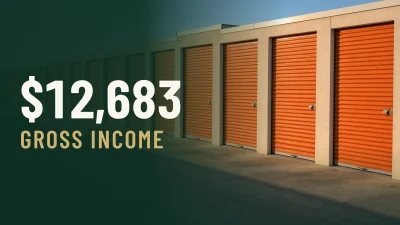
Take a typical investor with $300,000 split evenly across three self-storage REITs held outside any tax-advantaged account. That portfolio pays about $12,683 a year, and in the 24% federal bracket, the IRS collects roughly $3,044 annually.
Why Self-Storage Dividends Lose More to Taxes
IRS Publication 550 says ordinary dividends “are paid out of earnings and profits and are ordinary income to you.” REIT distributions of net short-term capital gains are also reported as ordinary dividends. These payouts are generally taxed at the investor’s marginal income rate, not the lower qualified rates. Some of that income may count as a “qualified REIT dividend”[1] under Section 199A, which can lower the effective rate. The figures below assume the full marginal rate as a ceiling. For tax year 2026, the 24% bracket covers single filers with taxable income over $105,700 ($211,400 for joint filers).
Three Storage REITs Built for a Roth
- CubeSmart (NYSE:CUBE): Yields 4.82% on a $2.12 annual dividend, raised from $0.52 to $0.53 quarterly in 2026. The highest yield of the three means the most ordinary income per dollar to protect. Safety: the dividend uses about 82% of the midpoint of 2026 adjusted FFO guidance ($2.58 to $2.60)[2].
- Extra Space Storage (NYSE:EXR): Yields 4.18% on $6.48 a year. Its $1.62 quarterly payout has held flat since 2023 (two unusual merger-related 2023 payments were taken out). Safety: about 77% of the midpoint of raised Core FFO guidance of $8.40 to $8.50[3].
- Public Storage (NYSE:PSA): Yields 3.68% on $12 a year, with a $3 quarterly dividend flat since 2023. The $13.15 special in 2022 was a one-time payment. Safety: about 71% of the $17[4] Core FFO guidance midpoint, the firmest coverage here.
Roth vs. Taxable: Hypothetical $300,000 Investor at 24%
Step 1: $100,000 in each stock times its yield makes $4,820, $4,178, and $3,684, a blended 4.23%. Step 2: multiply that gross income by 24%.
| Account | Gross Income | Federal Tax | Net Income |
|---|---|---|---|
| Roth IRA | $12,683 | $0 | $12,683 |
| Taxable | $12,683 | $3,044 | $9,639 |
The result is a $3,044 annual Roth advantage and $30,439 over 10 years with no growth assumed.
Higher Brackets Pay a Steeper Price
| Bracket | Taxable Net Income | Annual Roth Edge |
|---|---|---|
| 22% | $9,893 | $2,790 |
| 24% | $9,639 | $3,044 |
| 32% | $8,624 | $4,059 |
| 37% | $7,990 | $4,693 |
High earners can also owe the 3.8% net investment income tax above $200,000 (single) or $250,000 (joint), widening the gap further.
Compounding Turns the Tax Gap Into a Permanent Cost
Reinvest the 24% bracket’s annual tax savings at a conservative 4%, and the gap hits about $36,545 after 10 years and $90,641 after 20, even assuming share prices stay flat. Roth IRAs also face no RMDs while the owner is alive, so the income can keep compounding.
This placement helps most for investors in the 24% bracket or higher with long horizons. It goes poorly for investors in the 10% or 12% brackets, those with little Roth contribution room, and anyone facing a large upfront conversion tax bill (the low-tax years between a last paycheck and the first RMD are usually the best window to convert, which we sized up in a free Roth conversion guide) or who needs the cash before Roth qualified-distribution rules are met.
What to Do Before Your Next Tax Filing
- Grab your Form 1099-DIV from last year for any REIT held in a taxable account and multiply Box 1a by your marginal rate to get your actual annual tax cost.
- Before converting, compare the one-time tax on converting your REIT shares with your annual delta from the bracket table above.
- If you plan a phased Roth conversion, rank holdings by ordinary-income yield. Here, CubeSmart’s yield is highest, Extra Space is next, and Public Storage is third.
Contact [email protected] for any questions or corrections.
Chris Lange is a financial and geopolitical writer with more than a decade of experience covering a myriad of topics. He has published thousands of articles for 24/7 Wall St., with past coverage focused heavily on stocks, IPOs, healthcare, defense, global affairs, and technology.
His work has been quoted, or referenced by a number of outlets including Business Insider, USA Today, Yahoo Finance, MSN, The Motley Fool, and many other publications. A graduate of Southwestern University, he studied business with a focus on investments and has previous experience in banking and startups.
When not reading or writing the news, he is following his passion for Lacrosse, playing chess, or building solar projects with his dad.