$75,000 in These 5 Dividend Stocks Could Pay More Than $1,700 a Year Across 5 Sectors

This post may contain links from our sponsors and affiliates, and Flywheel Publishing may receive compensation for actions taken through them.
Retirees who draw most of their income from one industry carry a risk that rarely shows up until it is too late. When that industry struggles, the dividend checks shrink with it. The latest selloff has been sharp enough that Wall Street trading desks have dropped bullish stock calls, and a selloff like that rarely hits every sector equally. Spreading the income stream around means a patent cliff, a tech spending pause, a credit downturn or a commodity squeeze lands on one position, and the rest of the income keeps arriving.
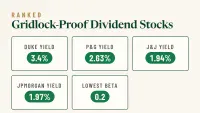
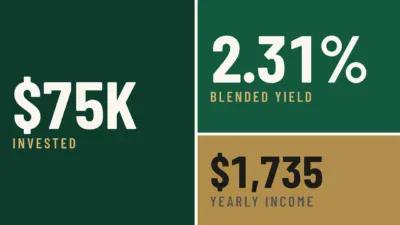
Spreading $15,000 across each of five dividend payers from healthcare, consumer staples, technology, banking, and utilities would return the following. That is $75,000 invested, getting more than $1,700 in yearly passive income, all paid quarterly. I chose each pick based on how well its dividend is covered, not how large its yield is. All yields below are forward yields at current prices.
Cisco Systems
- Stock #5: Cisco Systems (NASDAQ:CSCO | CSCO Price Prediction)
- Forward Yield: 1.79%
- Shares for $15,000: 159.81
- Annual Passive Income: ~$268.48 (~$67.12 per quarter)
Cisco sells networking, security, and collaboration technology to enterprises, cloud providers, and hyperscalers. The yield is low because AI demand has driven the stock higher: fiscal Q1 2027 revenue rose 24.4% to $18.52 billion[1]. The $1.68 annual dividend uses about 31% of the $5.47 to $5.53[1] non-GAAP EPS guidance. Operating cash flow rose 36% to $4.4 billion in the quarter, and Cisco still had room to buy back $2.0 billion[1] of stock. Risk: hyperscaler orders can be lumpy, and shares fell 11.87% over the past month.
Johnson & Johnson
- Stock #4: Johnson & Johnson (NYSE:JNJ)
- Forward Yield: 1.94%
- Shares for $15,000: 54.43
- Annual Passive Income: ~$291.75 (~$72.94 per quarter)
J&J runs two segments, Innovative Medicine and MedTech. Its yield is modest because the shares are up 35.31% year to date. The April raise to $1.34[2] a quarter was its 64th consecutive year of dividend growth. The $5.36 annualized payout equals roughly 46% of the $11.60 to $11.75[3] adjusted EPS guidance, and trailing EBITDA of $34.5 billion gives the dividend a wide cash cushion. Risk: STELARA sales fell 55.2% as biosimilars arrived, and the planned Orthopedics separation will change the earnings base.
JPMorgan Chase
- Stock #3: JPMorgan Chase (NYSE:JPM)
- Forward Yield: 2.08%
- Shares for $15,000: 47.25
- Annual Passive Income: ~$311.82 (~$77.96 per quarter)
JPMorgan, with $5.0 trillion in assets, runs consumer banking under the Chase brand along with investment banking and wealth management. For the October payment, the quarterly dividend rose to $1.65 from $1.50, which raises the forward rate to $6.60. That is about 27% of trailing EPS of $24.31. For a bank, capital says more about dividend safety than free cash flow does. JPMorgan’s CET1 ratio is 14.3%, and it has a new $50 billion[4] buyback authorization. Risk: trading and dealmaking revenue swings with market sentiment, and the stock lost 6.13% over the past week.
Procter & Gamble
- Stock #2: Procter & Gamble (NYSE:PG)
- Forward Yield: 2.53%
- Shares for $15,000: 87.10
- Annual Passive Income: ~$379.25 (~$94.81 per quarter)
P&G sells Tide, Pampers, Gillette, and Crest in roughly 65 countries, and it has raised its dividend for 70 consecutive years. The $4.354 annualized payout uses about 62% of the $6.89 to $7.11[5] core EPS guidance. Fiscal 2026 free cash flow of $15.83 billion[5] is well above the roughly $10 billion in dividends planned for fiscal 2027. Risk: management expects about $1.4 billion in after-tax commodity cost pressures, and recent job cuts suggest earnings growth is getting harder to come by.
Southern Company
- Stock #1: Southern Company (NYSE:SO)
- Forward Yield: 3.23%
- Shares for $15,000: 159.17
- Annual Passive Income: ~$483.87 (~$120.97 per quarter)
Southern serves about 9 million regulated electric and gas customers through Georgia Power, Alabama Power, Nicor Gas, and its other subsidiaries. Utilities usually yield more than the rest of this group because regulators cap their returns and their earnings grow slowly. In 2026, the quarterly payout rose to $0.76 from $0.74. The forward rate of $3.04 is about 69% of trailing EPS of $4.38, a normal level for a utility.
Southern pays for construction with debt and new shares, so earnings coverage is the key measure. On that front, Q3 adjusted EPS of $1.94 beat the $1.71 estimate as commercial sales climbed 10.1% on data center demand. Risk: interest expense and share dilution reduced Q3 EPS by 11 cents and 9 cents, respectively.
Five Sectors, One Income Stream
| Name | Forward Yield | Annual Dividend Income |
|---|---|---|
| Cisco Systems | 1.79% | $268.48 |
| Johnson & Johnson | 1.94% | $291.75 |
| JPMorgan Chase | 2.08% | $311.82 |
| Procter & Gamble | 2.53% | $379.25 |
| Southern Company | 3.23% | $483.87 |
| Total | 2.31% | $1,735.17 |
Combined, these five positions generate $1,735.17 in annual passive income on a $75,000 investment, a blended yield of 2.31%. Southern contributes $483.87, P&G adds $379.25, JPMorgan adds $311.82, J&J adds $291.75, and Cisco rounds out the group with $268.48.
Three things could change that total. A different purchase price changes the share count. Dividend increases would raise the income, and all five companies raised their payouts during 2026. A cut at any one company would remove only that company’s share of the income.
The payment dates are also spread out. Upcoming checks are scheduled for December 7, December 8, and January 20, so cash arrives in more months of the year. For someone paying bills in retirement, that steady timing matters as much as the annual total.
Contact [email protected] for any questions or corrections.
Chris Lange is a financial and geopolitical writer with more than a decade of experience covering a myriad of topics. He has published thousands of articles for 24/7 Wall St., with past coverage focused heavily on stocks, IPOs, healthcare, defense, global affairs, and technology.
His work has been quoted, or referenced by a number of outlets including Business Insider, USA Today, Yahoo Finance, MSN, The Motley Fool, and many other publications. A graduate of Southwestern University, he studied business with a focus on investments and has previous experience in banking and startups.
When not reading or writing the news, he is following his passion for Lacrosse, playing chess, or building solar projects with his dad.