Forget Doorbusters: These 3 S&P 500 Dividend Stocks Are Trading at Black Friday Prices

This post may contain links from our sponsors and affiliates, and Flywheel Publishing may receive compensation for actions taken through them.
Black Friday rewards shoppers who can tell a real markdown from a gimmick, and income investors face the same test. The three S&P 500 dividend payers below cover holiday retail, net-lease real estate, and chemicals. Each one trades below its 52-week high and still generates enough cash to fund its payout. The deepest discount in the group sits 32% below its annual high, and every name here gets screened on dividend safety before yield.
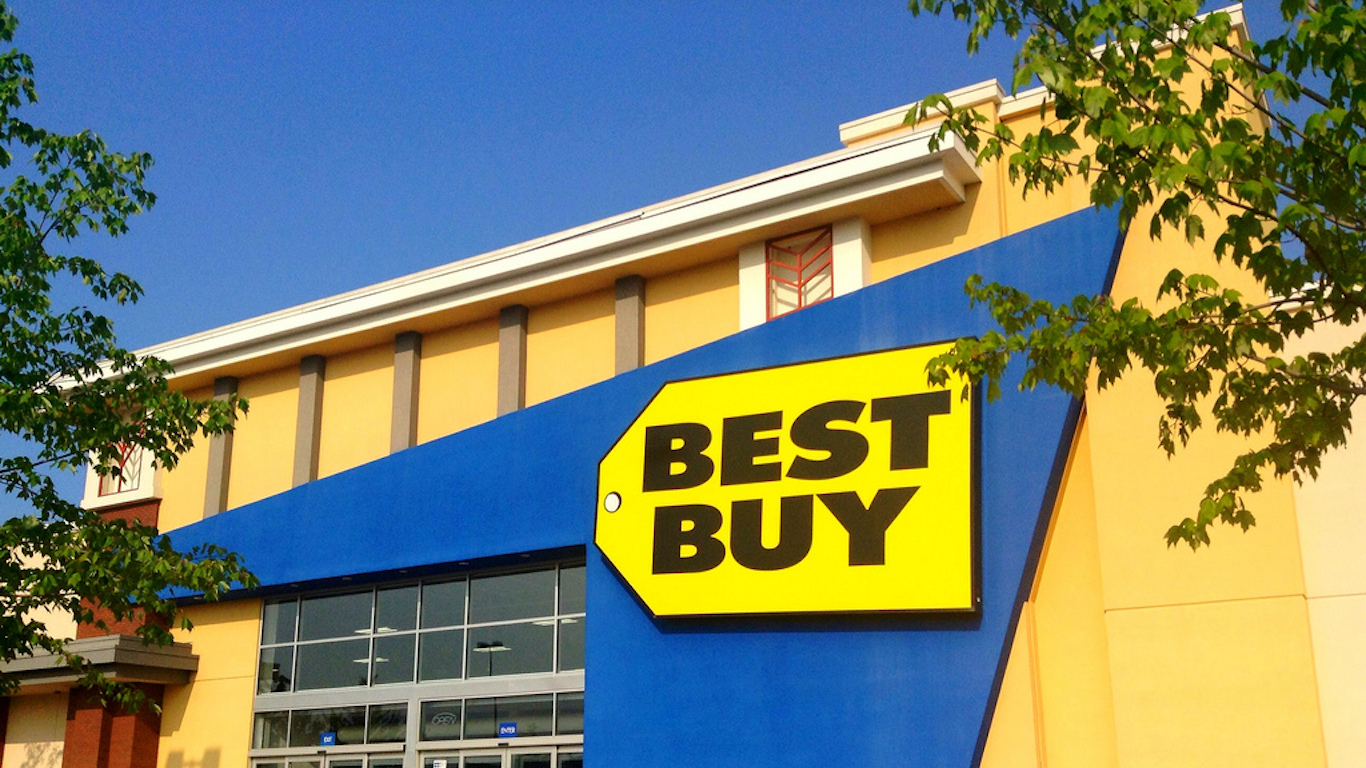
Best Buy: A Holiday Retailer That Has Raised Its Payout Every Year Since 2017
Best Buy (NYSE:BBY | BBY Price Prediction) is the most seasonal name in the group. At $99.50, the stock yields about 3.86% on the $0.96[1] quarterly dividend declared with third-quarter results. The annualized payout comes to $3.84 a share.
Why it’s on sale: The shares sit 6.9% below their 52-week high of $106.83, even though the retailer just posted enterprise comparable sales growth of 6.1%[1], its best in five years. The stock trades at 14 times forward earnings and 16 times trailing earnings. Over five years, the price has risen only 7.66%, so income buyers are paying a modest multiple for a business whose earnings are accelerating.
Dividend safety: The $3.84 annual dividend uses about 64.5% of trailing earnings of $5.95 a share. Management raised full-year adjusted EPS guidance to $6.90 to $7.05[1], which adds to that buffer. Through the first three quarters, Best Buy returned $791 million[2] to shareholders, including $606 million in dividends, while holding $1.99 billion[1] in cash. The CFO said the company will keep returning excess cash “while maintaining investment-grade credit metrics.”[2] The quarterly dividend has risen every year since 2017, from $0.34 that year to $0.96 now.
Bull case: Operating income rose 17.4%[1] year over year, and adjusted EPS of $1.62 beat the $1.49 estimate. Higher-margin businesses are growing too. Marketplace is on track to pass $1.3 billion[2] in gross merchandise value for the year, and CEO Jason Bonfig sees a new upgrade wave starting: “We do think that we’re starting to enter that multi-year cycle in TVs and we’re excited about that.” Rising earnings give the dividend room to keep growing.
Risk: Wall Street is more cautious than the results suggest. The average analyst price target of $91.29 is below the share price, and fourth-quarter guidance calls for comparable sales growth of only 2% to 4%[2].
Realty Income: Monthly Checks at a Markdown
Realty Income (NYSE:O) calls itself “The Monthly Dividend Company,” and the name fits retirees who budget month to month. Its latest monthly dividend of $0.274 works out to a forward yield of about 5.5% at $59.72.
Why it’s on sale: The REIT trades 9.4% below its 52-week high of $65.93, below its 200-day moving average of $61.44 and below the average analyst target of $63.77. Its price-to-book ratio is 1.4. Investors have marked the stock down because of higher financing costs and a trimmed GAAP outlook. Net income per share guidance was cut to $1.55-$1.56.
Dividend safety: For a REIT, adjusted funds from operations (AFFO) is the right coverage measure. Management raised 2026 AFFO guidance to $4.45-$4.46 per share. Against the annualized dividend of $3.258, that puts the payout ratio at about 73.2% at the low end. Management said on the call, “If you look at our AFFO payout ratio, it’s amongst the lowest it has been in the history of Realty Income.”[3] Occupancy is 98.8%, more than 94% of pro rata debt carries fixed rates, and liquidity totals about $5.4 billion. The track record is the best in this group: the company recently announced its 116th consecutive quarterly dividend increase, its 136th raise since its 1994 NYSE listing.
Bull case: Realty Income put $2.6 billion to work in the third quarter at a 6.8% initial cash yield and earned a leverage-neutral spread of about 170 basis points[3]. AFFO per share rose 3.7% year over year. The company is also spreading into European industrial property and data centers, which offer faster built-in rent growth. CEO Sumit Roy said of the fourth-quarter pipeline, “The good news for us is we have effectively prefunded that entire investment.”[3]
Risk: Borrowing costs are biting. Interest expense rose to $333.6 million from $294.5 million, and net debt runs 5.4x annualized adjusted EBITDA. As a result, dividend increases are likely to stay small. Third-quarter dividends rose just 0.7% from the prior quarter.
LyondellBasell: Deepest Discount, Reset Dividend
LyondellBasell Industries (NYSE:LYB) is the biggest markdown here, and it also needs the closest look. Data providers show a trailing yield of 6.28%, but that figure includes larger payments made before the reset. The current quarterly dividend is $0.69, down from $1.37 in 2025. That gives a forward yield of about 4.96% at $55.61. Use the forward number when planning income. A headline yield above 6% that depends on a dividend already cut is a classic yield-trap signal.
Why it’s on sale: Shares are 32.4% below the 52-week high of $82.22 and fell 16.31% over the past month. Third-quarter revenue of $8.499 billion[4] missed the $8.927 billion estimate, and adjusted EPS of $2.54 fell short of the $2.59 estimate. As polymer and olefin prices came back down, Olefins and Polyolefins Americas EBITDA, taking out items, fell to $641 million[4] from $1.267 billion. The stock trades at 9 times forward earnings, and the average analyst target is $71.83.
Dividend safety: After the reset, the $2.76 annualized dividend takes about 66.8% of trailing EPS of $4.13. Cash flow covers it by a larger margin. Third-quarter free cash flow of $1.4 billion[5] covered the $224 million in dividends about 6.25 times. The company ended the quarter with $3.2 billion[5] in cash and $7.7 billion of liquidity after repaying a €500 million[4] note, and it plans to repay another $900 million. LyondellBasell has paid dividends without break since 2011, but the reset ended its record of regular increases.
Bull case: The dividend is smaller now, well covered, and management has put deleveraging first. CFO Agustin Izquierdo described the priorities this way: “Investment grade is very important, making sure net leverage comes down, maintenance on our assets to run them safely and reliably, dividend growth and eventually buybacks to offset dilution.”[5] Selling the former Houston refinery site to Valero Energy (NYSE:VLO) for $320.5 million should improve annual cash flow by about $50 million to $100 million. The $500 million[6] Cash Improvement Plan adds more support.
Risk: Chemical prices move in cycles, and the conditions that helped earnings are fading. Management expects recovery to take “quarters, not months,”[5] and the European segment earned just $13 million of EBITDA in the third quarter.
Three Discounts, Three Different Income Profiles
Best Buy offers the strongest earnings momentum, with a payout covered by rising profits and annual increases since 2017. Realty Income returns monthly checks supported by AFFO coverage and more than a hundred consecutive quarterly raises. LyondellBasell has the deepest discount and a newly reset dividend that free cash flow covers several times over. All three trade below their annual highs, and cash coverage supports each payout for income investors.
Contact [email protected] for any questions or corrections.
Lee Jackson has covered Wall Street analysts' equity and debt research and equity strategy daily for 24/7 Wall St. since 2012. His broad, diverse career, including a stint as creative services director at an NBC affiliate in Austin, Texas, gives him unique insight into the financial industry.
Lee Jackson's journey in the financial industry spans more than 30 years, including nearly two decades as an institutional equity salesperson at Bear Stearns, Lehman Brothers, and Morgan Stanley. His career spanned pivotal sell-side Wall Street events, from the dot-com rise and bubble to the Long-Term Capital Management debacle, 9/11, and the Great Recession of 2008. This reflects his resilience and adaptability amid market volatility.
Lee Jackson’s practical financial industry experience, gained through a career at some of the biggest banks and brokerage firms, is complemented by a lifetime of writing across various platforms. This unique combination allows him to shed light on the intricacies of Wall Street in a way only someone with deep insider experience and knowledge can. Moreover, his extensive network across Wall Street continues to provide direct access for him and 24/7 Wall St., a privilege few firms enjoy.
Since 2012, Jackson’s work for 24/7 Wall St. has been featured in Barron’s, Yahoo Finance, MarketWatch, Business Insider, TradingView, Real Money, The Street, Seeking Alpha, Benzinga, and other media outlets. He attended the prestigious Cranbrook Schools in Bloomfield Hills, Michigan, and has a degree in broadcasting from the Specs Howard School of Media Arts.