The $132B Backlog Paradox: Dell vs. Super Micro Computer in 2027

This post may contain links from our sponsors and affiliates, and Flywheel Publishing may receive compensation for actions taken through them.
Dell Technologies (NYSE:DELL | DELL Price Prediction) and Super Micro Computer (NASDAQ:SMCI) both raised their fiscal 2027 prospects this month on demand for AI servers. Dell booked $60.2 billion[1] of AI orders and now holds a record $132.3 billion backlog. Supermicro raised its full-year revenue range to $72 billion to $82 billion[2]. Yet both stocks fell on November 24. Behind those order books, Dell’s margins and cash flow run well ahead of Supermicro’s.
Dell Sells Vetted Racks While Supermicro Sells Volume
Dell’s Infrastructure Solutions Group revenue rose 198% to $41.97 billion[3]. AI-optimized servers jumped 291% to $22.03 billion[3]. Traditional servers and networking rose 235%[3], which shows that inference and agentic workloads are pulling CPU servers along with GPU systems. Consumer PCs fell 15%[3], the one weak spot. Vice Chairman Jeff Clarke stressed discipline: “Every AI order is vetted for access to capital and customer quality, trade and export compliance, and access to land and power.”[1]
Supermicro’s revenue grew 298% to $19.9 billion[2], but about $2.3 billion came from deployments first scheduled for earlier periods. A single data center customer accounted for 44%[2] of revenue, so one late delivery can swing a whole quarter. Non-GAAP gross margin came in at 12.8%[2] as AI solutions rose to about 71% of sales.
| Business Driver | Dell | Supermicro |
|---|---|---|
| Latest Quarter Revenue | $54.94B[3] | $19.9B[2] |
| Gross Margin | 21.2%[1] | 12.8%[2] |
| Quarterly Free Cash Flow | $3.47B[3] | Negative $481M[2] |
| P/E | 15 | 7 |
Dell Funds Buybacks While Supermicro Funds Inventory
Dell returned $4.9 billion[3] to shareholders and added a $25.0 billion buyback authorization. Those buybacks carry a cost: a $456 million[3] shareholders’ deficit and interest expense that doubled to $355 million. For now, cash generation covers it.
Supermicro used $6.8 billion[2] in operating cash during fiscal 2026 and raised $5.6 billion in June to fund working capital. Its cash conversion cycle contracted from 149 days to 97 days[2], which is real progress. Governance remains an concern. In August, Supermicro disclosed a board-led independent review of transactions tied to export controls, and its fiscal 2026 results were preliminary and unaudited at that time. Mark Long, the new CFO, lists transparency among his priorities.
Memory Shortages Will Set the 2027 Pace
Clarke warned that “the demand is further ahead of supply in calendar 27 than it’s been in 26.”[1] Supermicro expects second-half gross margin to come in below the first half and guides to 11.8% to 12.2%[2] for the full year. The open question is whether Dell’s storage sales, up 24%[3], can support rack-level margins as Vera Rubin shipments increase.
Why Dell Carries the Steadier Profile Into 2027
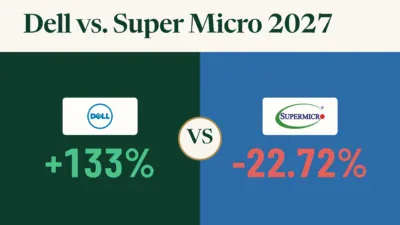
Supermicro’s shares are down 22.72% year to date. Dell’s are up 133.23%. In my view, Supermicro’s lower multiple reflects real risk. Dell’s established backlog, more than 7,500[1] AI Factory customers and steady capital returns give it the steadier financial profile in the AI build-out.
Supermicro’s heavy customer concentration adds volatility to its results. A clean finish to the board review and positive free cash flow would quickly change my view. Server integrators are only one piece of the AI infrastructure trade; we covered seven more non-chipmaker suppliers, from power to cooling, in a free report you can grab here.
Contact [email protected] for any questions or corrections.
Alex Sirois is a financial writer with experience spanning both retail and institutional investing. He has written for InvestorPlace and held roles at BNY Mellon and Bernstein, giving him a perspective that bridges Main Street portfolios and Wall Street analysis.
Alex holds an MBA from George Washington University and has built his career across multiple industries, including e-commerce, education, and translation — a breadth of experience that informs how he breaks down complex financial topics for everyday investors. His writing is conversational, actionable, and grounded in long-term, buy-and-hold investing principles.
At 247 Wall St., Alex focuses on delivering analysis that is both accessible and useful, with a clear emphasis on helping readers make more informed decisions with their money.