Turn $100,000 Into Lifetime Paychecks With These “Forever” Passive Income Dividend Stocks

This post may contain links from our sponsors and affiliates, and Flywheel Publishing may receive compensation for actions taken through them.
Some stocks are bought to trade. Others are bought to hold through recessions, rate cycles, and management changes, with the only expected transaction being a dividend deposit. For investors who want income that lasts for decades, the second group matters more. A payout that rises every year becomes a single purchase that grows into a paycheck without adding new money.
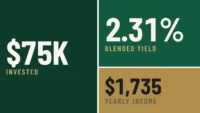
Splitting $100,000 equally across four dividend stocks, with $25,000 in each, would return more than $3,250 in annual passive income at forward yields. Each company has a long record of dividend increases, and each covers its payout from earnings or cash flow with room to spare. The figures below show what a $25,000 position in each of these four high-yield names would produce every year, ordered from the lowest yield to the highest.
AbbVie
- Stock #4: AbbVie (NYSE:ABBV | ABBV Price Prediction)
- Forward Yield: 2.41%
- Shares for $25,000: 82.83
- Annual Passive Income: ~$603.03
AbbVie is a biopharmaceutical company that was spun out of Abbott Laboratories (NYSE:ABT). Its immunology franchise now carries the business after Humira. In the third quarter, Skyrizi brought in $5.776B (+22.7%) and Rinvoq $2.706B (+23.9%), while Humira fell to $683M (-31.2%). Total revenue rose 10.32% to $17.404B. The yield sits above most large-cap pharma peers because investors still price in some risk from the Humira transition, along with the debt AbbVie took on for the Allergan deal.
The dividend is well covered. Management raised and narrowed full-year adjusted EPS guidance to $13.95 to $13.99, and the new annualized dividend of $7.28 works out to about 52% of the low end of that range. The board raised the quarterly payout from $1.73 to $1.82, and the first payment at the higher rate is due February 16, 2027. AbbVie’s negative book value comes from years of share buybacks, which reduced reported shareholder equity on the balance sheet.
Procter & Gamble
- Stock #3: Procter & Gamble (NYSE:PG)
- Forward Yield: 2.51%
- Shares for $25,000: 144.12
- Annual Passive Income: ~$627.49
P&G sells everyday household staples, including Tide, Pampers, Gillette, Charmin, Crest, and Dawn, through five segments. It added supplement maker Thorne in a deal that closed October 1, 2026. Its yield comes from being a mature, slow-growing company that pays out most of its cash: P&G plans to pay more than $10B[1] in dividends and buy back about $5B of stock in fiscal 2027.
Earnings cover the dividend comfortably. Fiscal 2027 core EPS guidance of $6.89 to $7.11[1] compares with a forward annual dividend of $4.354, a payout of about 62% at the midpoint. First-quarter core EPS of $2.00[1] beat the $1.89 estimate, and organic sales grew 4%, with all five segments posting gains. The quarterly dividend increased from $1.0568 to $1.0885 in April, the latest step in the record that makes P&G a Dividend Aristocrat.
Exxon Mobil
- Stock #2: Exxon Mobil (NYSE:XOM)
- Forward Yield: 2.71%
- Shares for $25,000: 158.15
- Annual Passive Income: ~$676.87
Exxon is an integrated energy supermajor. Its upstream business runs from Guyana to the Permian Basin to Golden Pass LNG, and it also owns refining, chemicals, and specialty products units. Exxon made a final investment decision on the Kizomba fields offshore Angola, according to Reuters. Two things lift the yield: a disciplined capital return policy and a 13.16% drop in the share price over the past month, which drove the forward yield higher.
Cash flow covers the dividend many times over. Third-quarter adjusted EPS came in at $4.23[2], compared with a quarterly dividend of $1.07, so the payout used only about 25% of earnings. Free cash flow reached $19.1B[2] for the quarter. Exxon also set a $20B[2] share repurchase target for 2027 and cut net debt to $22.1B. The latest increase, from $1.03 to $1.07, marks 44 consecutive years[2] of annual dividend growth.
Realty Income
- Stock #1: Realty Income (NYSE:O)
- Forward Yield: 5.50%
- Shares for $25,000: 418.20
- Annual Passive Income: ~$1,375.04
Realty Income is a net-lease REIT that owns single-tenant commercial properties in the U.S., Europe and Mexico. Its tenants pay most property costs, so rental income flows through to shareholders. Data centers made up 11.7% of third-quarter new investments by cash income, and portfolio occupancy stood at 98.8%. The yield is high for structural reasons: REITs must give out at least 90% of taxable income, and Realty Income makes a spread between its cost of capital and the rents it collects on long leases.
Adjusted funds from operations (AFFO) is the right measure of coverage here. Third-quarter AFFO rose 3.7% to $1.12 per share, and full-year guidance was raised to $4.45 to $4.46. The forward annual dividend of $3.288 matches about 74% of the low end of that range. The latest monthly payment of $0.274 is due December 15, 2026. In September 2026, the company announced its 116th consecutive quarterly increase. Recent financing includes $1.0B of convertible notes and a European joint venture with KKR.
Four Income Streams in One Table
| Name | Forward Yield | Annual Dividend Income |
|---|---|---|
| AbbVie | 2.41% | $603.03 |
| Procter & Gamble | 2.51% | $627.49 |
| Exxon Mobil | 2.71% | $676.87 |
| Realty Income | 5.50% | $1,375.04 |
| Total | 3.28% | $3,282.43 |
What a $100,000 Portfolio Pays Every Year
Combined, these four positions generate $3,282.43 in annual passive income on a $100,000 investment, a blended yield of 3.28%. Realty Income contributes $1,375.04, Exxon Mobil adds $676.87, Procter & Gamble supplies $627.49, and AbbVie rounds out the group with $603.03.
Those figures are only the starting point. Each of these companies has raised its dividend in the past year, so the same shares should pay more over time. Investors who reinvest the payments also add shares every month or quarter, and the larger share count raises the next payment without any new money. Over decades, rising payouts and reinvested dividends build on each other, and the income from a single purchase keeps growing. That is the whole idea behind a dividend ladder built to last a life without ever selling a share, which we walked through in a free guide here.
Contact [email protected] for any questions or corrections.
Lee Jackson has covered Wall Street analysts' equity and debt research and equity strategy daily for 24/7 Wall St. since 2012. His broad, diverse career, including a stint as creative services director at an NBC affiliate in Austin, Texas, gives him unique insight into the financial industry.
Lee Jackson's journey in the financial industry spans more than 30 years, including nearly two decades as an institutional equity salesperson at Bear Stearns, Lehman Brothers, and Morgan Stanley. His career spanned pivotal sell-side Wall Street events, from the dot-com rise and bubble to the Long-Term Capital Management debacle, 9/11, and the Great Recession of 2008. This reflects his resilience and adaptability amid market volatility.
Lee Jackson’s practical financial industry experience, gained through a career at some of the biggest banks and brokerage firms, is complemented by a lifetime of writing across various platforms. This unique combination allows him to shed light on the intricacies of Wall Street in a way only someone with deep insider experience and knowledge can. Moreover, his extensive network across Wall Street continues to provide direct access for him and 24/7 Wall St., a privilege few firms enjoy.
Since 2012, Jackson’s work for 24/7 Wall St. has been featured in Barron’s, Yahoo Finance, MarketWatch, Business Insider, TradingView, Real Money, The Street, Seeking Alpha, Benzinga, and other media outlets. He attended the prestigious Cranbrook Schools in Bloomfield Hills, Michigan, and has a degree in broadcasting from the Specs Howard School of Media Arts.