Annaly Yields Nearly 17%. These 3 High-Yield Stocks Raise Dividend Safety Concerns

This post may contain links from our sponsors and affiliates, and Flywheel Publishing may receive compensation for actions taken through them.
Annaly Capital Management (NYSE:NLY) now yields 16.8% on its $3 forward annual dividend. For a retired person, that looks like a paycheck. But a yield is only as good as the company’s ability to keep paying it. The three stocks below have each paid shareholders more than their business produced by at least one important measure, and that gap has to be filled from somewhere.
Quick test for sustainability: when earnings (measured the right way for the business model) or free cash flow fall short of the dividend, the company has to close the gap with cash on hand, new debt, asset sales, or new shares. None of those sources lasts forever.
Annaly Capital Management (NLY): Book Value Is Paying the Bill
Annaly pays $0.75 per quarter, up from $0.70 in Q2 2026. At $17.86, that positions the stock firmly in ultra-high-yield territory.
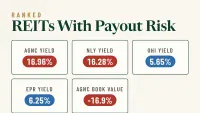
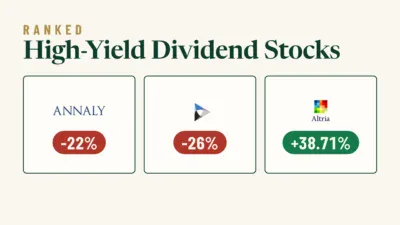
For a mortgage REIT, the right coverage measure is earnings available for distribution (EAD), not GAAP EPS. EAD of $0.80[1] did cover the dividend in Q3. The full picture looks worse. Annaly posted a GAAP net loss of about $1.00 billion, or $(1.36) per share[1], driven by $4.72 billion in net investment losses. Book value per share fell to $17.86 from $20.15[1], down 11.4%, and economic return was negative at 7.6%. GAAP leverage rose to 8.0x from 7.4x[1]. Shares are down 22% from $22.91[2] at the Q2 report, so part of that yield reflects a stock in fall. Annaly has cut before: the quarterly payout sat at $0.22 from 2020 through 2021 and dropped from $0.88 to $0.65 in 2023.
The bull case: management said EAD is “once again exceeding the common stock dividend,”[1] and net interest income rose to $543.6 million from $488.2 million. Our earlier look at the numbers that will decide whether Annaly’s dividend survives covers this in more depth. The warning sign to watch: another quarter of book value erosion alongside rising leverage.
AGNC Investment (AGNC): A One-Penny Cushion
AGNC Investment (NASDAQ:AGNC) pays $0.12 every month, or $1.44 a year. At $8.31, that works out to a 17.3% yield.
AGNC’s preferred coverage measure, net spread and dollar roll income, came in at $0.37[3] per share against $0.36 of dividends declared. That leaves a one-penny buffer, and the figure slipped $0.03 from Q2[3]. On a GAAP basis, AGNC lost $1.36 billion[4] on $5.01 billion of unrealized losses on agency MBS. Tangible book value per share fell 16.9% to $7.13[4], net interest spread narrowed to 1.86% from 2.00%, and leverage rose to 7.9 times from 7.4 times[3]. AGNC also issued 97.6 million shares[4] through its at-the-market program, which dilutes existing holders. The stock has fallen 26% from $11.25[5] at the Q2 report. Holding the payout flat through that kind of stress is a warning sign for holders. The record shows repeated cuts, from $0.22 monthly down to today’s level.
Management’s chief executive said, “Our dividend continues to be well-aligned with the economics of our business,”[3] and tangible book value was up 3% after quarter-end as of the call. Our deep dive on AGNC’s monthly yield and its catch lays out the details. Watch for net spread income to drop below the quarterly dividend.
Altria (MO): Earnings Cover It, Cash Returns Run Ahead
Altria (NYSE:MO | MO Price Prediction) pays $4.44 annualized after its 61st increase in 57 years. That positions the yield at 5.8% at $76.25.
EPS covers the dividend. Against the midpoint of raised 2026 adjusted EPS guidance of $5.66 to $5.74[6], the payout ratio is about 78%. The pressure shows up in cash and in the company’s finances. Through the first three quarters of 2026, free cash flow totaled $5.89 billion against $5.33 billion in dividends. Once buybacks are added in, total payouts reach $6.07 billion, more than the business generated.
Shareholders’ equity remains negative at $(2.225) billion[6], and cash fell 22.3% year over year to $2.70 billion. Cigarette shipments fell about 4%[6], and oral tobacco adjusted income dropped 3.7%. Equity income from its Anheuser-Busch InBev (NYSE:BUD) stake rose to $228 million from $123 million, doing much of the work in the Q3 beat. Reuters also reports Altria is exploring a cash bid for Imperial and a possible carve-up. A large deal could put more pressure on a balance sheet that already has negative equity.
The yield here comes from the payout itself: shares are up 38.71% year to date. Watch whether buybacks shrink and how any acquisition would be financed.
How to Check Any Dividend You Own
When a dividend gets cut, the stock usually falls with it, so a high yield alone is never a reason to own a stock. To check a holding yourself, start with the right earnings measure (EPS, FFO, AFFO, EAD, or distributable cash flow) and compare it to the dividend per share. Then subtract capital spending from operating cash flow and see whether what’s left covers dividends plus buybacks. Finally, check whether debt or book value is moving the wrong way and whether the yield rose mainly because the stock fell (we laid out seven warning signs that a big yield is about to be cut in a free dividend trap guide).
Contact [email protected] for any questions or corrections.
Chris Lange is a financial and geopolitical writer with more than a decade of experience covering a myriad of topics. He has published thousands of articles for 24/7 Wall St., with past coverage focused heavily on stocks, IPOs, healthcare, defense, global affairs, and technology.
His work has been quoted, or referenced by a number of outlets including Business Insider, USA Today, Yahoo Finance, MSN, The Motley Fool, and many other publications. A graduate of Southwestern University, he studied business with a focus on investments and has previous experience in banking and startups.
When not reading or writing the news, he is following his passion for Lacrosse, playing chess, or building solar projects with his dad.