Near-Equal ~$664B–$678B Backlogs: Why Oracle’s AI Concentration Risk Differs From Microsoft’s

This post may contain links from our sponsors and affiliates, and Flywheel Publishing may receive compensation for actions taken through them.
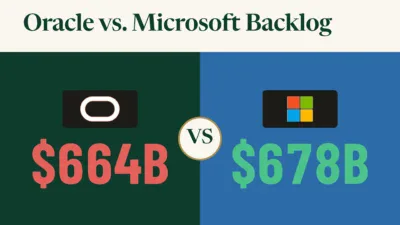
Oracle (NYSE:ORCL | ORCL Price Prediction) and Microsoft (NASDAQ:MSFT) ended their latest quarters with nearly the same backlog. Oracle reported $664 billion[1] in RPO. Microsoft reported $677 billion[2] in commercial RPO. The totals match, but the backlogs differ in who the customers are, how the work gets funded and how much cash supports it.
GPU Clusters Carry Oracle While a Whole Software Stack Carries Microsoft
Oracle’s cloud infrastructure revenue rose 121% to $7.39 billion[1], driven by AI training and inference work. Its legacy software segment shrank 3%[1], so AI capacity now drives the story. Demand looks firm for now. GPU usage reached 97.9%[3], and GPUs that came up for renewal were renewed or resold at a 20% premium.
Azure grew 48%[2], with demand spread across far more customers. Foundry has over 120,000 customers[4], and daily Copilot users grew over 5x year over year. Satya Nadella was blunt about leaning on a few giant buyers: “That’s not a business, as far as I’m concerned. So I want the breadth.”[4]
| Business Driver | Oracle | Microsoft |
|---|---|---|
| Main Growth Engine | AI cloud infrastructure | Azure, Microsoft 365, Copilot |
| Q1 Operating Cash Flow | $23.10B[1] | $58.0B[2] |
| Q1 Free Cash Flow | -$5.40B[1] | $18.6B[4] |
Oracle’s Backlog Depends on Frontier Labs Staying Funded
Oracle signed more than $30 billion[1] in new AI cloud contracts during the quarter, and most of them came through prepayments or bring-your-own-hardware deals. That structure protects Oracle’s cash. It also ties the backlog to how well AI labs can keep raising money. OpenAI’s newest model was trained at Oracle’s Abilene site, yet the call gave no figure for OpenAI’s share of RPO. CEO Clay Magouyrk said “All of our eggs are not in a single basket.”[3] I would like to see that claim backed by a number.
Microsoft’s RPO has a weighted duration of 2.3 years[4], and about 30% of it should turn into revenue within 12 months. That gives it a shorter runway with more customers behind it, which offers a cushion if any single AI buyer pulls back.
Oracle Still Has No Date for Positive Free Cash Flow
Oracle expects full-year capex of $90 billion to $95 billion[3], and its CFO declined to give a timeframe for positive free cash flow. It will be worth watching whether new sites like Shackleford turn backlog into revenue on schedule. At Microsoft, you should keep an eye on third-party GPU capacity that slid to H2[4]. Microsoft also guided to calendar-year capex near $170 billion[4] and still expects to stay free cash flow positive. All of that spending has to flow through the companies providing the data centers’ power, cooling, and networking gear, and we covered seven of them in a free report on the AI infrastructure buildout.
Why I Lean Toward Microsoft on Backlog Quality
Oracle shares are down 45.99% year to date, while Microsoft is up 2.15%. Oracle now trades at roughly 13x its FY27 EPS guidance of $8.10[3]. Microsoft carries a P/E of 27. That discount reflects real risks: centered customers and a expansion that burns cash.
For me, Microsoft’s backlog deserves the higher multiple because it rests on enterprise subscriptions and self-funded capex. Investors looking for a recovery may prefer Oracle’s lower multiple. My view would change if Oracle disclosed its customer concentration or set a firm date for positive free cash flow.
Contact [email protected] for any questions or corrections.
Alex Sirois is a financial writer with experience spanning both retail and institutional investing. He has written for InvestorPlace and held roles at BNY Mellon and Bernstein, giving him a perspective that bridges Main Street portfolios and Wall Street analysis.
Alex holds an MBA from George Washington University and has built his career across multiple industries, including e-commerce, education, and translation — a breadth of experience that informs how he breaks down complex financial topics for everyday investors. His writing is conversational, actionable, and grounded in long-term, buy-and-hold investing principles.
At 247 Wall St., Alex focuses on delivering analysis that is both accessible and useful, with a clear emphasis on helping readers make more informed decisions with their money.