No Threat to TSMC Before 2028: Intel’s Foundry Gap Is Still Huge

This post may contain links from our sponsors and affiliates, and Flywheel Publishing may receive compensation for actions taken through them.
Intel (NASDAQ:INTC | INTC Price Prediction) and Taiwan Semiconductor Manufacturing (NYSE:TSM) both reported third-quarter results in October. Intel posted its strongest data center growth in 15 years, but its foundry arm still lost money. TSMC raised its full-year growth outlook to about 44%[1] and said AI demand still tops supply. Both companies build chips, but one is still far behind the other.
Xeon Rescues Intel While AI Wafers Carry TSMC
Intel’s revenue reached $16.51B[2], up 20.95%. Data Center and AI did most of the work, rising 78%[2] on Xeon demand. Intel Foundry revenue hit $6.7 billion[3], but external foundry revenue was only $411 million, about 6.1% of the unit. A one-time customer program raised even that figure, so nearly all of Intel’s fab output still goes into Intel’s own products. The CFO said so simply: “We still have considerable work ahead of us to deliver a sustainably profitable Foundry business.”[3]
TSMC’s quarter ran on outside customers. Revenue hit $46.72B[4], with high-performance computing at 68%[1] of revenue. That makes AI accelerators and server chips TSMC’s main business (and if you want the picks-and-shovels angle beyond the fabs, we rounded up seven AI infrastructure suppliers outside the chipmakers, which you can read here: here).
| Business Driver | Intel | TSMC |
|---|---|---|
| Foundry Profitability | $1.9 billion[3] operating loss | 58.7%[1] operating margin |
| Gross Margin | 43.0%[2] GAAP | 66.4%[4] |
| Leading-Edge Traction | 18A at nearly one-third[3] of client CPU revenue | 7nm and below at 79%[4] of wafer revenue |
Intel Is Still Courting Customers TSMC Already Has
Intel’s manufacturing is clearly improving. 18A yields rose at a double-digit rate[3], and 18A costs fell about 40% since Q1. Timing still works against Intel: it released its 14A 0.9 PDK in October and expects the 1.0 PDK by Q1 next year[3]. Only after that will customers start talking about which products to build there. Tape-outs, large-die defect proof and qualification usually take years after that point.
TSMC plans A14 risk production in 2027[1] and volume production in 2028, the same year Intel targets Coral Rapids on 14A. The CEO, C.C. Wei, said A14 customer activity is “higher than the 2 nm activities so far.”[1] Intel also has a capacity conflict: it is transferring wafers toward its own Xeon chips, and substrate shortages limit output too.
2027 Looks Like a Tough Year for Intel
Intel expects no positive free cash flow next year, and the CFO called 2027 “a knothole.”[3] Gross capex of $20 billion in 2026 is expected to rise sharply. TSMC’s $60 billion to $64 billion[1] budget is far larger, and its own operations pay for it. One thing I’m watching is whether Intel names customers “in the next two quarters,”[3] as its CEO promised.
Why TSMC Still Leads the Foundry Race
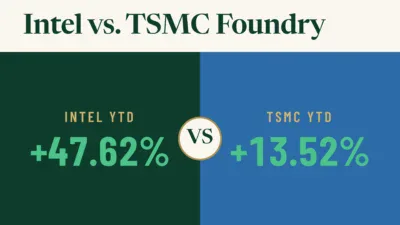
To me, Intel looks like a server CPU and packaging turnaround, with its foundry business as a long-dated option. The stock fell 39.79% over the past month but is still up 47.62% year to date, so plenty of hope is still priced in. TSMC shares are up 13.52% this year, and the company owns the AI wafer pipeline. My view would change if Intel signs a large external 14A customer with real volume commitments. Until that happens, I don’t see Intel threatening TSMC before 2028.
Contact [email protected] for any questions or corrections.
Alex Sirois is a financial writer with experience spanning both retail and institutional investing. He has written for InvestorPlace and held roles at BNY Mellon and Bernstein, giving him a perspective that bridges Main Street portfolios and Wall Street analysis.
Alex holds an MBA from George Washington University and has built his career across multiple industries, including e-commerce, education, and translation — a breadth of experience that informs how he breaks down complex financial topics for everyday investors. His writing is conversational, actionable, and grounded in long-term, buy-and-hold investing principles.
At 247 Wall St., Alex focuses on delivering analysis that is both accessible and useful, with a clear emphasis on helping readers make more informed decisions with their money.