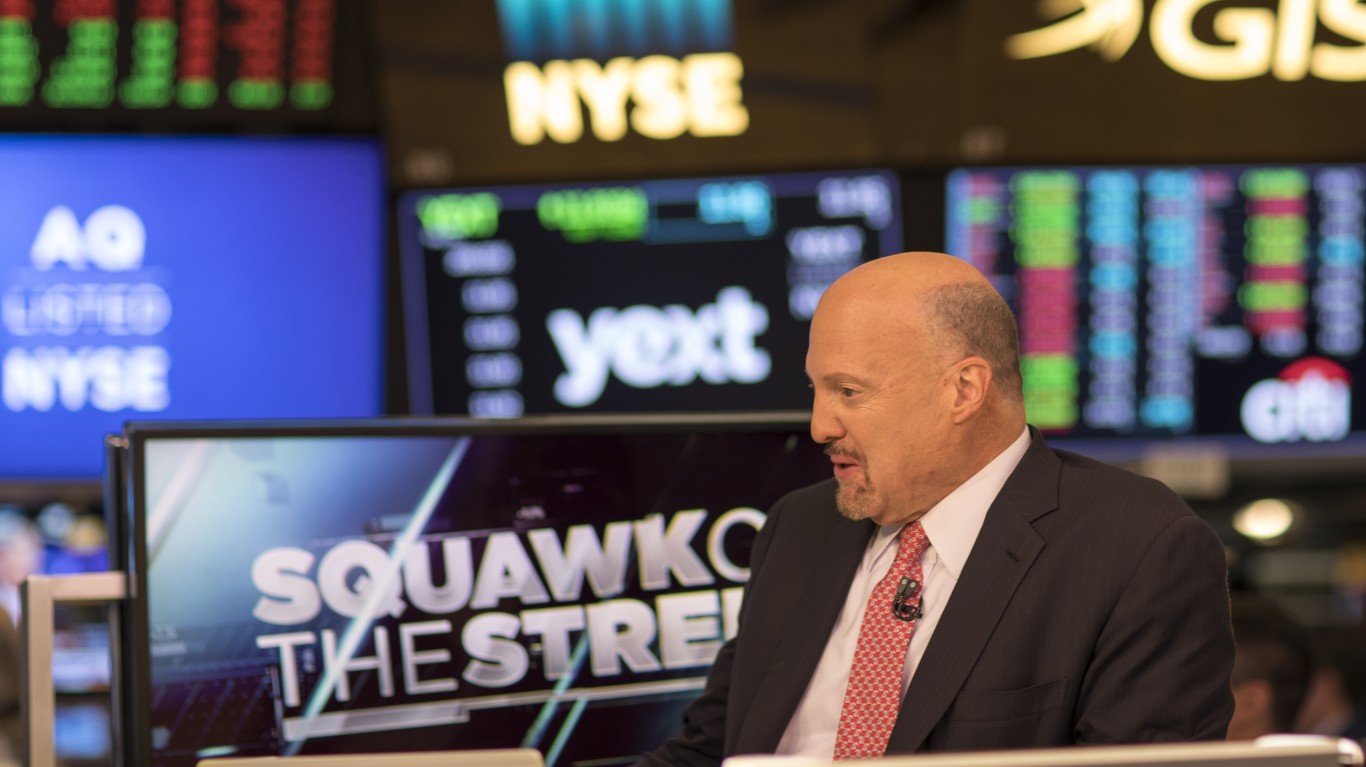
Jim Cramer Admits He Was Wrong About Intel as Stock Plunges 29%
Jim Cramer publicly reversed course on Intel the morning after a quarter that actually beat Wall Street expectations, and his reason touches on a supply crisis that may run far longer than the company admits.


On October 30, 2026, Jim Cramer told CNBC viewers he got Intel (NASDAQ:INTC | INTC Price Prediction) wrong. “I made a mistake here,” he said, adding, “They’re not ready to do the things that I thought it was.” He made the comments one day after an earnings report that beat estimates, yet it still triggered one of the worst single-day drops in the stock’s recent history.

Intel traded at $65.80 late Friday morning, down 28.53% from $92.07. Over the past month, it has fallen 43.24% from $115.93. Even so, the shares are still up 78.32% for the year. The selloff spread across chip stocks and pulled the broader tech sector lower on Friday.
A Strong Quarter Investors Sold Anyway
For the third quarter, Intel made $0.52 per share on a non-GAAP basis. Analysts had expected $0.3953. Revenue rose 20.9% to $16.51 billion. The standout was Data Center and AI, where revenue climbed 78% to $7.32 billion, and operating income rose to $3.04 billion from $964 million, according to Intel’s earnings release filed with the SEC.

Two other segments moved in the opposite direction. Client Computing revenue slipped 5% to $8.10 billion. Intel Foundry revenue grew to $6.70 billion, but it posted a $1.85 billion operating loss.
Fourth-Quarter Guidance Drove the Selloff
Intel guided fourth-quarter revenue to $15.0 billion to $16.0 billion, with non-GAAP EPS of $0.25 and a non-GAAP gross margin of 38.0%, down from 44.1% in Q3. An accident at its Israel factory accounts for roughly $300 million of lost revenue and 200 basis points of margin. Management expects Client Computing revenue to fall more than 20% from Q3 as memory costs squeeze PC demand. It now projects the PC market shrinking about 12% in 2026 and about 10% in 2027.

Spending is also going up. CFO Dave Zinsner said 2027 capital spending will be “up strongly” and added, “I don’t think that this will be a year in which we see positive cash flow.”
Where Intel Says It Isn’t Ready Yet
In the clip, Cramer didn’t say exactly which abilities he had expected. Management’s own comments on the call point to where Intel still falls short. Demand for data center chips “continues to meaningfully exceed available supply,” and Intel said it may not fully meet customer needs in the first half of 2027. On the foundry side, Intel has no announced customers for its 14A process yet. It expects “a couple of customers ready to announce the next two quarters.”
Cramer’s Shortage Timeline Is Longer Than Intel’s
Cramer also pushed back on the company’s schedule: “The shortage is going to last for 2 or 3 years. So the idea that they’re saying it’s going to be a half year, I mean, are you kidding me?” Zinsner had said wafers and substrates will stay tight in the first half of 2027, with more substrate capacity arriving in the back half. Intel also said the wider industry should stay supply-constrained “throughout 2027 and into 2028,” with server CPU units growing more than 30% in both 2026 and 2027. If shortages last as long as Cramer expects, Intel’s market share will depend on how much product it can build. Management said as much: next year’s share will be “a function of supply.”
What Intel Shareholders Should Watch Next
- 14A customer announcements: Signed external customers would be the clearest sign the foundry can start cutting its losses.
- Israel factory recovery: Management expects a similar impact in Q1 and called its assessment early.
- Nova Lake at CES in January: Intel expects design wins at launch to be twice those of Panther Lake. That gives it a chance to win share even as the PC market shrinks.
- Supply growth: Watch for updates on Intel 3 output and substrate supply. Both now cap data center sales.
Intel’s quarter delivered strong data center results while guiding to a cash-hungry 2027 and a weaker PC market. Cramer’s reversal shows how wide that gap has become.
Contact [email protected] for any questions or corrections.
Chris Lange is a financial and geopolitical writer with more than a decade of experience covering a myriad of topics. He has published thousands of articles for 24/7 Wall St., with past coverage focused heavily on stocks, IPOs, healthcare, defense, global affairs, and technology.
His work has been quoted, or referenced by a number of outlets including Business Insider, USA Today, Yahoo Finance, MSN, The Motley Fool, and many other publications. A graduate of Southwestern University, he studied business with a focus on investments and has previous experience in banking and startups.
When not reading or writing the news, he is following his passion for Lacrosse, playing chess, or building solar projects with his dad.