XRP vs Stellar (XLM): Which Could Double First in 2027?

This post may contain links from our sponsors and affiliates, and Flywheel Publishing may receive compensation for actions taken through them.
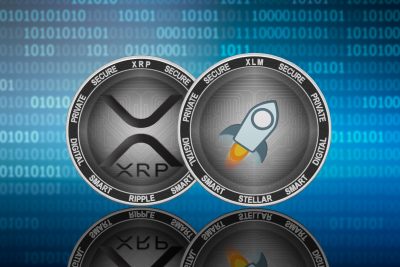
XRP (CRYPTO:XRP) and Stellar (CRYPTO:XLM) are being closely watched by holders, who are eyeing a potential doubling. XRP currently trades near 96 cents, while Stellar is at approximately 13.9 cents. On November 14, both coins closed at one-year lows, with XRP at about 91 cents and Stellar at around 13.5 cents.
Despite their recent struggles, Stellar has been more stable, dropping just 8.3% in the last week compared to XRP’s sharper decline of 17.3%. So, which of these coins stands a better chance of doubling its value first in 2027?
XRP Needs $1.91, and Stellar Needs 28 Cents, With More Coins in Circulation

To double its current price, XRP needs to reach about $1.91, while Stellar needs about 28 cents. XRP is down 48.1% this year and trades 73.8% below its all-time high of $3.65 from July 2025. Meanwhile, Stellar is down 31.3% this year and remains 84.2% below its highest price of 87.6 cents in January 2018.
Market capitalization, calculated by multiplying a coin’s price by the number of coins in circulation, is the other half of the math. XRP’s market cap stands at about $60.7 billion, sixth among all cryptocurrencies, while Stellar’s is about $4.9 billion, 20th.
The growing supply of these coins makes it harder for them to double in value. About 63.5 billion XRP are in circulation out of a maximum of 100 billion, while Stellar has approximately 35.4 billion XLM out of a total supply of 50 billion. Both Ripple and the Stellar Development Foundation keep releasing coins from their reserves, which means the same price requires a larger market valuation over time.
For instance, our look at what it would take for XRP to get back to $2 found that $2 now implies roughly $127 billion, more than the $125.3 billion XRP was worth when it closed at $2.06 on January 17. For Stellar, a return to its 87.6-cent 2018 peak would now imply about $31 billion, compared to $15.7 billion back then, as our piece on whether Stellar can reach $1 by 2030 showed.
XRP Last Traded Near $1.91 in January, While Stellar Topped 28 Cents in May

XRP last traded near its doubling target in January, peaking at $2.42 before closing the month at $1.65. Bitcoin (CRYPTO:BTC) also hit a one-year high of $96,899 shortly before XRP’s last close above $2. However, XRP then plummeted to as low as $1.12 in February, and its strongest month since topped out at $1.70 in August.
Stellar had a more recent peak, starting May at 15.8 cents, reaching 29.8 cents and closing the month at 26 cents. The surge came the same month the Depository Trust & Clearing Corporation (DTCC) announced on May 27 that it would connect its tokenization service to Stellar.
After touching 27.6 cents in June, Stellar’s price faded, and our look at what $1,000 in Stellar could be worth in 12 months used the 26-cent May close as its top scenario.
Both coins have experienced rapid price increases in the past. Following the November 2024 U.S. election, XRP surged from 51 cents to $1.94 that month, while Stellar jumped from 9.2 cents to 52.6 cents. However, a broader market rally drove those moves, and both coins have trended downward this year.
Stellar Leads on Tokenized Assets While XRP Leads on Fund Access
Stellar is leading in tokenized assets. As of October, Stellar hosted around $3.5 billion in tokenized assets compared to $2.5 billion on the XRP Ledger, according to our analysis. The Stellar Development Foundation has since reported that the total has passed $5 billion.
Payment activity further supports Stellar’s position, as Stellar reported a 127% increase in stablecoin transfer volumes this year. Meanwhile, Ripple’s RLUSD stablecoin has a supply of about $2.8 billion, but a comparable figure for payment volumes on the XRP Ledger isn’t available.
In terms of fund access, XRP has the upper hand. Spot XRP ETFs hold actual coins and drew net inflows of $1.79 billion by November 13, according to SoSoValue. Nonetheless, total net assets have slipped from $1.57 billion on October 21 to $1.15 billion, with most sessions in the past month showing zero net flow. Stellar lacks a spot ETF, and its low transaction fees don’t create significant demand for XLM.
The nearest forecasts are ChatGPT scenarios from November 9, with middle scenarios of $2.50 for XRP and 30 cents for XLM by December 31, 2028, as our look at what 5,000 XRP and Stellar could be worth outlines. The DTCC’s Stellar launch is targeted for the first half of 2027, although that timeline hasn’t been reconfirmed since.
Which Could Double First in 2027, XRP or Stellar?
Stellar appears more likely to double in value first, although the path for both coins seems challenging without a broader market rally. Stellar needs to recover its 50-day and 200-day averages, both around 18 cents, close to 30% higher, before it can aim for its May close of 26 cents. XRP needs to reclaim its 50-day average of $1.31, approximately 37% higher, and surpass its September 22 high of $1.57.
The DTCC launch is the key trigger. A confirmed Stellar launch before the end of June 2027, with XLM closing above 18 cents, could make Stellar the more likely coin to reach its double. But if the launch slips and XLM breaks its 13.5-cent November 14 low, XRP could take the lead once ETF inflows return, since the spot XRP ETFs buy actual XRP.
Contact [email protected] for any questions or corrections.
Sam Daodu is a crypto analyst and the editor of 24/7 Wall St.'s Crypto Desk, where he covers Bitcoin, XRP, Ethereum, Solana and the altcoins investors search for most. His work focuses on price levels, spot ETF flows, on-chain data and the regulatory decisions that move crypto markets, written so a first-time buyer and a seasoned trader can both use it.
Sam has written about crypto professionally since 2019 and has published more than 2,000 articles. Before joining 24/7 Wall St., he wrote for crypto media outlets and Web3 companies and ghostwrote for crypto founders and token launches. His analysis is syndicated on Yahoo Finance, MSN and AOL and has been cited by other crypto news sites. He also founded MacLabs Marketing, a content and personal branding agency for crypto founders and executives.
When he isn't reading charts, Sam is usually at the gym or watching One Piece, a series he maintains has better tokenomics than most altcoins.