Up 14.81% in a Year, COWZ Proves You Don’t Need Apple
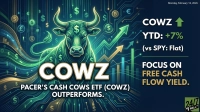
The Pacer US Cash Cows 100 ETF (CBOE:COWZ) is having a solid 2026, up 6.4% year to date and 14.81% over the past year through July 6. Yet a fund built expressly to own America’s biggest cash machines holds zero…

This post may contain links from our sponsors and affiliates, and Flywheel Publishing may receive compensation for actions taken through them.

The Pacer US Cash Cows 100 ETF (CBOE:COWZ) is having a solid 2026, up 6.4% year to date and 14.81% over the past year through July 6. Yet a fund built expressly to own America’s biggest cash machines holds zero shares of Apple, arguably the most famous cash generator on the planet. That contradiction is baked into the methodology.
What COWZ Actually Owns
COWZ is issued by Pacer ETFs and tracks the Pacer US Cash Cows 100 Index, which ranks the Russell 1000 by trailing free cash flow yield and buys the top 100 names. The fund had $18.18 billion in net assets as of April 30, 2026, spread across 102 positions. The expense ratio was not disclosed.
The top holdings read like a checklist of mature, cash-generative businesses. Qualcomm (NASDAQ:QCOM | QCOM Price Prediction) sat at the top at 2.67% of net assets, followed by ConocoPhillips (NYSE:COP) at 2.17%, CVS Health (NYSE:CVS) at 2.16%, and Ford Motor (NYSE:F) at 2.01%. Altria, Uber, Bristol-Myers Squibb, Pfizer, Verizon, and AT&T round out the upper ranks.
Why It’s Up
The one-year gain traces back to a handful of leaders across sectors. CVS surged 56.84% over the trailing year and is up 30.76% year to date as its Health Care Benefits segment turned a corner. Ford tacked on 22.82% over the past year. QUALCOMM added 17.39% and ConocoPhillips 14.22% in the same window. The heavy tilt toward energy, healthcare, telecom, and consumer staples has done the lifting while high-multiple growth names were absent from the roster.
The Apple Absence, Explained
Apple’s absence from a “cash cow” fund traces directly to methodology. Apple generated $98.77 billion in free cash flow in fiscal 2025, one of the largest figures ever produced by a single company. The catch is the denominator. Apple carried a market capitalization of roughly $4.59 trillion, a trailing P/E of 38, and a dividend yield of 0.34%. Divide that enormous cash flow by an even more enormous market value, and Apple’s free cash flow yield lands well below the level required to crack the top 100.
Compare that with a name COWZ does own. QUALCOMM produced $12.82 billion in free cash flow in fiscal 2025 against a market cap near $196.5 billion. Smaller absolute cash flow, dramatically higher yield relative to price. That is the screen doing its job.
The same logic sweeps out the rest of the Magnificent Seven. Microsoft, Nvidia, Alphabet, Amazon, Meta, and Tesla are also absent from the portfolio, a systematic outcome of the yield-based screen rather than a stock-picker’s judgment call.
What the Exclusion Means for a Portfolio
For investors comparing COWZ with a broad market index, the trade-off is direct. Apple gained 15.22% year to date and 46.99% over the past year, both ahead of COWZ. Funds that hold Apple at index weights captured that. COWZ did not. In exchange, holders got heavier exposure to energy producers, healthcare cash generators, telecoms, and older-economy industrials, sectors that behave differently from mega-cap tech in a drawdown.
Concentration risk shifts as well. Without the mega-cap tech anchors, COWZ leans into cyclicals like ConocoPhillips (energy) and Ford (autos, dividend yield 4.49%). Those names typically move with commodity prices, credit conditions, and consumer demand, tracking cyclical rather than AI-driven forces.
The Takeaway
COWZ does exactly what it says on the tin: it ranks the Russell 1000 by free cash flow yield and buys the top 100. Because Apple trades at a growth-stock valuation, its cash yield is not high enough to qualify, no matter how many billions it prints. Investors who want a value-tilted, cash-flow-first slice of the U.S. large-cap market may find that appealing. Investors who want mega-cap tech exposure will need to look elsewhere.
Contact [email protected] for any questions or corrections.
I am a long time investor and student of business, and believe finding good companies that can become great investments is the best game on earth. After 20 years of writing and researching the public markets it is clear that individuals have never had more tools and information to take control of their financial lives. From ETFs and $0 commissions to cryptos and prediction markets there has never been a greater democratization of access to investing.
I write to help people understand the investments available to them so they can make the best choice for their portfolio, whether they're starting out or looking for income in retirement.