




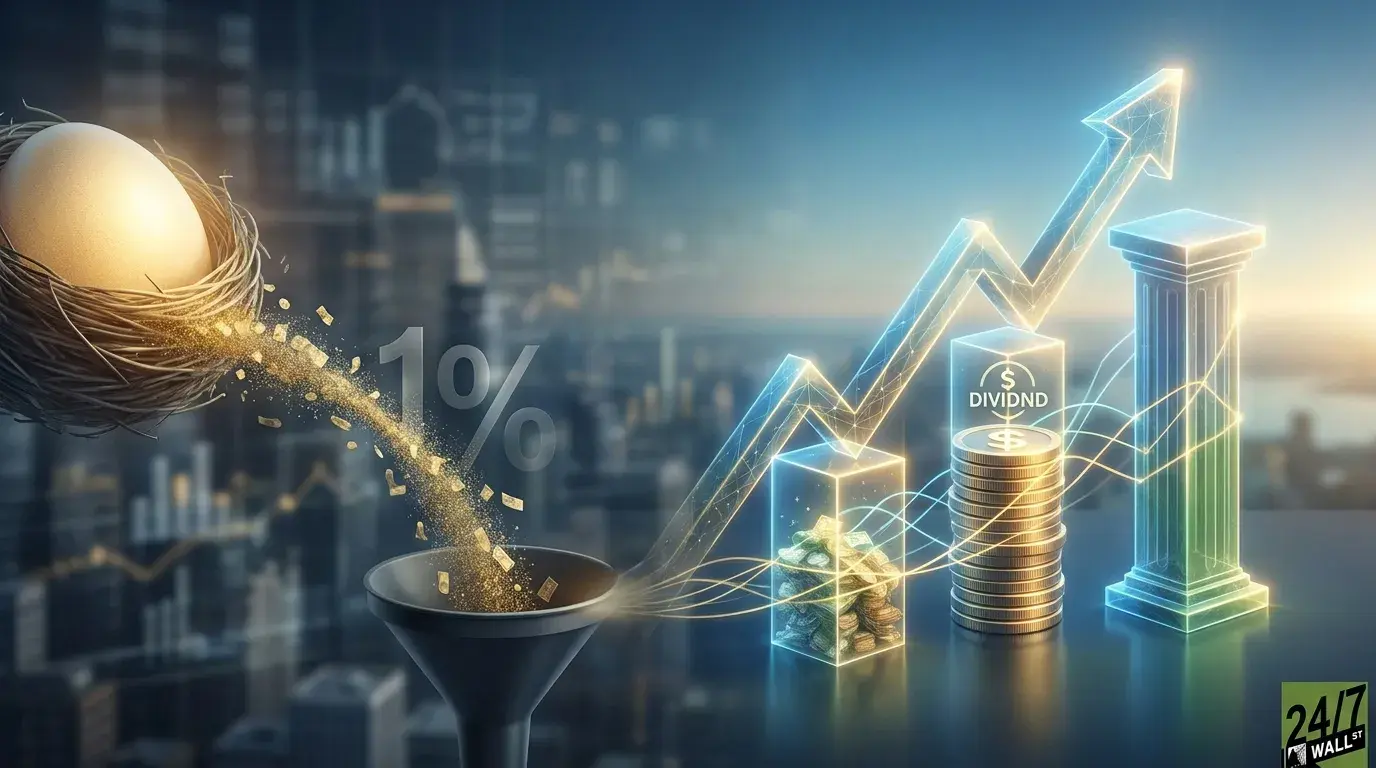
Your adviser sends you a nice holiday card, buys you lunch once a year, and quietly bills 1% of your account balance every quarter. On a $750,000 portfolio, that is $7,500 a year skimmed off the top before you buy a single share of anything. Stretch that across a 25-year retirement and the math is brutal: six figures of wealth you never got to spend, gift, or leave behind. The good news is that you can rebuild the core of a serious retirement portfolio using three plain-vanilla index ETFs that charge almost nothing. Vanguard S&P 500 ETF (NYSEARCA:VOO), Schwab U.S. Dividend Equity ETF (NYSEARCA:SCHD), and iShares Core U.S. Aggregate Bond ETF (NYSEARCA:AGG) give you U.S. large-cap growth, a rising dividend paycheck, and an investment-grade bond anchor for a combined cost that rounds toward zero.
Why a 1% Fee Is More Than It Sounds
A 1% advisory fee does not sound overly aggressive next to hedge funds. But retirement is a long compounding window, and every dollar taken out is a dollar not compounding. VOO charges an expense ratio of 0.03%, and AGG charges 0.03%. Put another way, on every $10,000 you invest, you keep about $9,997 working for you each year instead of $9,900. Do that math for 30 years, and the difference is substantial. The price of a house.
VOO: The Growth Engine
Vanguard’s S&P 500 ETF is the workhorse. It owns the 500 largest U.S. companies in proportion to their market value, which means you automatically own more of what is winning and less of what is fading. The fee is the headline: at 0.03%, VOO is roughly 33 times cheaper than a 1% adviser. Performance has done the rest. Over the last decade, the ETF returned 310.19% on a total-return basis, and over the last year it is up 23.31%, closing recently at $686.65. For core large-cap exposure, VOO delivers the S&P 500 at a fraction of what an adviser would charge to assemble the same beta.
SCHD: The Dividend Paycheck
Where VOO gives you growth, SCHD gives you cash flow that lands in your account four times a year. The fund holds 127 positions screened for dividend quality. Top holdings include QUALCOMM at 6.74%, Texas Instruments at 5.90%, plus Coca-Cola, Merck, Chevron, Procter & Gamble, and PepsiCo. That is a portfolio built for reliable payers. Distributions have grown from roughly $2.03 per share in 2020 to $1.0476 across the four quarters of 2025, with each quarter arriving on a predictable mid-month schedule. The ETF holds roughly $95 billion in net assets, and shares closed recently at $33.56, up 24.36% year to date. For a retiree who wants income without hunting individual dividend stocks, this is the cleanest single-ticker answer on the market.
AGG: The Ballast
Stocks pay for the good years. Bonds are what keep you from panic-selling in the bad ones. AGG tracks the broad U.S. investment-grade bond market, mixing Treasuries, mortgage-backed securities, and corporates, with an expense ratio of 0.03%. Because the 10-year Treasury yield sits at 4.75%, near the top of its 12-month range, new bond buyers are finally being paid to lend. That shows up in AGG’s monthly distributions, which have run steadily around $0.33 per share, adding up to $3.608833 over the trailing 12 months on a share price of $97.31. That said, shares are down 0.33% year to date, a reminder that rising rates pressure existing bond prices, but the coupon stream is what a retirement portfolio actually needs.
The Real Trade-Off
Three tickers cannot replace every service a good adviser provides. You will not get a tax-loss harvesting overlay, Roth conversion planning, or a human voice when the market drops 20% and you want permission to sell. If those are worth 1% a year to you, keep the adviser. If they are not, this three-fund core covers U.S. equity growth, dividend income, and bond ballast for effectively pennies on every thousand dollars invested. Over the length of a retirement, keeping that difference for yourself is the whole point.
Contact [email protected] for any questions or corrections.









 Top Gaining Stocks
 Top Losing Stocks