VNQ Returned 62.61% in 10 Years. SPY Returned 253.49%. Here’s the Hidden Cost Nobody Talks About
VNQ's 0.13% expense ratio looks like a bargain until you see what the IRS quietly collects every quarter, and it has nothing to do with management fees.

This post may contain links from our sponsors and affiliates, and Flywheel Publishing may receive compensation for actions taken through them.
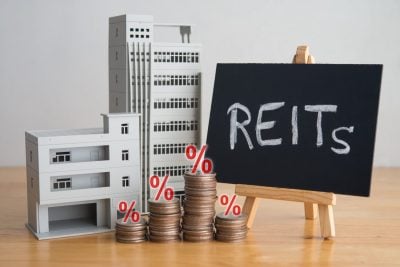
The Vanguard Real Estate ETF (NYSEARCA:VNQ) advertises a rock-bottom fee. But management fees are only part of the cost. The real hidden cost sits on your Form 1099-DIV every April, and it has quietly siphoned returns for a decade. Because REITs distribute most of their taxable income, much of VNQ’s dividend is taxed as ordinary income rather than at the lower qualified dividend rate. Over time, that tax treatment can materially reduce after-tax returns for investors holding the fund in a taxable account.
What You’re Actually Paying
At face value, the sticker price looks harmless. VNQ charges a 0.13% expense ratio, or roughly $13 per year on a $10,000 position. Vanguard’s marketing leans on that figure.
However, the tax bill is the number the factsheet doesn’t underline. REIT distributions are non-qualified ordinary income, taxed at your marginal rate instead of the preferential 15% or 20% long-term rate that applies to most stock dividends. VNQ paid out $3.4732 per share over the trailing twelve months on a $98.92 price. That is a distribution yield near 3.5%. For an investor in the 24% federal bracket, the extra tax versus a qualified-dividend equivalent runs roughly $32 a year per $10,000. In the 32% bracket, closer to $60. Add state tax and the drag widens.
Compound that over twenty years and the shortfall is real money. The fee costs $260 across two decades. The tax gap could quietly cost several times that, and it repeats every quarter, four times a year, whether or not the fund’s price moved.
The Part the Factsheet Doesn’t Highlight
Now add that tax drag on a lost decade of relative performance. Over the past ten years, VNQ returned 62.61%. The SPDR S&P 500 ETF Trust (NYSEARCA:SPY) returned 253.49% over the same window. A $10,000 stake in VNQ grew to about $16,261. The same money in SPY grew to about $35,349. That gap represents a materially different retirement outcome.
The problem isn’t unique to just Vanguard’s product. The iShares U.S. Real Estate ETF (NYSEARCA:IYR) returned 67.7% over the same decade, telling you the underperformance is structural to the REIT wrapper, not to Vanguard. The interest rate backdrop hasn’t helped the situation. The 10-year Treasury yield sits at 4.70%, near a 98.8th percentile reading over the past year. Higher risk-free yields raise cap rates and cap what REIT investors will pay for property cash flows.
The Cheaper Mirror
If you want cheaper REIT beta, the Schwab U.S. REIT ETF (NYSEARCA:SCHH) tracks a similar universe at a lower headline fee. While that saves basis points, it does not fix the ordinary-income tax problem because both funds pass through the same REIT distributions. The real cost mirror lives in the account choice. Holding VNQ inside a Roth IRA or traditional IRA converts those non-qualified distributions from an annual tax event into tax-deferred or tax-free compounding. The trade-off is opportunity cost. Using retirement account space for VNQ means giving up room for investments that have generated much stronger returns. Over the past five years, VNQ gained 11.88%, while SPY advanced 74.58%.
What This Means for You
VNQ’s real expense lives in the tax code rather than the expense ratio. Before you buy another share, the question worth asking is “which account is this fund allowed to touch?” If it lives in a taxable brokerage, every quarter you are cutting the IRS a check at your top rate for the privilege of owning landlords who have trailed the index for a decade. Ask whether that trade still makes sense at a 4.70% risk-free yield.
Contact [email protected] for any questions or corrections.
Ryne Mauck is an investment writer covering exchange-traded funds, retirement planning, and portfolio strategy. Through his work at 24/7 Wall St. and other investment platforms, including Seeking Alpha, he aims to provide clear, research-driven insights that help investors make more informed decisions while maintaining a long-term approach to investing.
Ryne holds a B.Sc. in Finance and an M.A. in Political Science. He is a formerly registered Municipal Advisor Representative and has passed the Series 50, Series 63, and Series 65 exams. His articles are not intended to be, nor should they be interpreted as, financial advice.