AMDL Doubles Your AMD Bet. It Also Doubles the Nvidia Problem
AMDL gives traders twice the upside of AMD's booming AI momentum, but it also locks them into twice the exposure to the one problem AMD still cannot solve.

This post may contain links from our sponsors and affiliates, and Flywheel Publishing may receive compensation for actions taken through them.

The GraniteShares 2x Long AMD Daily ETF (NASDAQ:AMDL) gives you a simple way to double down on one of the semiconductor industry’s biggest potential winners. The fund seeks twice the daily performance of Advanced Micro Devices (NASDAQ:AMD | AMD Price Prediction), turning every gain (as well as every loss) into something much larger. That sounds attractive as AMD continues to grow its AI business. The catch is that buying AMDL does not just double your exposure to AMD. It also doubles your exposure to the company’s biggest challenge: catching Nvidia (NASDAQ:NVDA), which still dominates the AI accelerator market.
AMD’s AI Growth Is Real — But Nvidia Is Still the Standard
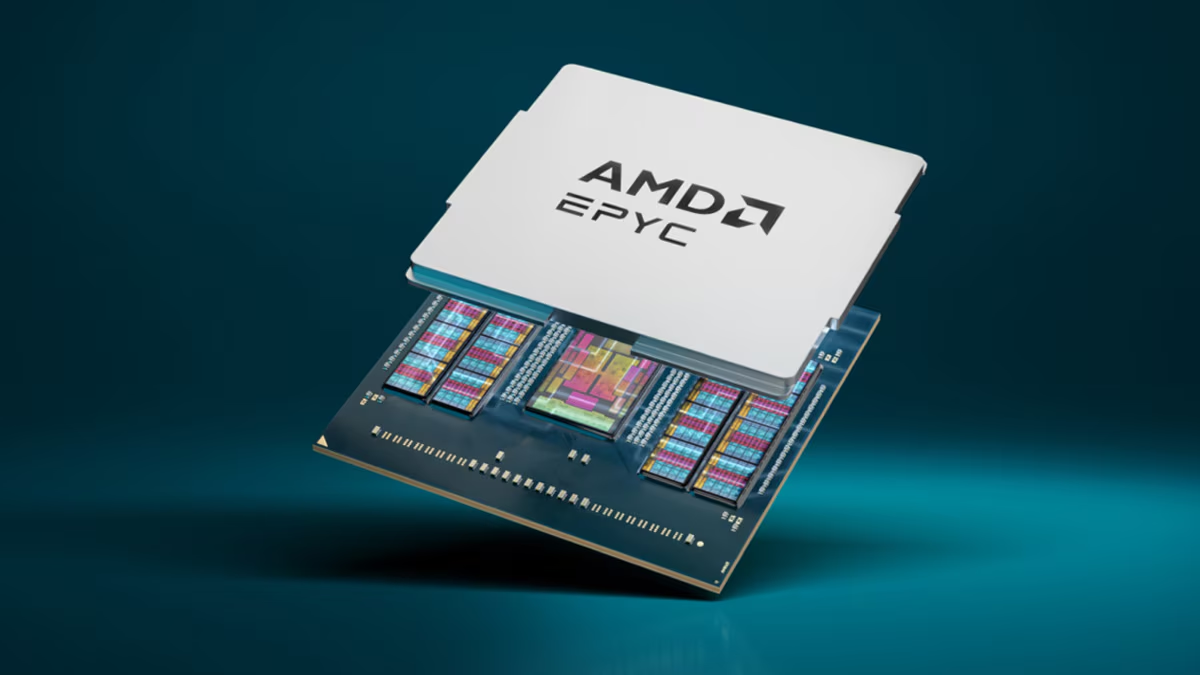
AMD has plenty of momentum. Second-quarter revenue reached a record $11.54 billion, up 50% year over year. Data Center revenue more than doubled to $6.72 billion as demand for EPYC processors and Instinct AI accelerators continues to grow. Management also guided for roughly $13 billion in third-quarter revenue, ahead of Wall Street expectations. Those numbers solidify AMD as a legitimate AI infrastructure company rather than simply a CPU manufacturer.
The challenge is scale. Nvidia generated more than $81 billion of revenue in a single quarter, with its Data Center business continuing to dwarf AMD’s. Nvidia also benefits from its CUDA software ecosystem, networking products, and integrated AI platform that many enterprise customers have already standardized on. While AMD continues to win customers and gain market share, investors are ultimately betting on how quickly that gap can narrow. If AMD’s AI business grows slower than expected, AMDL shareholders will feel that disappointment twice as much.
How AMDL’s 2X Daily Leverage Changes the Investment
AMDL seeks to deliver 200% of AMD’s daily return, not twice AMD’s long-term performance. That distinction matters. Because the fund resets its leverage every trading day, returns become path dependent. During strong, sustained rallies, leverage can amplify gains beyond what many investors expect. However, during volatile periods, daily compounding can steadily erode returns even if AMD ultimately finishes near where it started (a phenomenon known as volatility decay).
That risk is especially relevant for AMD. The stock frequently experiences large moves following earnings reports, AI product announcements, hyperscaler contract wins, and developments involving its largest competitor, Nvidia. Those swings become significantly larger inside AMDL. Investors should also remember that the fund carries a substantially higher expense ratio than simply owning AMD shares (current expense ratio = 1.07%), making it better suited for tactical positioning than long-term buy-and-hold investing.
Key Fund Statistics
Before investing, it is worth understanding exactly how AMDL is structured. Unlike owning AMD directly, investors are purchasing a leveraged product designed to achieve a specific daily objective. Key fund metrics are included in the table below.
| Metric | AMDL |
| Inception Date | March 4, 2024 |
| Investment Objective | 2× Daily AMD Performance |
| Net Assets | $1.05B |
| Expense Ratio | 1.07% |
| YTD Total Return | +236.27% (Compared to +125.70% for AMD) |
| 1-year Total Return | +330.02% (Compared to +180.37% for AMD) |
| Since Fund Inception | +104.98% (Compared to +135.37% for AMD) |
| Max Historical Drawdown | -88.63% |
What This Means for You
AMD continues to execute well. Revenue growth remains impressive, the Data Center business is expanding rapidly, and the company is steadily becoming a larger player in the AI infrastructure space. If AMD continues to gain market share, AMDL can magnify those gains.
However, this ETF also magnifies AMD’s biggest uncertainty. Nvidia remains the industry’s dominant force, and even small disappointments in AMD’s execution can translate into outsized negative swings for AMDL investors. For traders with a strong short-term conviction on AMD, the leverage can be attractive. For long-term investors, owning AMD shares directly is likely the more predictable way to benefit if the company’s AI strategy continues to succeed.
Contact [email protected] for any questions or corrections.
Ryne Mauck is an investment writer covering exchange-traded funds, retirement planning, and portfolio strategy. Through his work at 24/7 Wall St. and other investment platforms, including Seeking Alpha, he aims to provide clear, research-driven insights that help investors make more informed decisions while maintaining a long-term approach to investing.
Ryne holds a B.Sc. in Finance and an M.A. in Political Science. He is a formerly registered Municipal Advisor Representative and has passed the Series 50, Series 63, and Series 65 exams. His articles are not intended to be, nor should they be interpreted as, financial advice.