Bullish on Silver? This 2X ETF Doubles Your Bet and Your Risk
Silver has soared to record highs and then collapsed by more than half, and one leveraged ETF is designed to magnify every move in both directions. Before you consider doubling down on silver's next rally, there is a hidden structural…

This post may contain links from our sponsors and affiliates, and Flywheel Publishing may receive compensation for actions taken through them.
The ProShares Ultra Silver ETF (NYSEARCA: AGQ) has become an increasingly popular way for bullish investors to amplify their exposure to silver. Designed to deliver twice the daily return of silver futures, the leveraged ETF offers the potential for significantly larger gains when prices rise. However, that additional upside comes with equally amplified downside risk and an important feature that many investors overlook. Understanding how AGQ’s daily leverage works may be the single most important consideration before adding it to your portfolio.
Silver Tailwinds
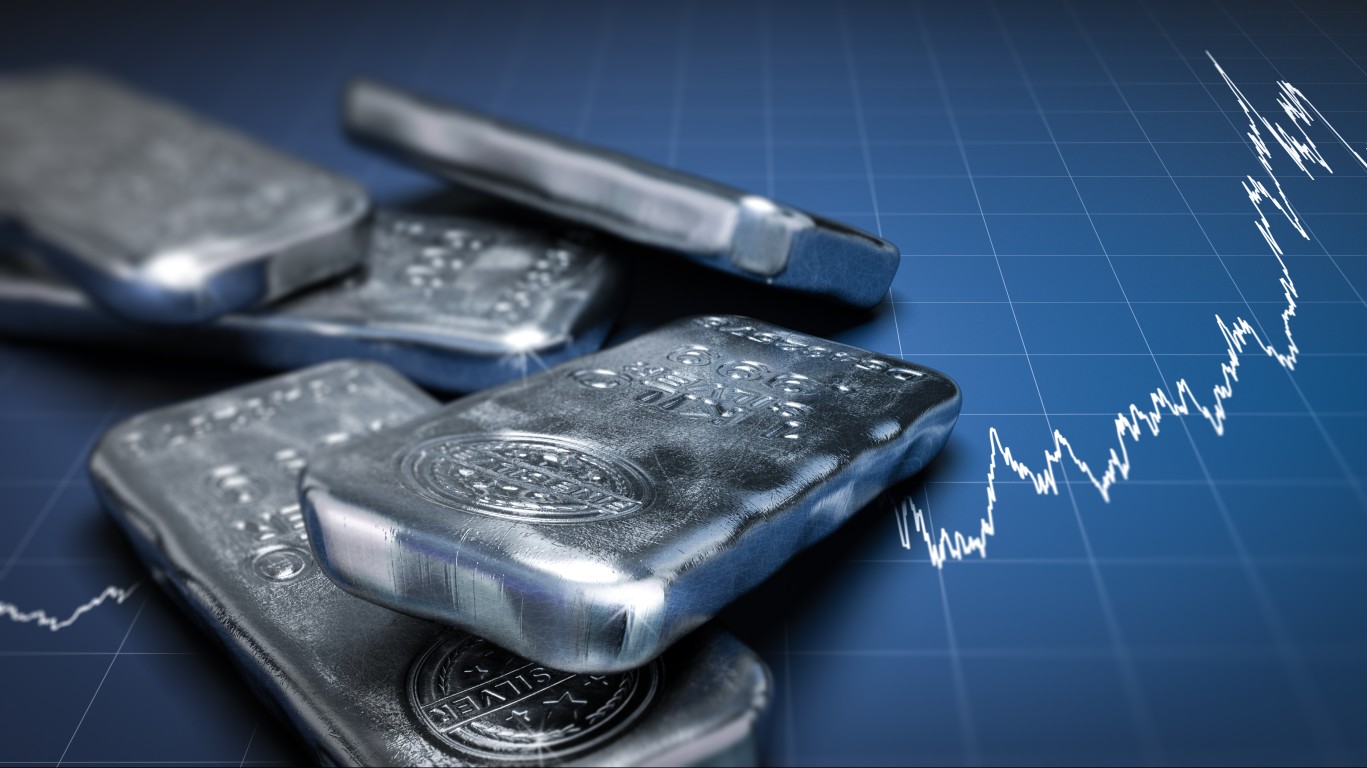
Silver performed exceptionally well at the start of 2026, rising to a nominal all-time high of $121.62 per ounce in January, before falling back down to current levels around $60.
Investor demand earlier in the year was driven by an increased demand for precious metals (led by gold as a potential safe-haven investment) and expanding industrial use. Unlike gold, which has primarily served as a store of value, industrial use cases for silver have been increasing. These use cases include solar panels, electronics, and other technologies that rely on the metal.
Despite its recent 52% pullback, analysts remain constructive on the metal’s outlook. J.P. Morgan Global Research expects the metal to find a solid cyclical base somewhere in the ballpark of $81 per ounce.
How AGQ Amplifies Both Gains and Losses
AGQ is a leveraged ETF specifically designed to deliver 2x the daily performance of the Bloomberg Silver Subindex. What this means in theory is that if silver rises by 1%, AGQ should rise by roughly 2%. Conversely, if silver falls 1%, then AGQ should fall roughly 2%.
Rather than directly investing in the underlying asset, AGQ gains exposure through swaps and futures contracts. Because the fund uses derivatives to maintain approximately 200% exposure, its leverage is reset at the end of every trading day.
For that reason, returns over multiple days, months, or even years can diverge significantly from simply doubling silver’s return over that same period (a phenomenon known as volatility decay or drag). This is especially true in volatile or sideways markets. If silver chops up and down wildly, the constant daily mathematical friction will drag the fund downward, meaning you can lose money over a prolonged multi-week hold even if the spot price of silver ultimately remains flat.
Key Fund Metrics
Before including AGQ into your day-to-day market operations, active investors and traders should consider the current fund metrics.
| Metric | AGQ |
| Investment Objective | 2x the daily price movement of silver |
| Leverage Reset | Daily |
| Inception Date | December 1, 2008 |
| Net Assets | $1.15B |
| Expense Ratio | 0.95% |
| 3-Month Average Daily Volume | 3,046,553 shares |
| 10-year Cumulative return | 19.63% |
| Max Drawdown | -98.16% |
| Best Suited For | Short-term tactical investors |
Who is AGQ Best Suited For
Given the fund’s structure, AGQ is built for a narrow investor profile. That being short-term tactical traders, active investors who are actively monitoring positions, investors with a high-risk tolerance, and traders seeking leveraged exposure without directly needing to open a margin account to trade futures.
Generally speaking, AGQ is not suited for buy-and-hold investors seeking long-term silver exposure. The fund’s daily reset mechanism, punishing historical max drawdowns (-98.16%) and high costs (expense ratio of 0.95%), make it a poor long-term proxy for the underlying metal.
For investors simply looking for portfolio diversification and capital preservation, the iShares Silver Trust ETF (NYSEARCA:SLV) is a much better, cost-effective option. By comparison, SLV’s one-to-one exposure and 0.50% expense ratio prove to be the better vehicle for most passive investors.
Final Takeaway
AGQ functions exceptionally well as a specialized financial instrument when silver prices dramatically spike. However, at its core, it is a tactical tool, not a core portfolio holding. Long-term buyers trying to ride out the metal’s broader 2026 macro cycle should avoid this fund, or risk watching volatility decay systematically eat away at their capital.
Contact [email protected] for any questions or corrections.
Ryne Mauck is an investment writer covering exchange-traded funds, retirement planning, and portfolio strategy. Through his work at 24/7 Wall St. and other investment platforms, including Seeking Alpha, he aims to provide clear, research-driven insights that help investors make more informed decisions while maintaining a long-term approach to investing.
Ryne holds a B.Sc. in Finance and an M.A. in Political Science. He is a formerly registered Municipal Advisor Representative and has passed the Series 50, Series 63, and Series 65 exams. His articles are not intended to be, nor should they be interpreted as, financial advice.