Gold Miners or Gold Itself: Which Trade Actually Paid Investors More
Owning physical gold and owning the companies that mine it sound like two versions of the same bet, but the returns over the past year tell a wildly different story, and the reason behind the gap changes everything about which…

This post may contain links from our sponsors and affiliates, and Flywheel Publishing may receive compensation for actions taken through them.
Gold trades near $4,428 an ounce, and investors chasing the trade face a choice that looks cosmetic but is anything but. Do they own the metal through SPDR Gold Trust (NYSE:GLD) or own the companies that dig it out of the ground through VanEck Gold Miners ETF (NYSEARCA:GDX)? Over the past year, that seemingly small distinction produced returns that were not remotely comparable, and the mechanism behind the gap matters more than the gap itself.
What Each Fund Is Actually Betting On
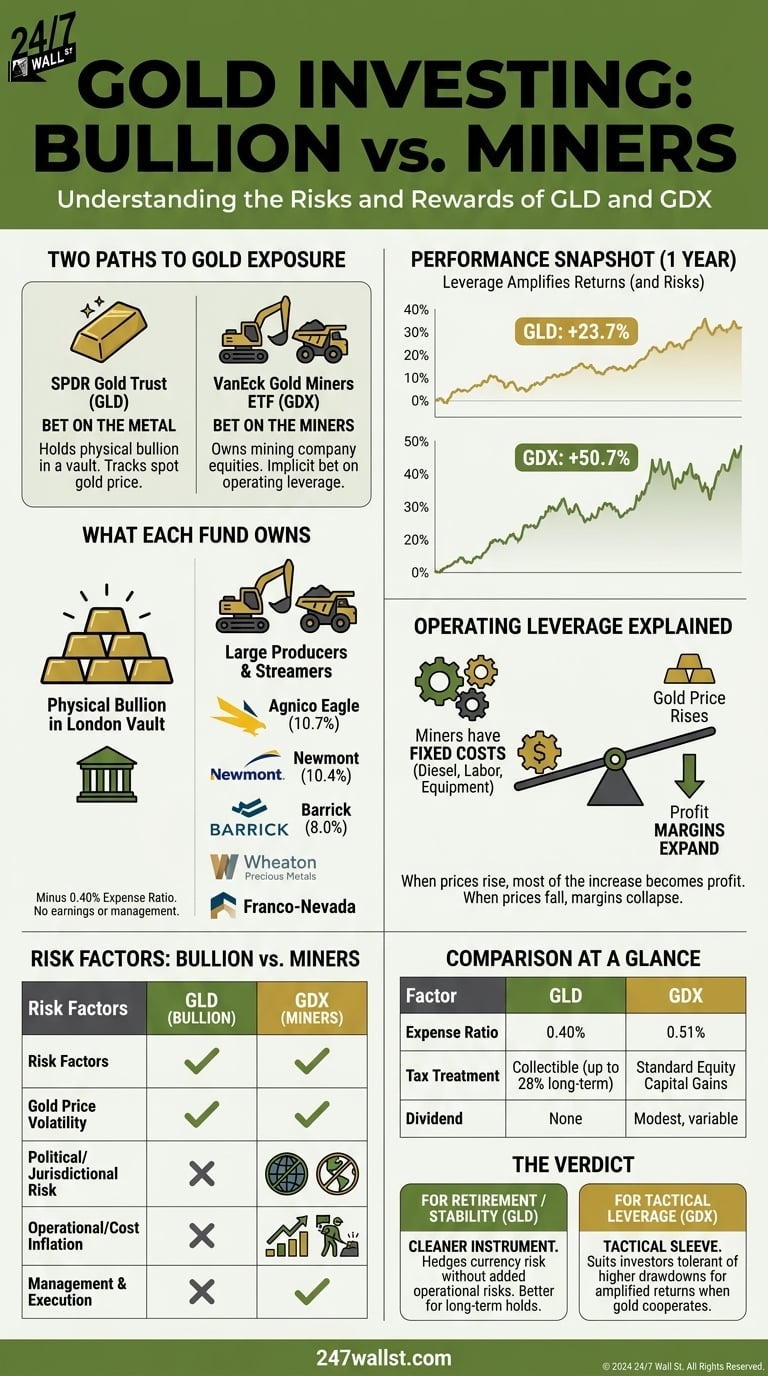
The trust is a grantor trust that holds physical bullion in a London vault. Its share price tracks spot gold minus a 0.40% expense ratio, and that is essentially the whole story. There are no earnings, no management teams, no jurisdictions to worry about. You own an ounce of gold, or a fraction of one.
The miners fund owns the operators. Its $22.75 billion in assets are concentrated mostly in a set of large producers: Agnico Eagle Mines (10.7%), Newmont (10.4%), and Barrick Mining (8.0%), followed by streaming names such as Wheaton Precious Metals and Franco-Nevada. The implicit bet is on operating leverage. A miner’s costs to pull gold from a pit are largely fixed. When the metal price rises, most of that increase drops straight to profit. When it falls, margins collapse the same way in reverse.
Where The Leverage Showed Up
Recent numbers make the mechanism concrete. Over the past year, the trust returned 23.7% while the miners fund returned 50.7%. Over one month, GLD advanced 8.4% and GDX jumped 31.8%. Zoom out five years and the pattern holds: the trust up 138.0%, the miners fund up 200.4%.
That leverage cuts both ways. In last week’s pullback, the trust slipped 4.4% and the miners fund dropped 4.7%, a modest gap. But during the 2013 gold bear market, miners fell far harder than bullion, and there is nothing in the miners fund’s construction to prevent a repeat. On Reddit’s WallStreetBets and investing forums, discussions around themes like “Is the debasement trade back?” pushed bullion sentiment to a bullish 73 reading on August 10, but retail enthusiasm has historically been a poor guide to miner drawdowns.
Risks Miners Carry That Bullion Does Not
Bullion’s one risk is the price of gold. Miners have several more. The miners fund’s holdings operate across Canada, the United States, Australia, South Africa, Mexico, Indonesia, and Peru, exposing the fund to expropriation risk, royalty changes, labor disputes, and permitting delays. Diesel and labor inflation can widen all-in sustaining costs even when gold rises. A single mine failure at a top holding can wipe out a quarter’s gains regardless of the metal.
Practical Comparison at a Glance
| Factor | GLD | GDX |
|---|---|---|
| Exposure | Physical bullion | Mining equities |
| Expense ratio | 0.40% | 0.51% |
| One-year return | 23.7% | 50.7% |
| Tax treatment | Collectible, up to 28% long-term | Standard equity capital gains |
| Dividend | None | Modest, variable |
The tax quirk matters. The trust’s collectible tax rate hits long-term holders harder than a normal equity fund would, which partly offsets its lower expense ratio in a taxable account.
Verdict
For an investor at or near retirement, the SPDR Gold Trust is the cleaner instrument. It hedges the currency-debasement risk gold is meant to hedge without adding jurisdictional accidents or cost inflation to the portfolio. The VanEck Gold Miners ETF suits a smaller, tactical sleeve for investors who can tolerate the drawdowns that come attached to the operating leverage. The one-year run should be read as a demonstration of what leverage does when gold cooperates, not a forecast; the same mechanism will define the losses when it does not.
Contact [email protected] for any questions or corrections.
Trey has been an editor and author at 24/7 Wall St. for more than a decade, where he has published thousands of articles analyzing corporate earnings, dividend stocks, short interest, insider buying, private equity, and market trends. His comprehensive coverage spans the full spectrum of financial markets, from blue-chip stalwarts to emerging growth companies.
Beyond 24/7 Wall St., Trey has created and edited financial content for Benzinga and AOL's BloggingStocks, contributing additional hundreds of articles to the investment community.
Trey's editorial expertise extends across multiple publishing environments. He served as production editor at Dearborn Financial Publishing and development editor at Kaplan, where he helped shape financial education materials. Earlier in his career, he worked as a writer-producer at SVE. His freelance editing portfolio includes work for prestigious clients such as Sage Publications, Rand McNally, the Institute for Supply Management, the American Library Association, Eggplant Literary Productions, and Spiegel.
Outside of financial journalism, Trey writes fiction and has been an active member of the writing community for years, moderating workshop sessions at regional conventions.