Musk Says a Billion Robots Will Outproduce All Humans, So Why Are Robot Funds Losing Money?
Sponsors are rushing to launch robot-themed ETFs at a pace not seen in years, betting billions on humanoid factories that do not yet exist. The funds already trading tell a very different story about who is actually winning.


Elon Musk said on September 1 that a billion humanoid robots will be more productive than all humans combined within 10 years. Two weeks later, the fund industry pushed out its third robot-themed ETF in five weeks. The catch: the robot funds already trading are losing money.
The newest launch hit the market Monday. Defiance Robotics Actuators ETF (NASDAQ:AT) charges a 0.69% net expense ratio and targets actuators, the motors and joints inside machines, rather than the robot brands themselves. If humanoid production ramps the way Musk promises, the theory goes, every arm and gripper needs precision motion hardware. Owning the suppliers avoids having to guess which robot company wins.
Launches Are Speeding Up as Returns Slide
Sponsors have rolled out three robot-themed funds since early August: Defiance China Robotics on Aug. 9, the HOID humanoid ETF on Aug. 27, and Monday’s actuator fund. That’s a striking cadence for a niche corner of the market, and a clear signal of sponsor conviction. A fund launch, though, is a bet on a theme, not proof of one.
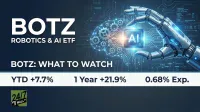
The scoreboard on funds already trading looks very different. Global X Robotics & Artificial Intelligence ETF (NASDAQ:BOTZ), the largest robotics ETF with $3.74 billion in net assets, is down 4.4% year to date and down 10.42% over five years. Its one-month return through Sept. 14 was negative 8.27%. Five years of holding a robotics fund has left investors behind cash.
The humanoid-specific fund is holding up better on the year but wobbling now. KraneShares Global Humanoid and Embodied Intelligence Index ETF (NYSEARCA:KOID) is up 16.75% over one year and down 10.61% over the past month. Its net expense ratio, per the July 31 prospectus, is 0.69%, matching the fee on the new actuator fund.
That divergence is the whole story. Investors chasing robotics have been rewarded on 12-month timeframes and punished on the longer horizons that actually decide retirement outcomes. The theme has been talked up for a decade. The stocks haven’t tracked the hype.
Inside Where the Money Actually Sits
To see what “robotics ETF” means in practice, look at BOTZ’s May 31 filing. The heaviest weights are Japanese automation stalwarts and one U.S. chipmaker: KEYENCE at 9.3%, ABB at 9.03%, FANUC at 8.98%, and NVIDIA at 8.28%. That’s the incumbent playbook: industrial automation plus AI silicon. Rounding out the top of the book are Intuitive Surgical at 6.14% and Chinese factory-automation name Shenzhen Inovance at 4.32%. It is a broad supply-chain basket, and it has trailed the S&P 500 badly.
The fund is also top-heavy. One recent ETF review noted that BOTZ carries roughly 40% of its weight in just five companies. That’s the nature of a supply chain dominated by a handful of Japanese and Swiss equipment giants. It also explains why the fund can lag the broader market for long stretches when those specific names are out of favor.
The new actuator ETF proposes a narrower cut. How narrow? Investors can’t yet say. AT’s first holdings file has not posted, so the names and concentration levels aren’t public. The prospectus is the only disclosure so far.
Why the Fee Actually Matters
The one variable retail investors fully control is cost. Both AT and KOID sit at 0.69%, which is standard for thematic ETFs but roughly seven times the fee on a plain S&P 500 index fund. For contrast, Defiance Quantum ETF (NASDAQ:QTUM), a nearby tech-theme fund from the same sponsor, charges 0.40% and is up 31.8% year to date. Thematic funds don’t move in lockstep, and fees compound whether the returns show up or not.
The bet here is that slicing the theme thinner captures more upside. HOID zooms in on humanoids. AT zooms again to the components inside them. If Musk’s timeline lands anywhere close to right, a component-level basket could compound for years. If humanoid production arrives slower than promised, concentrated theme funds tend to see the fastest outflows once the story cools.
What to Watch Next
Three markers matter from here. First, AT’s initial holdings disclosure, which will reveal whether the actuator basket leans on Japanese and German precision-motion suppliers or reaches into smaller specialists. Second, HOID’s performance since its Aug. 27 debut, which is still too fresh for a fair read. Third, flows into BOTZ, which have kept climbing even as returns haven’t: net assets rose from roughly $3.54 billion at the end of February to $3.74 billion at the end of May. Retail keeps showing up. Sponsors keep launching. The billion robots have not.
Contact [email protected] for any questions or corrections.
Jake has been been working in financial media for almost 15 years. He focuses on all things personal finance for 24/7 Wall St. with high hopes to educate and entertain. Most recently, Jake spent 12 years working various roles at The Motley Fool. He started copy editing fool.com content, worked on premium and marketing campaigns, and helped launch The Ascent, a personal finance brand.
His work has been featured on platforms like MSN, Yahoo Finance, USA Today, and more. He's written about credit cards, social security, ETFs, savings accounts, and just about anything else you can imagine when thinking about money. Jake love to cook, play golf, and tell people he's never had a cavity. (It's true!)