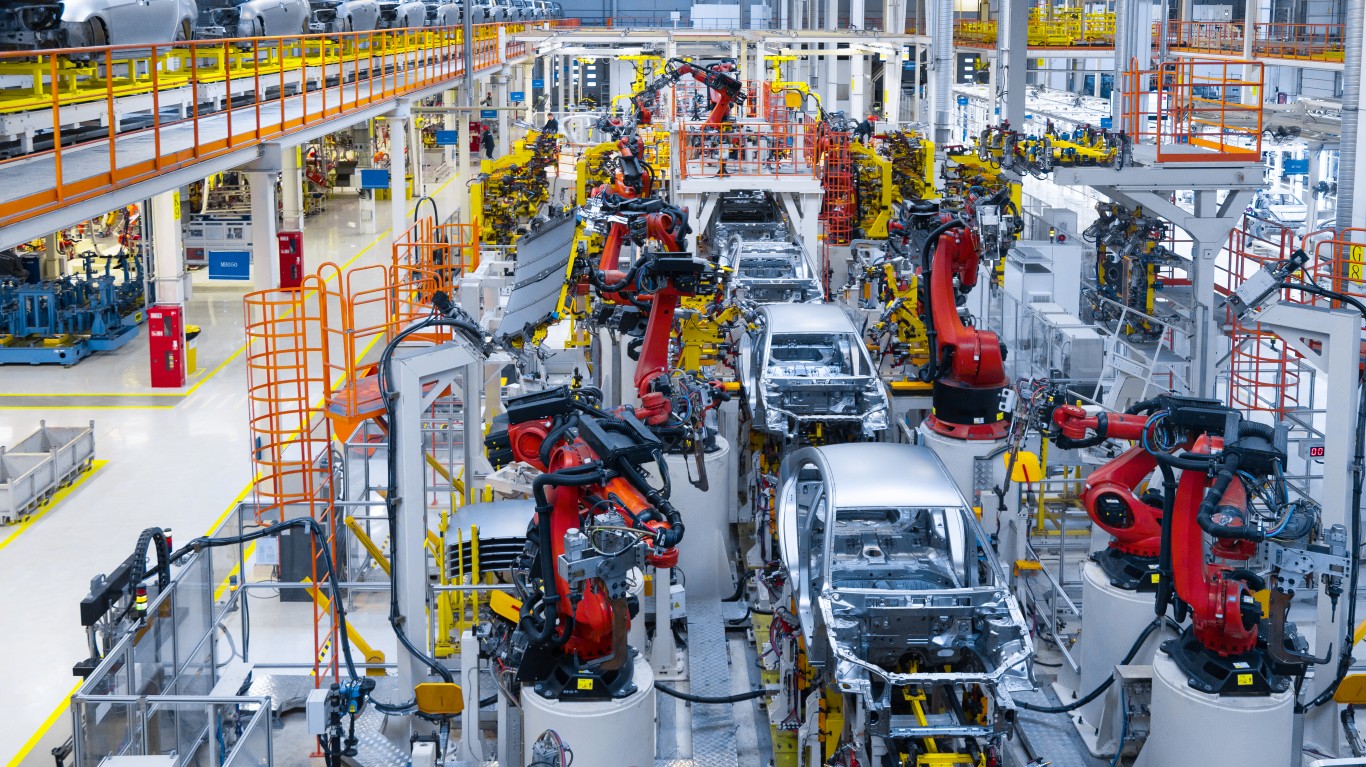
Jensen Huang Calls It the Next Wave of AI. 5 ETFs Built for the Embodied AI Era
Jensen Huang has spent the past year saying the next artificial intelligence (AI) boom will land in factories, warehouses, hospitals, and on highways, where AI gets a body. Generative AI taught machines to think in language and pixels; embodied AI…

This post may contain links from our sponsors and affiliates, and Flywheel Publishing may receive compensation for actions taken through them.

Jensen Huang has spent the past year declaring that the next artificial intelligence boom will land in factories, warehouses, hospitals, and on highways, where AI gets a body. At CES 2026, he put it bluntly: “The ChatGPT moment for physical AI is here, when machines begin to understand, reason and act in the real world.” Generative AI taught machines to think in language and pixels; embodied AI teaches them to act in the physical world through humanoids, autonomous vehicles, surgical robots, and industrial automation. The scale Huang envisions is staggering: he has publicly put the total addressable market for humanoid robots alone at $40 trillion, a figure that has reoriented how Wall Street thinks about the robotics space. For investors who want a basket rather than a single bet, five ETFs offer the cleanest way to play it:
- Global X Robotics & Artificial Intelligence ETF (NASDAQ: BOTZ)
- ARK Autonomous Technology & Robotics ETF (NYSEARCA: ARKQ)
- ROBO Global Robotics and Automation Index ETF (NYSEARCA: ROBO)
- First Trust Nasdaq Artificial Intelligence and Robotics ETF (NASDAQ: ROBT)
- ROBO Global Artificial Intelligence ETF (NYSEARCA: THNQ)
These five split into two camps. BOTZ, ROBO, and ARKQ tilt toward the physical hardware that gives AI its body: actuators, sensors, and chassis. ROBT and THNQ lean into the software brains and compute layer that make embodied systems intelligent. Most investors will want exposure to both sides of that divide.
BOTZ: The household-name pure-play
BOTZ is the fund most retail investors reach for first when they hear “robotics ETF,” and that name recognition translates into genuine liquidity when moving size without slippage. The fund concentrates on global leaders in industrial automation, surgical robotics, and AI semiconductors. Core holdings include NVIDIA, Intuitive Surgical, ABB, Keyence, and Fanuc, a mix that maps directly onto what Huang describes as embodied AI in action: factory arms learning from simulation, da Vinci systems operating in hospitals, and chips coordinating the whole stack.
The case for BOTZ is structural, though recent performance has been more measured than many investors expect. Shares trade near $36, with a one-year return of roughly 11% and a slightly negative year-to-date figure as of mid-2026. The fund concentrates returns heavily in a handful of Japanese and Swiss automation giants, so it behaves more like a focused industrial-growth fund than a diversified theme play. NVIDIA’s June 2026 momentum is visible inside the portfolio: on June 1, 2026, the company announced the Isaac GR00T Reference Humanoid Robot at GTC Taipei, an open platform built on NVIDIA Jetson Thor compute and the Isaac GR00T software stack. The design pairs a Unitree H2 Plus chassis with Sharpa Wave five-finger hands and is aimed at academic research institutions, with Ai2, ETH Zurich, Stanford Robotics Center, and UC San Diego already committed to using it. Several of BOTZ’s core holdings sit directly inside that supply chain.
ARKQ: The aggressive active bet on humanoids and autonomy
If BOTZ is the index approach, ARKQ is the conviction approach. Cathie Wood’s team runs ARKQ as an actively managed fund that invests at least 80% of assets in autonomous technology and robotics companies focused on disruptive innovation in automation, transportation, energy, AI, and materials. The portfolio reads like a who’s who of embodied AI: Tesla at roughly 10%, Teradyne about 8%, AMD above 6%, plus Kratos Defense, Rocket Lab, Deere, and Palantir.
The Tesla weighting is the heart of the bull case. If Optimus humanoids and full self-driving move from demo to revenue, ARKQ carries more direct exposure than any other broad robotics ETF. That bet has paid off recently: the fund has returned roughly 72% over the past year and over 14% year to date, with 39% of the portfolio in industrials and 32% in information technology by sector.
Volatility is the price of that outperformance. ARKQ is concentrated and high-beta, with approximately $2.1 billion in assets and meaningful Tesla single-name risk. When the embodied AI narrative hits turbulence, this fund falls harder and faster than its passive peers.
ROBO: The picks-and-shovels diversifier
ROBO was the original robotics ETF and still offers the broadest exposure across the value chain. Its modified equal-weight methodology spreads risk across sensors, actuators, compute, and end-market applications, with about 43% in information technology and 46% in industrials. Geographically, the fund leans on the United States at 39% and Japan at 21%, capturing the two most important industrial automation ecosystems in the world.
Top weights include companies like Harmonic Drive Systems, Hiwin Technologies, Ambarella, Infineon, and Jenoptik, alongside smaller positions in NVIDIA, Rockwell Automation, and Fanuc. That mix represents the picks-and-shovels of embodied AI: semiconductor test equipment, factory automation, and motion control that every humanoid and autonomous machine depends on regardless of which brand wins the platform battle. With approximately $2.1 billion in net assets, ROBO has returned about 52% over the past year and roughly 22% year to date.
The tradeoff is the flip side of diversification. Because no single name dominates the portfolio, ROBO will lag a concentrated winner like ARKQ in years when one or two stocks run far ahead of the pack. Investors who prize consistency over peak performance will find that an acceptable bargain.
ROBT: The balanced AI-and-robotics blend
ROBT tracks a Nasdaq index that deliberately splits holdings into AI “enablers,” “engagers,” and “enhancers,” giving investors both brains and bodies in a single wrapper. The tiered weighting tilts the fund more toward AI software than ROBO or BOTZ while preserving meaningful robotics hardware exposure. That structure sidesteps the question of whether embodied AI’s value will accrue to chipmakers, model builders, or robot OEMs. The honest answer is some of each, and ROBT declines to force a choice.
Performance has been the most muted of the five. Shares trade near $54, up about 19% over the past year but less than 4% year to date. By spreading evenly across tiers, the fund captures less upside when any single sub-theme surges, which explains why it has trailed more concentrated peers during the current run in humanoid and autonomous vehicle names.
THNQ: The overlooked compute-layer pick
THNQ is the unconventional choice on this list, the one most readers will not find on a basic robotics screen. As the AI-pure-play sibling to ROBO, it covers cloud compute, semiconductors, AI software, and applied AI in healthcare and business processes. A humanoid without a foundation model is little more than a mannequin. The training compute, inference chips, and vision-language models that make a robot useful all live inside the names THNQ holds.
The scale of that compute buildout is accelerating beyond even the most bullish projections. NVIDIA’s Data Center revenue reached $75.2 billion in Q1 FY2027, up 92% year over year, driven by surging Blackwell architecture demand across hyperscalers and industrial customers. Then, on August 26, 2026, NVIDIA reported Q2 FY2027 results that topped every prior record: total revenue of $96.2 billion, up 106% from a year earlier, with Data Center revenue of $89.0 billion, up 117% year over year. The company guided Q3 FY2027 revenue to $108.0 billion. That sustained pace of growth underscores the argument that the compute layer is not a one-quarter story.
The market is catching on to the compute connection. THNQ has returned over 54% over the past year and roughly 23% year to date, with a five-year gain of 1,065%. The fund carries approximately $398 million in assets, making it the smallest of the five by that measure, but momentum in AI compute has driven outsized inflows in recent quarters. One caveat worth noting: THNQ is technically an AI fund, not a robotics fund. In a year when physical robotics underperforms software, it will diverge from BOTZ and ROBO in ways that can surprise investors expecting close tracking.
How to choose among them
The decision comes down to which slice of the embodied AI stack an investor believes will capture the most value, and over what time horizon. Someone who wants clean, liquid robotics exposure and is comfortable with concentrated industrial automation should start with BOTZ. An investor with conviction in Tesla’s Optimus program and a higher risk tolerance will find ARKQ the most direct expression of that view, and the fund’s recent one-year performance reflects how strongly the market has rewarded that bet so far. Those who prefer broad, equal-weight diversification across the robotics value chain belong in ROBO, with its wide coverage of sensors, actuators, and motion control.
ROBT suits investors who do not want to pick between hardware and software and are willing to accept more modest peaks in exchange for a balanced ride. THNQ works best as a complement to the hardware-tilted funds. Pairing it with BOTZ or ROBO gives exposure to both bodies and brains, which more closely mirrors how Huang has framed the opportunity. During his Seoul visit in June 2026, Huang told Hyundai Motor Group employees directly: “This is truly your time,” pointing to the convergence of physical AI and the company’s manufacturing expertise. He has used similar language across his appearances in Taipei and Seoul. Embodied AI is a credible multi-year thesis, and these five funds are the cleanest ways to express it without concentrating the outcome on any single stock.
Editor’s note: This pass adds NVIDIA’s Q2 FY2027 results (revenue $96.2 billion, Data Center revenue $89.0 billion, up 117% year over year, with Q3 guidance of $108.0 billion, reported August 26, 2026) to the THNQ section, and adds context on the Isaac GR00T Reference Humanoid Robot’s academic research mission and the institutions committed to adopting it.
Contact [email protected] for any questions or corrections.
Trey has been an editor and author at 24/7 Wall St. for more than a decade, where he has published thousands of articles analyzing corporate earnings, dividend stocks, short interest, insider buying, private equity, and market trends. His comprehensive coverage spans the full spectrum of financial markets, from blue-chip stalwarts to emerging growth companies.
Beyond 24/7 Wall St., Trey has created and edited financial content for Benzinga and AOL's BloggingStocks, contributing additional hundreds of articles to the investment community.
Trey's editorial expertise extends across multiple publishing environments. He served as production editor at Dearborn Financial Publishing and development editor at Kaplan, where he helped shape financial education materials. Earlier in his career, he worked as a writer-producer at SVE. His freelance editing portfolio includes work for prestigious clients such as Sage Publications, Rand McNally, the Institute for Supply Management, the American Library Association, Eggplant Literary Productions, and Spiegel.
Outside of financial journalism, Trey writes fiction and has been an active member of the writing community for years, moderating workshop sessions at regional conventions.