QQQ Is Almost Half In 10 Stocks. This Nasdaq ETF Caps Every One at 1%

This post may contain links from our sponsors and affiliates, and Flywheel Publishing may receive compensation for actions taken through them.

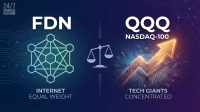
The Invesco QQQ Trust (QQQ) has increasingly become a bet on the artificial intelligence (AI) boom, or bubble, depending on your perspective, continuing to grow. As of November 11, its 10 largest holdings accounted for 46.46% of the portfolio, with all seven Magnificent Seven stocks represented.
That’s a considerable amount of concentration for an ETF holding 100 companies. While the Nasdaq-100 provides exposure to some of the world’s most innovative businesses, its market-cap-weighted methodology means a relatively small number of trillion-dollar technology companies can have an outsized influence on returns. If those companies continue delivering strong earnings growth, that’s great. But if AI spending disappoints or valuations contract, QQQ could face significant pressure even if many of its other holdings perform reasonably well.
Fortunately, investors who like the Nasdaq-100’s methodology and constituent companies but don’t want their fortunes tied to a handful of stocks have another option: the Direxion Nasdaq-100 Equal Weighted Index Shares (QQQE). It’s one of Direxion’s relatively few ETFs that don’t use leveraged or inverse strategies, and I think it’s particularly noteworthy today given the growing concerns surrounding concentration risk in the U.S. equity market.
What Is QQQE?
QQQE is a passively managed ETF tracking the Nasdaq-100 Equal Weighted Index. It charges a 0.35% expense ratio and provides exposure to essentially the same companies as QQQ, but with a fundamentally different weighting methodology.
Instead of allocating more capital to companies with larger market capitalizations, QQQE gives each of the Nasdaq-100’s constituents an approximately 1% weight at its quarterly rebalance. That means a trillion-dollar Magnificent Seven company receives the same initial allocation as one of the smaller companies in the index.
The practical effect is that QQQE dramatically reduces single-stock concentration. Its 10 largest holdings would account for approximately 10% of the portfolio immediately after an equal-weight rebalance, compared with QQQ’s 46.46% concentration as of November 11. Actual weights can drift between rebalances as share prices move.
There’s another important consequence of this methodology: systematic rebalancing. Every quarter, the index trims companies whose share prices have appreciated enough to push their weights above 1% and adds to those whose weights have fallen below that threshold.
In effect, it’s a systematic way of selling relative winners and buying relative laggards. That can be beneficial when market leadership broadens beyond the largest companies or when previously overlooked Nasdaq-100 constituents begin outperforming.
Of course, this approach introduces additional turnover. Rebalancing 100 stocks toward equal weights every quarter can require considerably more trading than simply allowing market capitalizations to determine portfolio weights. In a conventional mutual fund, that turnover could create substantial realized capital gains that must be distributed to shareholders.
Fortunately, the ETF structure provides a potential tax-efficiency advantage through in-kind creation and redemption transactions, which can help managers remove appreciated securities without realizing taxable gains at the fund level. The ETF structure helps mitigate one of the traditional disadvantages of frequent portfolio rebalancing.
Is QQQE Worth It?
I think QQQE makes sense for investors with a particular investment thesis. Suppose you believe that Nasdaq-100 companies, collectively, will continue investing heavily in research and development, introducing innovative products, and growing revenues and earnings faster than the broader S&P 500. But you’re less comfortable with the idea that a handful of Magnificent Seven companies should determine almost half your portfolio’s performance.
QQQE offers a reasonable compromise. You retain exposure to the Nasdaq-100’s growth-oriented businesses while spreading your capital much more evenly across its constituents. And so far in 2026, that approach has been working. As of November 13, QQQ had gained 10.89% year-to-date on a price-return basis. QQQE, meanwhile, was up 13.17%.
The comparison suggests that investors haven’t necessarily needed to concentrate in the largest Nasdaq-100 companies to participate in this year’s market gains. Broader participation among smaller index constituents has helped QQQE outperform. However, there are two disadvantages worth considering.
The first is cost. QQQE charges 0.35%, compared with QQQ’s 0.18%. That 17-basis-point difference is a recurring drag on performance, and it compounds over time. While neither expense ratio is particularly excessive for an equity ETF, QQQE needs its alternative weighting methodology to generate enough additional performance to justify the higher fee.
The second is that equal weighting systematically prevents winners from running indefinitely. One of the biggest advantages of market-cap weighting is that successful companies naturally become larger parts of the portfolio as their valuations rise. Investors don’t need to predict which businesses will become the next market leaders.
That characteristic was particularly beneficial during the past decade, when a relatively small group of U.S. technology companies generated an enormous share of the market’s gains. QQQE, by contrast, repeatedly trims those outperformers back toward 1%. If the Magnificent Seven continue dominating, that rebalancing discipline could become a significant disadvantage.
But that’s the past decade. The next one could look very different. Market leadership can broaden, valuations can change, and companies that previously lagged can become the next sources of growth. Equal weighting gives those smaller Nasdaq-100 constituents a much greater opportunity to influence portfolio returns.
Contact [email protected] for any questions or corrections.
Tony Dong is the founder of ETF Portfolio Blueprint. He also serves as Lead ETF Analyst for ETF Central, a partnership between Trackinsight and the NYSE.
Tony’s work focuses on ETF strategy, portfolio construction, and risk management, with an emphasis on making complex investment concepts accessible to everyday investors. His insights and analysis have also appeared in U.S. News & World Report, Kiplinger, MoneySense, and The Motley Fool.
Tony holds a Master of Science degree in enterprise risk management from Columbia University and the Certified ETF Advisor (CETF) designation from The ETF Institute.