Vanguard’s Overlooked Quality ETF Screens Out Weak Balance Sheets, and a Manager Picks the Stocks, Not an Index

This post may contain links from our sponsors and affiliates, and Flywheel Publishing may receive compensation for actions taken through them.
If your retirement savings sit in a Vanguard S&P 500 fund, you own America’s largest companies in proportion to their size, whatever their finances look like. Vanguard U.S. Quality Factor ETF (CBOE:VFQY) works differently. It screens for financially strong companies, and it is actively managed instead of tracking an index. This year, that approach has pulled ahead of both Vanguard S&P 500 ETF (NYSEARCA:VOO) and the best-known fund in the category, iShares MSCI USA Quality Factor ETF (CBOE:QUAL).
How Vanguard Actually Selects VFQY’s Stocks
According to Morningstar, the fund buys stocks with “strong fundamentals as determined by the advisor” and keeps at least 80% of net assets in U.S. quality stocks. Vanguard’s fact sheet shows that the advisor uses a rules-based quantitative model to evaluate U.S. common stocks. So the stock picking is systematic: a model scores the companies, and Vanguard runs the portfolio around those scores. The fund measures itself against the Russell 3000 Index.
What “Quality” Means, in Plain Terms
Vanguard measures quality using operating profitability, gross profitability, change in net operating assets, and intangibles intensity for non-financial stocks, and operating profitability and equity issuance for financial stocks. Put simply, the model favors companies that earn strong profits on their assets, grow without swelling their balance sheets, and lean less on hard-to-value intangibles. Vanguard says it targets strong operations, earnings, and balance-sheet quality. In practice, screening out weak balance sheets means companies that fund growth by issuing stock or piling up assets get scored down.
A Flatter Portfolio Than the Famous Funds
In the fund’s August 31, 2026[1] holdings filing, the larger disclosed positions include Fortinet (NASDAQ:FTNT | FTNT Price Prediction) at 1.65% of net assets and Gilead Sciences (NASDAQ:GILD) at 1.54%. Its exposure ranges across technology, health care, financials, industrials, consumer, energy, and materials. Many smaller retailers and industrial suppliers sit well below 0.5% each. Vanguard says the portfolio spans large, mid, and small market caps.
QUAL is far more top-heavy. Its single largest position made up 7.16%[2] of net assets as of July 31, 2026, and its three biggest megacap tech holdings each exceeded 5.85%.
Performance and Size Side by Side
All figures below are price changes, adjusted, through November 23, 2026.
| Return | VFQY | QUAL | VOO |
|---|---|---|---|
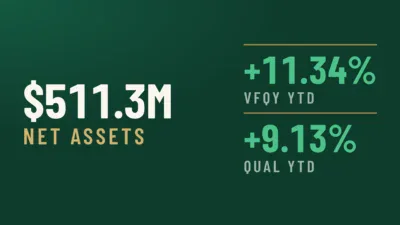
| Year to date | 11.34% | 9.13% | 6.85% |
| One year | 15.88% | 13.25% | 10.9% |
| Five years | 42.22% | 57.4% | 65.1% |
As of August 31, 2026, VFQY had $511.3 million in net assets. For comparison, QUAL had approximately $46.5 billion as of July 31, 2026. VOO charges 0.03% a year. VFQY’s current expense ratio sits at 0.13%.
Risks Retirees Should Weigh
- Long periods of lagging: Over five years, VFQY’s gain trailed VOO’s by a wide margin, as the table shows. Quality stocks can fall behind when speculative, unprofitable growth stocks lead the market.
- Taxable distributions: Active rebalancing can mean higher turnover, which can generate capital gains in taxable accounts.
- Volatility: A deeper reach into small caps can mean bigger swings. Over the past month, VFQY fell 3.92%.
Why So Few Investors Have Heard of It
VFQY launched on February 13, 2018, decades after Vanguard’s flagship index funds. Morningstar reported that Vanguard modified the approach in 2023 to deliver more consistent quality exposure, so the current strategy has a short record. Size matters too. Net assets grew from $462.9 million at the end of May to $511.3 million at the end of August, still a sliver of QUAL’s asset base.
Who VFQY Could Suit
VFQY could fit retirees who already own a broad index fund and want a complement shifted toward profitable, conservatively financed companies of all sizes, with less dependence on a handful of megacaps. It suits investors less well if they want the lowest possible cost, hate trailing the S&P 500 for years at a time, or hold mostly taxable accounts. Going forward, keep an eye on whether this year’s lead over VOO holds up and whether assets keep growing.
Contact [email protected] for any questions or corrections.
Ryne Mauck is an investment writer covering exchange-traded funds, retirement planning, and portfolio strategy. Through his work at 24/7 Wall St. and other investment platforms, including Seeking Alpha, he aims to provide clear, research-driven insights that help investors make more informed decisions while maintaining a long-term approach to investing.
Ryne holds a B.Sc. in Finance and an M.A. in Political Science. He is a formerly registered Municipal Advisor Representative and has passed the Series 50, Series 63, and Series 65 exams. His articles are not intended to be, nor should they be interpreted as, financial advice.