EWY Is a Bet on South Korea. $129,525 of Every $300,000 Sits in Two Chipmakers

This post may contain links from our sponsors and affiliates, and Flywheel Publishing may receive compensation for actions taken through them.
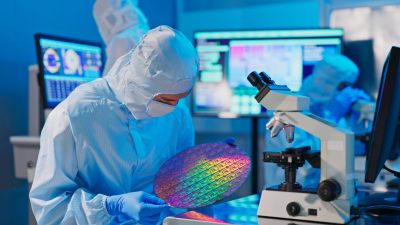
A South Korea fund bought for international diversification may depend on two companies for most of its performance. In the iShares MSCI South Korea ETF (NYSEARCA:EWY) SEC portfolio holdings filing as of August 31, 2026, Samsung Electronics and SK hynix together made up 43.17% of net assets. On a hypothetical $300,000 position, that puts $129,525 in two chipmakers.
Two Companies Hold Nearly Half Your Korea Money
Samsung Electronics accounted for 22.21% of the fund, or $66,635 of that hypothetical $300,000. SK hynix accounted for 20.96%, or $62,890. Both weights are as of August 31, 2026.
You also pay for that exposure. EWY’s fact sheet as of September 30, 2026 lists a 0.59% expense ratio. That comes to $59 a year per $10,000 committed, or $1,770 a year on $300,000. The fund charges it every year, whatever the chip cycle does.
Samsung Appears on Two Lines
Two separate lines of Samsung Electronics shares appear in the filing. The first takes a 22.13% weight. The second, a different share class, takes 0.08%. The combined weight is 22.21%. The two lines have different ISINs (security identification codes), but both are Samsung Electronics. When Samsung’s results shift, both lines feel it.
How Few Stocks Drive EWY
All told, the filing listed 82 positions, and that count includes cash, Korean won, and a KOSPI futures contract[1] alongside stocks. Below the two chipmakers, weights drop quickly.
The September 30 fact sheet put information technology at 51.56% of the fund. iShares markets EWY as a way to “express a single-country view,” yet one sector makes up most of the portfolio.
Why Country Funds End Up Lopsided
EWY’s benchmark is the MSCI Korea 25/50 Index. Country indexes like this one generally weight companies by market value (share price times shares available). The biggest companies get the biggest slices. In markets where a handful of giants dominate the exchange, a fund tracking that market ends up holding those giants in size.
What Retirement Savers Actually Own
When two chipmakers take this much of a fund, the memory-chip cycle can move the entire fund. Strong demand for memory can lift EWY. A pricing slump or a weak period at either company can drag it down, whatever Korean banks, automakers or shipbuilders are doing. For someone a few years from retirement, that is sector risk under a country label.
The fact sheet shows how much the fund swings. It lists a three-year standard deviation (a measure of price swings) of 42.81% and a three-year beta of 1.98 against the S&P 500. Simply put, EWY has moved far more sharply than the U.S. market.
Concentration Cuts Both Ways
Recently, concentration has paid off. EWY rose 55.58% over the year ending November 23, 2026. It also fell 10.27% over the month ending the same day. The same concentration drives both the gains and the losses.
EWY reveals all of this. iShares publishes its holdings, and the SEC filing lists every position. The gap lies between what holders assume they own and what the fund actually holds. Weights also change. By the September 30 fact sheet, SK hynix stood at 23.72% and Samsung Electronics at 22.77%. The filing figures in this article are as of August 31, 2026.
Questions to Ask Before You Buy a Country Fund
Before adding a single-country fund, pull up its top holdings and their weights. Then look at your other funds. If a global, emerging-markets, or technology fund already has Samsung, SK hynix, or other memory-chip makers, you may hold the same industry several times over. Ask yourself whether you want broad exposure to Korea’s economy, or a concentrated position in two chipmakers with the rest of Korea attached.
Contact [email protected] for any questions or corrections.
Ryne Mauck is an investment writer covering exchange-traded funds, retirement planning, and portfolio strategy. Through his work at 24/7 Wall St. and other investment platforms, including Seeking Alpha, he aims to provide clear, research-driven insights that help investors make more informed decisions while maintaining a long-term approach to investing.
Ryne holds a B.Sc. in Finance and an M.A. in Political Science. He is a formerly registered Municipal Advisor Representative and has passed the Series 50, Series 63, and Series 65 exams. His articles are not intended to be, nor should they be interpreted as, financial advice.