One Vanguard ETF Hunts for Stocks That Are Cheap, Rising, and Financially Strong All at Once. Almost Nobody Owns It

This post may contain links from our sponsors and affiliates, and Flywheel Publishing may receive compensation for actions taken through them.
Retirement savers holding a Vanguard S&P 500 or total market fund own every big company, no matter its price, trend, or balance sheet. Vanguard U.S. Multifactor ETF (CBOE:VFMF) is more selective. It looks for stocks with three traits at once: cheap (value, meaning a low price relative to fundamentals), going up (momentum, meaning strong recent performance), and financially strong (quality, meaning solid fundamentals). This year, that approach has pulled well ahead of the index fund most retirees already own.
How Vanguard Picks the Stocks
According to Vanguard, the fund’s advisor “uses a rules-based quantitative model to evaluate U.S. common stocks.” The model first removes the 20% most volatile names within each market cap grouping. It then picks stocks by their equally weighted ranking across momentum, quality, and value. Value is measured with book value, forward earnings, and operating cash flow relative to price. Quality is measured with return on equity, gross profitability, and leverage, among other inputs. The portfolio is rebalanced as needed to keep its factor exposure consistent.
VFMF is an actively managed fund. Vanguard calls factor funds “a form of actively managed funds,” and VFMF belonged to the suite Vanguard introduced as its first actively managed ETFs. It measures itself against the Russell 3000 Index.
Three Vanguard Factor Funds Rolled Into One
Vanguard also runs separate single-trait funds: Vanguard U.S. Value Factor ETF, Vanguard U.S. Momentum Factor ETF and Vanguard U.S. Quality Factor ETF. VFMF mixes all three ideas in one fund. Vanguard warns that “factor returns can be cyclical, so you could experience sharp and lengthy periods of underperformance compared with the broader stock market.” Blending the three means the fund’s results don’t depend on any single trait staying in favor.
Holdings Reach Deep Into Mid and Small Caps
According to Vanguard, the fund holds hundreds of names across large, mid, and small companies. The S&P 500, tracked by Vanguard’s S&P 500 ETF (NYSEARCA:VOO), is made up of large-capitalization stocks. In VFMF’s August 31, 2026 portfolio filing, the largest positions are ConocoPhillips (NYSE:COP) at 0.92%, EOG Resources (NYSE:EOG) at 0.92%, and Dell Technologies (NYSE:DELL | DELL Price Prediction) at 0.88%. Next come Altria, Bristol-Myers Squibb, and Johnson & Johnson. Those top weights lean toward energy and healthcare, and the same filing includes small regional banks such as ACNB and Amerant Bancorp. Apple makes up only 0.34%[1] of the fund. A full sector breakdown can be viewed on Vanguard’s fund page.
Returns Have Outpaced VOO This Year
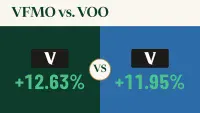
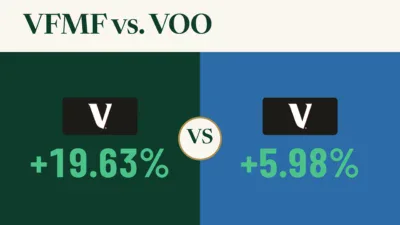
Both funds below are measured on the same basis (price change with dividends included) through November 25, 2026.
| Metric | VFMF | VOO |
|---|---|---|
| Year to date | 19.63% | 5.98% |
| One year | 22.84% | 7.39% |
| Five years | 84.65% | 67.39% |
| Expense ratio | 0.18% | 0.03% |
Over the past month, VFMF fell 5.43%, while VOO fell 6.33%.
Why So Few Investors Know About It
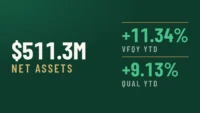
VFMF launched on February 13, 2018, and had $1.065 billion in net assets as of September 30, 2026. VOO reports $1 trillion. Trading volume shows a similar gap. On November 25, 97,395 VFMF shares changed hands, compared with 14,595,845 VOO shares. Assets are growing, though. Net assets rose from $641.9 million at the end of May to $976.2 million at the end of August.
Risks to Weigh Before Moving Money
- Long stretches of lagging: since inception, VFMF has returned an average of 12.51% a year at NAV, compared with 14.21% for the Russell 3000 through September 30.
- Taxes: active management can mean higher turnover and taxable distributions in brokerage accounts.
- Volatility: a tilt toward smaller companies can make returns bumpier.
- Trading costs: low volume can mean wider bid-ask spreads. Limit orders can help manage that cost.
Who VFMF Could Suit
Factor funds are not expected, in Vanguard’s words, “to serve as your core investment.” VFMF fits a retiree who already has a broad index fund and wants a modest satellite position that leans away from the market’s largest stocks, and who can stay patient through years of trailing. Investors seeking the lowest possible cost, simple tax reporting, or a fund that never strays far from the S&P 500 will find it a weaker match. If you consider it, watch its next fact sheet for turnover and whether this year’s lead over the broad market holds.
Contact [email protected] for any questions or corrections.
Ryne Mauck is an investment writer covering exchange-traded funds, retirement planning, and portfolio strategy. Through his work at 24/7 Wall St. and other investment platforms, including Seeking Alpha, he aims to provide clear, research-driven insights that help investors make more informed decisions while maintaining a long-term approach to investing.
Ryne holds a B.Sc. in Finance and an M.A. in Political Science. He is a formerly registered Municipal Advisor Representative and has passed the Series 50, Series 63, and Series 65 exams. His articles are not intended to be, nor should they be interpreted as, financial advice.