Vanguard’s Little-Known Value ETF Skips the Index and Goes Straight for the Cheapest Stocks

This post may contain links from our sponsors and affiliates, and Flywheel Publishing may receive compensation for actions taken through them.
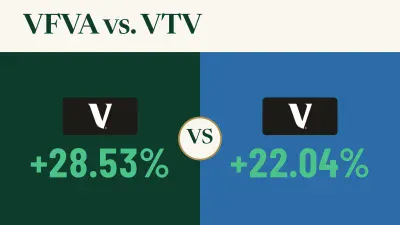
There’s a good chance your Vanguard value fund is the Vanguard Morningstar Value ETF (NYSEARCA:VTV). According to Vanguard, VTV “seeks to track the performance of a benchmark index that measures the investment return of large-capitalization value stocks.” Its far smaller sibling, the Vanguard U.S. Value Factor ETF (CBOE:VFVA), is actively managed. It launched as part of a group of six factor ETFs that Vanguard described as “the firm’s first actively managed ETFs in the U.S.” Over the past year, that approach has paid off.
How VFVA Hunts for Bargains
Vanguard says factor funds are “a form of actively managed funds” that by design tilt toward certain stock traits using “a transparent, rules-based approach.” For VFVA, the trait is “relatively lower share prices relative to their fundamental values.” Put simply, a quantitative model sorts U.S. stocks of every size and favors the ones that look cheapest against business fundamentals such as earnings or book value.
VTV works from a fixed rulebook. It holds whatever its large-cap value benchmark holds.
Inside a Flat, Deep-Value Portfolio
VFVA’s most recent holdings filing, from August 31, 2026[1], shows a widely spread portfolio. The largest position, Bristol-Myers Squibb (NYSE:BMY), made up just 0.86%[2] of assets. Next came EOG Resources (NYSE:EOG) at 0.83%[2] and AT&T (NYSE:T) at 0.78%. Together, the 10 largest holdings added up to only about 7.04% of the fund.
The top of the list leans toward health insurance companies, drugmakers, oil producers, telecom, and media. Further down, the fund holds dozens of small regional banks and little-known issuers, many at weights below 0.03%[2]. That’s how VFVA reaches into mid- and small-caps. VTV’s objective limits it to large-capitalization stocks.
Cost, Income and Returns Side by Side
The returns below are dividend-adjusted price changes, with both funds measured through November 18, 2026.
| Metric | VFVA | VTV |
|---|---|---|
| 1-year change | 28.53% | 22.04% |
| Year-to-date change | 19.97% | 17.63% |
| 5-year change | 69.76% | 74.71% |
| Trailing 12-month distributions | $2.8546 | $4.1646 |
| Trailing yield | 1.82% | 1.88% |
On cost, VTV charges 0.03% a year, according to its fact sheet. VFVA’s fee is posted at 0.13%. Active strategies usually cost more than index trackers. The two funds pay distributions quarterly, and their yields are close enough that income alone shouldn’t decide the choice.
Risks Retirees Shouldn’t Overlook
Value stocks are sometimes cheap for good reason. A shrinking business can look like a bargain on paper and keep falling, which is what investors call a value trap. Value can also trail growth for years. Vanguard warns that factor funds carry “significantly more risk than you’d experience investing in the broader stock market” and that investors “could experience sharp and lengthy periods of underperformance.”
The smaller-company tilt adds volatility. In the past week, VFVA fell 4.32%, compared with VTV’s 3.81% drop. Over five years, it still trails VTV.
Why So Few Investors Have Found It
Size is the main reason. VFVA held $956.6 million in net assets as of August 31, up about 15.8% from $825.9 million three months earlier. Trading activity is thin too. On November 18, 76,903 VFVA shares changed hands, compared with 2,370,692 for VTV, about 31 times as many.
Which Investors VFVA Suits Best
VFVA is designed for a satellite role next to a core position like VTV, and its profile aligns with investors who have a long time horizon, want cheaper, smaller companies in the mix, and can stand years of lagging returns. For investors drawing on the money within a few years, seeking the lowest possible fee, or needing steady, predictable returns, the large-cap index fund’s lower cost and large-cap focus line up more closely with those needs.
Investors should watch for VFVA’s next distribution. In recent years, the fund has gone ex-dividend in late December, including on December 23, 2025. The next holdings filing will also show whether this year’s rally has changed the model toward different corners of the market.
Contact [email protected] for any questions or corrections.
Ryne Mauck is an investment writer covering exchange-traded funds, retirement planning, and portfolio strategy. Through his work at 24/7 Wall St. and other investment platforms, including Seeking Alpha, he aims to provide clear, research-driven insights that help investors make more informed decisions while maintaining a long-term approach to investing.
Ryne holds a B.Sc. in Finance and an M.A. in Political Science. He is a formerly registered Municipal Advisor Representative and has passed the Series 50, Series 63, and Series 65 exams. His articles are not intended to be, nor should they be interpreted as, financial advice.