I’m 47 and Make $140k a Year. Am I Crazy to Think I Shouldn’t Be Paying for My Kids’ College?
The cost of a college education is staggering, and the debt students carry is a direct result of overly abundant government grants and loans driving tuition higher through the passthrough rate. According to the Federal Reserve Bank of New York,…

This post may contain links from our sponsors and affiliates, and Flywheel Publishing may receive compensation for actions taken through them.

The cost of a college education has become genuinely staggering. The debt burden students carry is, in large part, a product of overly abundant government grants and loans operating through a well-documented economic mechanism called the passthrough rate.
According to the Federal Reserve Bank of New York, for every $1 increase in the maximum amount of federally subsidized student loans, college tuition rises $0.60. The logic is straightforward: more federal money flowing into higher education gives colleges cover to raise prices, because students can simply borrow more to pay them.
Americans now owe $1.866 trillion in federal and private student loan debt as of March 2026, spread across approximately 42.6 million borrowers. That total ranks as the second-largest category of consumer debt in the country, behind only mortgages. The problem has grown not just in size but in severity: about 9 million borrowers holding $220 billion in loans were in default as of early 2026, representing more than 13% of the federally managed portfolio. That weight saps the financial security of students and parents alike, and more families are now asking whether it still makes sense for a parent to foot the bill at all.
That question was front and center for a Redditor on r/DaveRamsey, a community built around the personal finance principles of Dave Ramsey. The poster did not want to undermine his child’s opportunities, but he also could not ignore the damage that more debt would do to his own already precarious finances.
24/7 Wall St. Key Points:
- The ever-rising cost of college tuition has bankrupted the future of children and parents alike, with national student loan debt climbing to $1.866 trillion.
- Parents often find themselves choosing between paying for college and financing their retirement, a dilemma compounded by strict new borrowing caps.
- Prioritizing college over retirement planning can foster a child’s sense of entitlement while potentially ruining the chance for a secure financial future for both.
The 2026 Reality: Gen X Is Bearing the Brunt
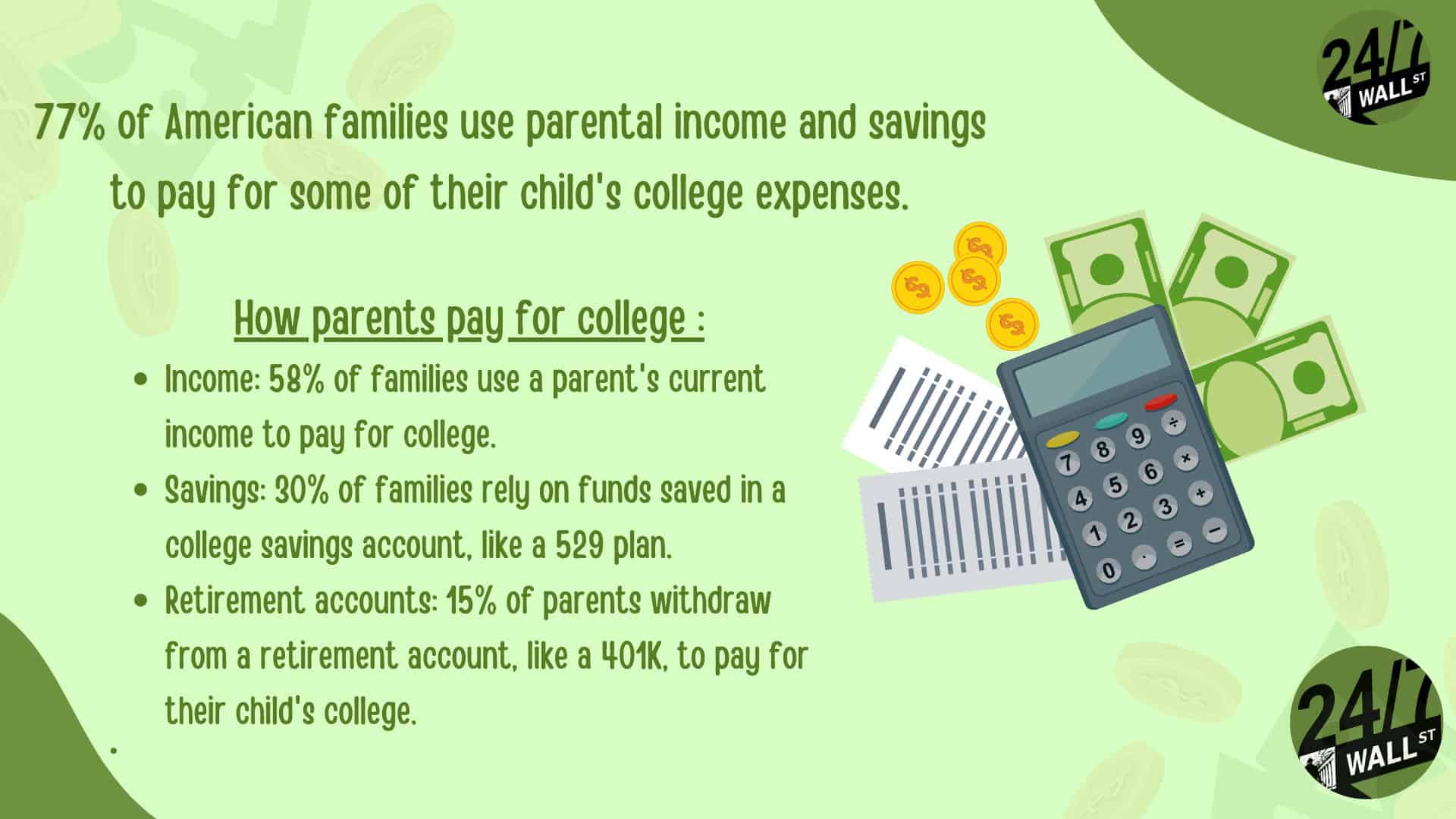
The standard advice to start saving for a child’s college education at birth, typically through a 529 plan, deserves more scrutiny than it usually gets. Any contributions to a child’s education fund should come only after you have maximized your own retirement savings. Borrowers aged 35 to 49 now hold approximately $607 billion in federal student loan debt, the largest share of any age group, and those millions of borrowers are carrying some of the highest delinquency rates since pandemic-era payment protections ended. That burden lands precisely during the years when wealth accumulation matters most.
Research from the Employee Benefit Research Institute puts a sharp number on that cost: 401(k) participants who carry student loans have median retirement balances 45% lower than their debt-free peers by the time they reach their 40s. One in five 401(k) participants between the ages of 25 and 69 carries student debt, and among workers in their late 20s the share rises to more than 35%. The retirement gap that opens during the prime earning years is extraordinarily difficult to close later in life.
Footing the entire college bill is also an increasingly costly choice that can undermine the child’s own sense of financial responsibility. The Class of 2024 left school with an average of $29,560 in federal and private student loan debt, a figure that sounds manageable until interest begins compounding on a modest starting salary.
The Redditor in question was divorced, paying alimony, carrying significant debt, and still working to stabilize his own finances. He wanted a bright future for his child, and that impulse is admirable. The most valuable conversation he could have had would have started years earlier: an honest discussion about the real cost of college and the limits of what parental support can realistically cover. Shifting the focus from parental funding to individual responsibility is preparation, not abandonment.
The Parent PLUS Trap Just Got Tighter
For parents weighing whether to borrow on a child’s behalf, the regulatory landscape shifted dramatically when President Trump signed the One Big Beautiful Bill Act into law on July 4, 2025. Under that legislation, Parent PLUS loans taken out on or after July 1, 2026 are capped at $20,000 per year per dependent student and $65,000 in total per dependent student. These limits are combined across all parents of a given student, meaning two parents cannot each borrow $20,000 for the same child in the same year. Previously, parents could borrow up to a school’s full cost of attendance with no hard cap. The same legislation also eliminated the Graduate PLUS Loan program for new borrowers beginning July 1, 2026, further tightening the federal credit available to families.
The repayment landscape changed just as sharply. For new loans disbursed on or after July 1, 2026, the SAVE, PAYE, and ICR plans no longer accept new enrollments and will sunset entirely by July 1, 2028. New borrowers after that date will have two options: the new Repayment Assistance Program (RAP) or the new Standard Repayment Plan. RAP caps payments at 1% to 10% of adjusted gross income over 30 years, with any remaining balance forgiven at the end of that period. Borrowers who took out loans before July 1, 2026 can remain on their current plan, switch to IBR, or opt into RAP voluntarily. New Parent PLUS loans disbursed after July 1, 2026 carry no income-driven repayment eligibility at all, adding a significant layer of risk for any parent signing onto federal debt now.
The opportunity cost of carrying that debt deserves plain accounting. A $100,000 parent loan balance on a 25-year standard repayment schedule runs roughly $770 a month in cash outflows. That same $770 a month invested over 25 years at a historically average 8% market return would grow to more than $730,000 in a retirement portfolio. Those numbers alone should give any parent serious pause before signing on.
Better Alternatives to Sacrificing Your Retirement
Breaking this cycle starts with expanding the options students explore before a single loan application is filed. Scholarships, grants, work-study arrangements, and part-time employment can meaningfully reduce the gap between what a family can afford and what a school costs. Since 2024, SECURE 2.0 has allowed employers to match an employee’s qualified student loan payments with contributions directly into that employee’s 401(k). Fidelity’s 2026 State of Student Debt study reports that more than 200 companies have implemented the benefit, covering nearly two million eligible employees, with participants receiving an average of $1,900 in employer contributions annually. For households with compressed cash flow, a well-constructed FAFSA financial aid appeal letter can also unlock additional institutional aid that a standard application misses.
If a parent decides to help financially, a cleaner approach is to have the student take on federal student loans directly, which carry far more repayment flexibility than Parent PLUS, while the parent contributes to the monthly payment as a third party. That structure keeps the primary debt in the student’s name and preserves the parent’s own credit flexibility. Beyond the loan question itself, a four-year private university is one path to a quality credential, but community college followed by a transfer to a four-year institution can cut total borrowing sharply, and the financial headroom that creates gives a young graduate a meaningful head start on building their own savings.
Do Not Sacrifice Your Financial Future
Investing in a child’s future ultimately means raising a financially capable adult. Vocational training, apprenticeships, and trade certifications all offer documented wage premiums and, critically, far less debt than a four-year degree. A parent who helps their child find that path is doing something more valuable than writing a tuition check.
The college cost conversation should begin long before a college application is filed. Children who grow up understanding that college is an investment with a real price tag and real consequences approach it with more seriousness and more strategy. Parents who choose not to go into debt for a child’s education are modeling exactly the financial discipline they want their children to develop.
Editor’s note: This pass updated the total student loan debt figure to $1.866 trillion (from $1.87 trillion) and the borrower count to 42.6 million, both per Federal Reserve and Education Data Initiative data as of March 2026. The age 35-49 debt figure was revised to approximately $607 billion per Q1 2026 data, and the Fidelity SECURE 2.0 employer-match figures were refreshed to reflect nearly two million eligible employees and an average $1,900 in annual employer contributions per participant, per Fidelity’s 2026 State of Student Debt study.
Contact [email protected] for any questions or corrections.
After two decades of patrolling the dark corners of suburbia as a police officer, Rich Duprey hung up his badge and gun to begin writing full time about stocks and investing. For the past 20 years, he’s been cruising the markets looking for companies to lock up as long-term holdings in a portfolio while writing extensively on the broad sectors of consumer goods, technology, and industrials. Because his experience isn’t from the typical financial analyst track, Rich is able to break down complex topics into understandable and useful action points for the average investor. His writings have appeared on The Motley Fool, InvestorPlace, Yahoo! Finance, Money Morning, and, of course, 24/7 Wall St. He has been featured in both U.S. and international publications, including MarketWatch, Financial Times, Forbes, Fast Company, and USA Today.