I’m 44 with $1.3 million in my 401(k) — can I stop contributing and still retire in 15 years?
A Reddit user recently posed an intriguing question: at what point does contributing to a 401(k) become unnecessary because compound growth alone will handle the heavy lifting? The 44-year-old poster has already accumulated $1.3 million and plans to retire at…

This post may contain links from our sponsors and affiliates, and Flywheel Publishing may receive compensation for actions taken through them.

A Reddit user recently posed a question that resonates with a lot of high-earning savers: at what point does contributing to a 401(k) become unnecessary because compound growth alone can do the heavy lifting?
The 44-year-old poster has already accumulated $1.3 million and plans to retire at 59 1/2. He noted that even maxing out his contributions would represent just 1% of his account’s expected annual growth. His goal is clear: generate at least $100,000 per year in retirement income. Can he coast from here, or does stopping early carry hidden costs?
The answer hinges on how much he actually needs at retirement and what he gives up by stepping back now.
Calculating the retirement target
Before deciding whether to halt contributions, you need to know your finish line. How much wealth does it take to safely produce $100,000 per year in retirement without depleting principal?
Financial planners have long referenced the 4% rule, which caps first-year withdrawals at 4% of the portfolio balance. That guideline continues to evolve. Morningstar’s 2025 “State of Retirement Income” report, published December 3, 2025, recommends a 3.9% starting withdrawal rate for retirees seeking steady, inflation-adjusted spending over a 30-year horizon. That represents a meaningful improvement from the 3.7% rate the firm published in 2024, driven by updated capital-market assumptions that blend top-down forecasts with bottom-up analyst inputs. One important qualification: the 3.9% figure applies specifically to portfolios with a modest equity weighting of 30% to 50%. Heavier stock allocations actually produce a lower safe rate in Morningstar’s model, because the higher volatility offsets the expected return benefit. For retirees willing to accept some variability in annual spending, flexible withdrawal strategies combining a guardrails approach with delayed Social Security and Treasury Inflation-Protected Securities can support a starting rate as high as 5.7%.
Using the conservative 3.9% benchmark, a retiree needs roughly $2.56 million to generate $100,000 annually. If this Reddit user’s $1.3 million grows at a 7% average annual return for 15 years with no additional contributions, the projected balance comes to approximately $3.59 million. That comfortably exceeds his target and would support around $140,000 in annual retirement income at the 3.9% rate. One important wrinkle: the 3.9% figure assumes a 30-year spending horizon. Someone retiring at 59 1/2 and living into their 90s could face a horizon of 35 years or more, which argues for a somewhat more conservative initial withdrawal rate. Morningstar’s own research notes that safe spending rates generally increase with age, providing useful context for how the math shifts as time horizons shrink.
On paper, stopping contributions now still gets him to his goal. But that narrow calculation misses several important considerations.
Why you might want to keep contributing anyway
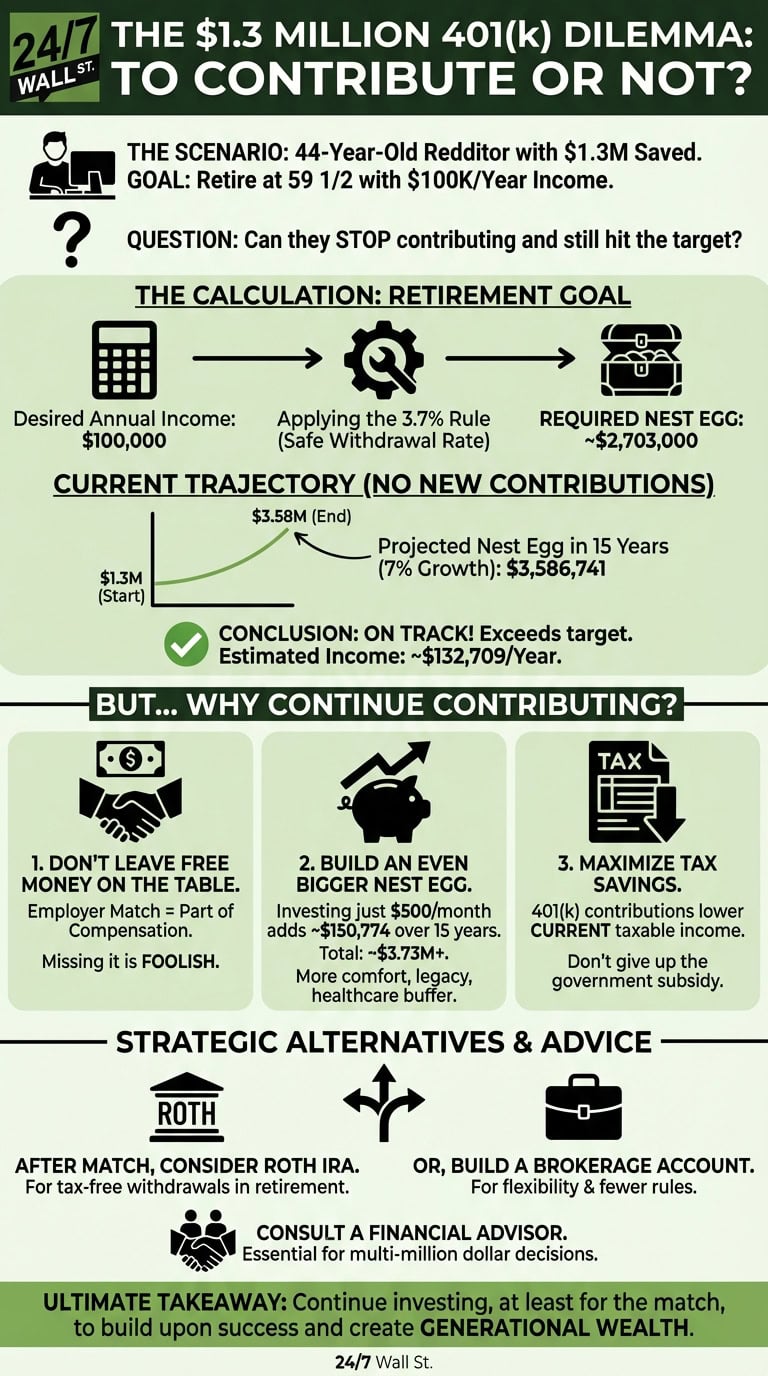
The first reason to keep contributing is employer matching. Walking away from employer match dollars means forfeiting part of your total compensation. Unless the deferrals genuinely strain your budget, leaving that money on the table is one of the costliest mistakes a well-positioned saver can make. The match represents an immediate 50% or 100% return on each dollar contributed, depending on the plan, and no other effectively risk-free investment comes close to that.
The second reason is cushion. Contributing just $500 per month over the next 15 years at a 7% return would push the projected balance to roughly $3.89 million instead of $3.59 million, before factoring in any employer match. That extra $300,000 provides flexibility for unexpected healthcare costs, a bad market in the early years of retirement, or a larger inheritance to pass on. Sequence-of-returns risk makes that buffer more valuable than the raw number suggests. Research from Fidelity Investments and Morningstar both identify the first five years of retirement as the highest-risk window: a portfolio that takes a large hit early, while withdrawals are actively drawing it down, loses both value and shares that could have recovered. The remaining assets then have to grow on a permanently smaller base. Gains in later years apply to fewer dollars, and the math rarely fully recovers.
The third reason is the immediate tax advantage. Every dollar deferred reduces current taxable income. Stop contributing and the tax bill rises, effectively redirecting money to the IRS rather than a growing retirement account. For someone already in a strong savings position, that trade-off is hard to justify.
Alternative strategies beyond the 401(k)
Continuing to save does not mean pouring everything back into your 401(k). Once you have captured the full employer match, other accounts may offer better advantages depending on your situation. For reference, the 2026 401(k) employee deferral limit is $24,500, up from $23,500 in 2025, leaving meaningful room to maximize the account if you choose. Workers who turn 60 through 63 during the calendar year can contribute a “super catch-up” of $11,250 above the standard limit under SECURE 2.0 rules. Standard catch-up for those 50 and older is $8,000 for 2026. One important new rule for 2026: employees whose prior-year wages exceeded $150,000 are now required to direct all catch-up contributions to a designated Roth account, shifting the tax benefit to the back end of retirement rather than the front.
A Roth IRA, if you qualify based on income, provides tax-free withdrawals in retirement. For 2026, the annual base contribution limit is $7,500. Those 50 and older can contribute $8,600 total, reflecting a $1,100 catch-up that SECURE 2.0 put on a CPI-indexed track, making 2026 the first year the IRA catch-up has exceeded the original $1,000 statutory figure. Single filers with modified adjusted gross income below $153,000, and married filers below $242,000, can contribute the full amount. Building a Roth alongside a traditional 401(k) creates valuable tax diversification, letting you draw from pre-tax and after-tax buckets strategically to manage your retirement tax bill.
A taxable brokerage account is worth considering as well. Unlike retirement accounts, brokerage holdings carry no withdrawal restrictions or required minimum distributions, providing full liquidity and a broad range of investment choices. If the 401(k) already covers core retirement income needs, steering additional savings into a brokerage account can fund pre-retirement goals or serve as bridge income for someone who wants to retire before 59 1/2 without triggering early-withdrawal penalties.
A financial advisor can help weigh these options, particularly once a portfolio crosses seven figures. At that scale, decisions around tax strategy, asset location, and withdrawal sequencing can translate into tens of thousands of dollars over a retirement spanning three decades or more.
The case for staying invested
The original poster’s math does hold up. Stopping contributions entirely and relying on 15 years of compounding still gets him to his $100,000 income goal. Even so, doing so means forfeiting employer match dollars, a larger safety margin, and meaningful annual tax savings, each of which compounds quietly in its own right.
At minimum, contributing enough to claim the full employer match is a straightforward win. Beyond that, a Roth IRA, taxable account, or additional 401(k) deferrals can each serve a distinct purpose in a well-structured plan. Retirement planning is about more than hitting a single number. Building resilience against market volatility, optimizing taxes across multiple account types, and preserving options for the unexpected all matter as much as the projected balance. Someone already on track has a rare advantage: the ability to build not just enough wealth, but a genuine foundation for long-term financial independence.
Editor’s note: This pass added clarification that Morningstar’s 3.9% safe withdrawal rate applies specifically to portfolios with 30% to 50% equity weighting, expanded the sequence-of-returns risk section with context from Fidelity and Morningstar research identifying the first five years of retirement as the highest-risk window, and noted that 2026 marks the first year the IRA catch-up contribution has exceeded its original $1,000 statutory figure following SECURE 2.0’s CPI-indexing provision.
Contact [email protected] for any questions or corrections.
Christy Bieber has been a personal finance and legal writer since 2008. She has a JD from UCLA School of Law and a BA in English, Media and Communications with a certification in business from the University of Rochester.
Christy has been published by a wide variety of sites, including WSJ Buy Side, Forbes, Kiplinger, Fox Business, Credit Karma, Insurify, and Annuity.org. In addition to writing for the web, she has also ghostwritten textbooks on business and law and served as a subject matter expert for course design.