If You Already Max Out Your 401(k), These Are the 7 Next Money Moves You Should Make
Maxing out a 401(k) is one of the most reliable foundations for retirement wealth. For 2026, the employee contribution ceiling sits at $24,500, up from $23,500 in 2025, with additional catch-up provisions for savers age 50 and older. If you…

This post may contain links from our sponsors and affiliates, and Flywheel Publishing may receive compensation for actions taken through them.

Maxing out a 401(k) is one of the most reliable foundations for retirement wealth. This workplace account lets you make pre-tax contributions to a retirement plan, and in many cases your contributions also unlock matching funds from your employer. For 2026, the employee contribution ceiling sits at $24,500, up from $23,500 in 2025. Workers age 50 and older can add an $8,000 catch-up on top of that, for a total of $32,500. Workers between ages 60 and 63 can make an even larger “super catch-up” of $11,250 instead of the standard $8,000, pushing their total allowable employee contribution to $35,750. Factor in employer contributions and the combined ceiling reaches $72,000 in 2026. That broader total matters for workers whose employers contribute generously through matching or profit-sharing.
Even so, many people who max out their 401(k) are unsure where additional savings should go. The options range from tax-advantaged accounts to flexible investment vehicles to targeted savings goals. If you have a maxed-out workplace account and are trying to figure out your next step, here are seven moves worth considering.
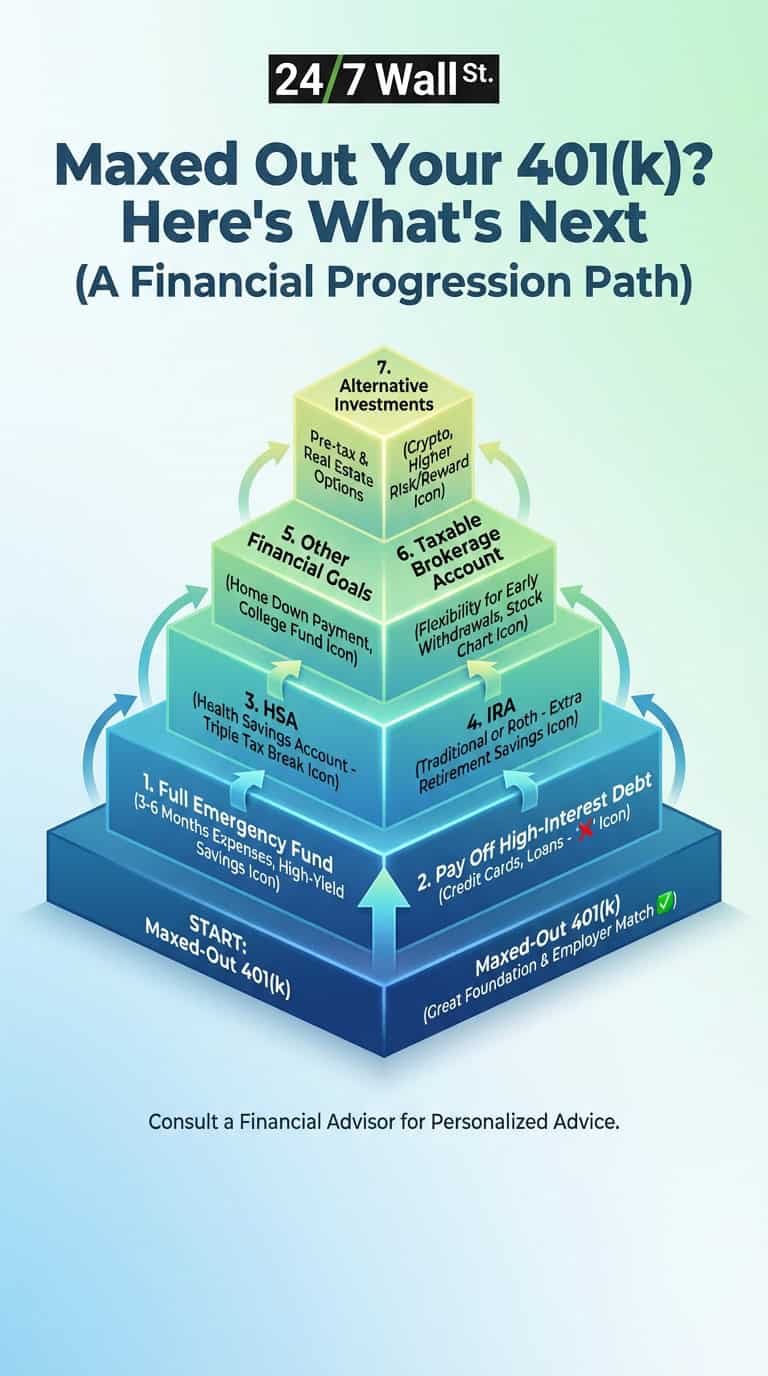
1. A fully-funded emergency fund
If you do not already have an emergency fund parked in a high-yield savings account, building one should sit at the top of your priority list alongside your 401(k) contributions.
A well-constructed emergency fund covers three to six months of living expenses. That cushion should be larger if you are the sole earner in your household, your income is variable, or you carry ongoing health concerns. The fund serves one purpose above all others: absorbing financial shocks without forcing you to tap retirement savings. Losing a job or facing a serious medical event is devastating on its own, and a solid reserve keeps the mortgage current and the bills paid while you recover.
Early withdrawals from a 401(k) trigger a 10% penalty plus ordinary income taxes on every dollar taken out. Avoiding that cost is itself a powerful return. The “yield” is simply a penalty you never have to pay, and that logic alone makes a properly funded emergency reserve one of the highest-value moves on this list.
2. Debt payoff
Carrying debt does not mean abandoning other financial goals, but the type of debt you hold shapes the right approach. High-interest debt from credit cards, medical bills, or personal loans deserves aggressive repayment. Eliminating those balances delivers a guaranteed, risk-free return: every dollar paid down stops generating interest that would otherwise compound against you for months or years.
Lower-interest debt calls for a different calculation. Student loans and mortgages are structured for long repayment timelines, and their interest is often tax-deductible depending on your income and filing status. When the after-tax cost of that debt is modest, directing extra cash into the market can produce a better long-run outcome than accelerating the payoff schedule. The key is comparing your loan’s effective interest rate against a realistic expected investment return and then making a deliberate choice based on those numbers rather than emotion.
3. A traditional or Roth IRA
A 401(k) is not the only account that provides tax-advantaged retirement savings. Depending on your income, you may also be eligible to contribute to a traditional or Roth IRA. For 2026, the annual IRA contribution limit is $7,500, up from $7,000 in 2025. Savers age 50 and older can add a $1,100 catch-up, bringing their total to $8,600. That increase to $1,100 is notable: it is the first increase to the IRA catch-up amount since 2006, made possible by SECURE 2.0 now indexing that figure to inflation.
A traditional IRA delivers benefits similar to a 401(k). Contributions may be deductible, growth is tax-deferred, and there is no employer match to miss. The real upside is investment freedom: you can open an IRA with any brokerage and invest in nearly anything, from individual stocks to mutual funds to gold or cryptocurrency with the right provider. A 401(k) typically confines you to a curated fund menu, so an IRA meaningfully widens your options.
A Roth IRA works differently. Contributions are made with after-tax dollars, so there is no upfront deduction. In exchange, qualified withdrawals in retirement are completely tax-free. For 2026, the Roth IRA income phase-out range for single filers runs from $153,000 to $168,000. For married couples filing jointly, the range is $242,000 to $252,000. One additional 2026 development worth knowing: high earners whose FICA wages exceeded $150,000 in the prior year must now make any 401(k) catch-up contributions on a Roth basis under a SECURE 2.0 provision that took statutory effect January 1, 2026. The IRS issued final regulations on September 16, 2025, formally applicable starting in 2027, with 2026 treated as a good-faith compliance period for plan sponsors. For those savers, the after-tax nature of Roth catch-up contributions is no longer optional. Those above the Roth income thresholds can still access Roth benefits through a backdoor conversion, which involves contributing to a traditional IRA and then converting those funds to a Roth.
Both IRA types share one combined annual contribution limit, well below the 401(k) ceiling. The additional tax diversification they offer is still worth pursuing when your income allows it.
4. A health savings account (HSA)
If you are enrolled in a qualifying high-deductible health plan, you have access to one of the most tax-efficient savings vehicles available: the Health Savings Account. Many financial planners argue that an HSA deserves priority even ahead of maxing out a 401(k), once you have captured your full employer match.
The HSA’s appeal comes from its triple tax advantage. Contributions go in pre-tax, the money grows tax-free, and withdrawals are tax-free when used for qualifying medical expenses. No other common savings account combines all three benefits at once. A 401(k) and a traditional IRA each deliver a tax break either at contribution or at withdrawal, not both simultaneously. For 2026, you can contribute up to $4,400 with self-only HDHP coverage (up from $4,300 in 2025), or $8,750 with family coverage (up from $8,550 in 2025). Those 55 and older can add an extra $1,000 as a catch-up contribution. The IRS has already set 2027 limits at $4,500 for self-only coverage and $9,000 for family coverage, confirming the account’s continued inflation adjustments. Despite these advantages, HSAs remain underutilized: Bureau of Labor Statistics data shows that only 41% of private-sector and government workers had access to an employer HSA in 2025, and access skews heavily toward higher-paying roles, with management and financial workers at 61% and service workers at just 22%.
Employer behavior around HSAs is shifting, though. According to the Plan Sponsor Council of America, nearly 46% of employers in 2025 automatically enrolled workers into an HSA when they chose a high-deductible health plan, up from 32% in 2019. That auto-enrollment push mirrors the approach that boosted 401(k) participation for years, nudging more workers into accounts they might otherwise overlook.
If you stay healthy and avoid large medical bills, the account still works in your favor. After age 65, you can withdraw HSA funds for any purpose without penalty, though non-medical withdrawals are taxed at ordinary income rates, making the account function much like a traditional IRA for general spending. Healthcare is consistently one of the largest expenses retirees face, so the HSA’s flexibility makes it a powerful complement to any long-term savings plan.
5. Saving for other financial goals
Retirement accounts are not the only place your extra savings can do meaningful work. Depending on where you are in life, you may want to direct money toward a home down payment, a future vehicle purchase, or a significant trip. These are legitimate uses of capital, and structuring your savings around them is worth the effort.
For goals a few months to a few years out, a high-yield savings account or a Certificate of Deposit can keep your money accessible while earning a competitive return. For longer-horizon goals like funding a child’s college education, a 529 plan provides tax-advantaged growth designed specifically for educational expenses. Many states also offer a deduction or credit on state income taxes for 529 contributions, adding another layer of benefit. The key throughout is matching the account type to the timeline: the longer the runway, the more room you have to invest rather than simply save.
6. A taxable brokerage account
Once you have maximized your tax-advantaged options, a taxable brokerage account is the natural next destination for additional savings. These accounts offer no special tax deductions and no tax-free withdrawals, but they carry one critical advantage: flexibility. There are no income limits, no contribution caps, and no penalties for withdrawing your money at any time for any reason.
The tax treatment is also more favorable than many people expect. Gains on assets held for more than one year qualify for long-term capital gains rates, which for 2026 are 0%, 15%, or 20% depending on taxable income. Those rates are considerably lower than ordinary income rates, which top out at 37%. In fact, single filers with taxable income up to $49,450 pay 0% on long-term gains in 2026, and married couples filing jointly get that same 0% rate on income up to $98,900. For anyone pursuing early retirement, a taxable brokerage account is especially valuable. You can draw income from it freely while waiting to reach age 59½, the threshold at which penalty-free withdrawals from a 401(k) or IRA become available.
7. Alternative investments

Beyond traditional markets, alternative investments such as cryptocurrency, real estate, precious metals, and private credit can offer diversification that stocks and bonds alone cannot provide. The tradeoff is higher risk and, in many cases, lower liquidity. Outsized returns are possible in certain alternatives, but so are significant losses. A financial advisor can help you assess what, if any, alternative assets belong in your portfolio given your risk tolerance and time horizon.
Every option on this list has merit, and the right combination depends on your income, goals, and stage of life. Working with a financial advisor to build a personalized plan is often the most efficient way to put additional savings to work.
Editor’s note: This pass added the $72,000 combined employer-plus-employee 401(k) ceiling for 2026 to the opening section, incorporated the newly confirmed 2027 HSA contribution limits ($4,500 self-only, $9,000 family, per IRS Revenue Procedure 2026-24) into the HSA section, and added the specific 2026 income thresholds for the 0% long-term capital gains rate ($49,450 for single filers, $98,900 for married filing jointly) to the taxable brokerage section.
Contact [email protected] for any questions or corrections.
Christy Bieber has been a personal finance and legal writer since 2008. She has a JD from UCLA School of Law and a BA in English, Media and Communications with a certification in business from the University of Rochester.
Christy has been published by a wide variety of sites, including WSJ Buy Side, Forbes, Kiplinger, Fox Business, Credit Karma, Insurify, and Annuity.org. In addition to writing for the web, she has also ghostwritten textbooks on business and law and served as a subject matter expert for course design.