





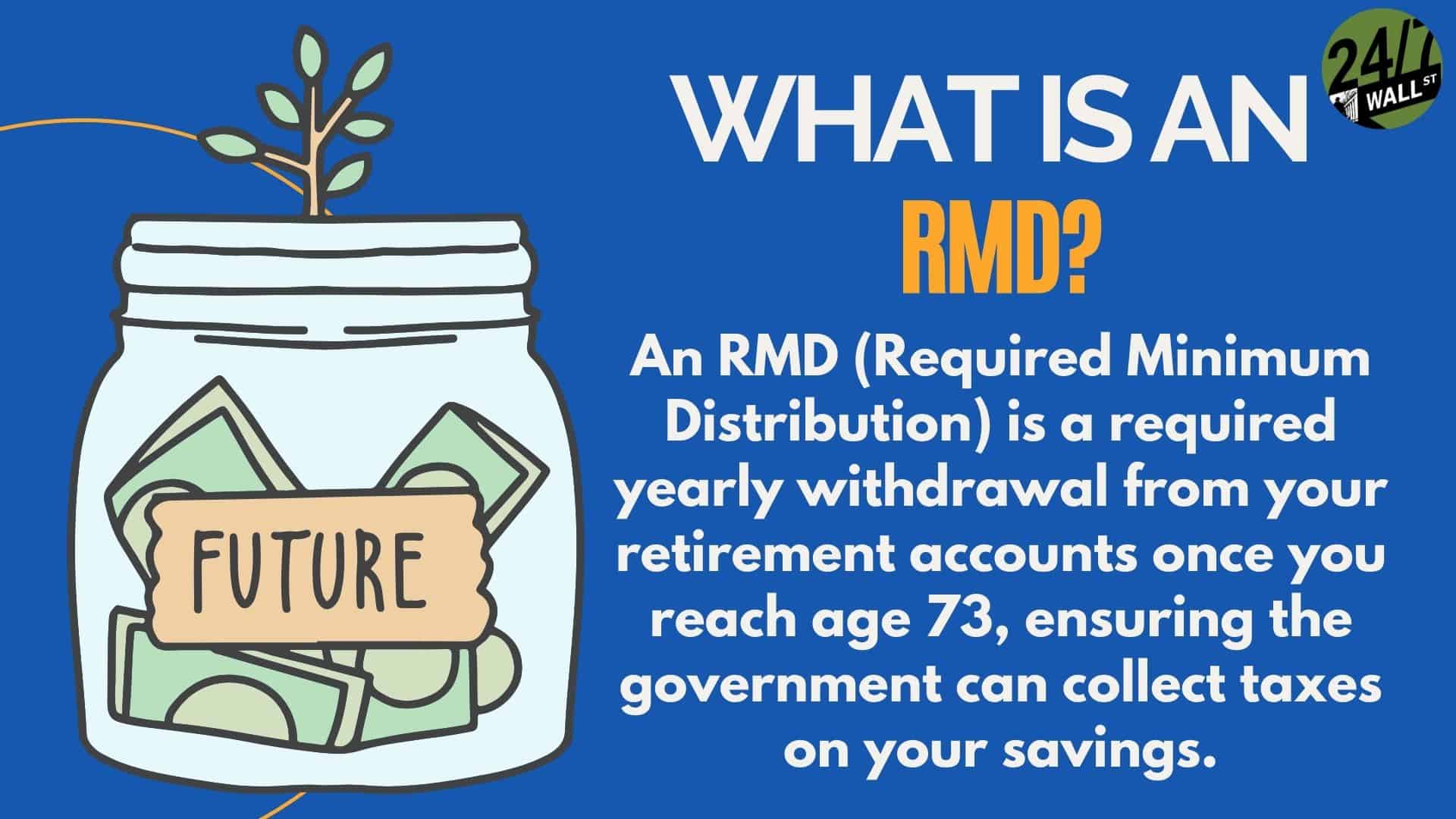
Once you reach age 73, you are legally required to take Required Minimum Distributions (RMDs) from most tax-deferred retirement accounts. The government uses these mandatory withdrawals to collect taxes on money that has been sheltered from taxation, sometimes for decades.
If you are already past 73, or approaching that milestone, understanding exactly how your RMD is calculated is critical. This is also a conversation worth having with a financial advisor before you take your first distribution.
The IRS calculates your RMD using a formula that factors in your total account balances, your age, your life expectancy, and the life expectancies of any beneficiaries. The agency divides your total account balance by a life expectancy factor drawn from its published tables. That factor is essentially the number of additional years the IRS expects you to live.
Here is a concrete example. At age 73, the IRS Uniform Lifetime Table assigns a life expectancy factor of 26.5. If your retirement account balance as of December 31 of the prior year was $250,000, you divide $250,000 by 26.5 to arrive at a required distribution of $9,433.96. For the full table, see the IRS Uniform Lifetime Table.
The IRS Has Delayed Inherited IRA Final Rules Again
If you are managing an inherited retirement account alongside your own RMDs, the rules have been complicated for years. The IRS issued Announcement 2026-7, which pushes back enforcement of strict new final regulations for certain beneficiaries until at least 2027. Specifically, those rules will not take effect earlier than six months after the final regulations are formally published. In the meantime, the IRS permits taxpayers to apply a “reasonable, good-faith interpretation” of the existing rules. If you are navigating the 10-year distribution window for an inherited IRA, this extended grace period gives you additional time to structure your withdrawal strategy.
There are Different Rules for RMDs Depending on Your Retirement Account
The RMD rules apply to all employer-sponsored retirement plans, including profit-sharing plans, 401(k) plans, 403(b) plans, and 457(b) plans. They also apply to traditional IRAs and IRA-based plans such as SEPs, SARSEPs, and SIMPLE IRAs. Roth IRAs and Designated Roth accounts are exempt from RMDs while the original owner is alive, though beneficiaries of those accounts are still subject to distribution requirements.
One important update from SECURE 2.0: starting in 2024, designated Roth accounts inside employer-sponsored plans (including Roth 401(k), Roth 403(b), and governmental Roth 457(b) plans) are also exempt from RMDs during the account owner’s lifetime. Before this change, only Roth IRAs enjoyed that treatment. If you have Roth money inside a workplace plan, it no longer gets pulled into your RMD calculation.
With a traditional IRA, you must calculate your RMD for each account separately, though you are permitted to combine those totals and satisfy them all from a single IRA. With a defined contribution plan such as a 401(k), the rules are stricter: you must take separate RMDs from each plan. You cannot satisfy a 401(k) RMD by pulling the money from an IRA.
There is one additional scenario worth knowing. If your spouse is more than 10 years younger than you and is listed as the 100% beneficiary of your account, the IRS requires you to calculate your RMD using a Joint Life Expectancy Table rather than the standard Uniform Lifetime Table. That joint calculation accounts for both your age and your spouse’s age, which typically produces a longer combined life expectancy and a smaller required distribution each year.
Reduce Your RMD Tax Bill with a QCD
You do not have to let your RMD push you into a higher tax bracket. If you are age 70 1/2 or older, you can use a Qualified Charitable Distribution (QCD) to transfer money directly from your traditional IRA to an eligible charity. For 2026, the annual QCD limit is $111,000 per individual (up from $108,000 in 2025), and the amount transferred counts toward satisfying your RMD for the year while being excluded entirely from your adjusted gross income. The funds must flow directly from your IRA custodian to the charity before December 31 to qualify.
QCDs are especially valuable in 2026 because the One Big Beautiful Bill Act has changed how charitable deductions work. Under those new rules, regular charitable deductions now face a 0.5% AGI floor and a reduced cap for top earners. A QCD sidesteps both restrictions entirely because it is an income exclusion, not an itemized deduction. Married couples who each hold their own IRA can each make up to $111,000 in QCDs, for a combined total of $222,000.
The Surviving Spouse RMD Advantage
SECURE 2.0 gave widows and widowers a meaningful new option. If you are a surviving spouse and the sole beneficiary of your late partner’s retirement account, you can elect to be treated as the deceased participant for RMD purposes. If your deceased spouse was younger than you, making this election allows you to delay mandatory distributions until the year your spouse would have turned 73. When distributions do begin, you also get to use the more favorable Uniform Lifetime Table rather than the Single Life Expectancy Table that would otherwise apply to a beneficiary.
There are Key Rules to Follow with RMDs
First, distributions become mandatory at age 73. Under SECURE 2.0, that starting age will rise to 75 beginning in 2033, giving future retirees an additional two years of tax-deferred growth.
Second, your required beginning date is April 1 of the year following the year you turn 73. If you turn 73 in 2025, you have until April 1, 2026, to take your first RMD covering 2025. Be aware, though: if you delay that first distribution until April 2026, you will also owe a second RMD for 2026 by December 31 of that year. Taking two distributions in a single calendar year can push you into a higher tax bracket, so many advisors recommend taking the first RMD before year-end rather than using the April extension.
Third, missing your RMD deadline carries a stiff penalty. The standard excise tax is 25% of the amount you failed to withdraw, down from the previous 50% penalty under earlier law. SECURE 2.0 added a correction window: if you identify the missed distribution and take it within two years before an IRS audit, the penalty drops to 10%. A corrective distribution resolves the past shortfall but does not count toward the current year’s RMD requirement.
Fourth, watch out for common RMD calculation errors. Using the wrong year-end account balance is one of the most frequent mistakes, and it can result in a distribution that is lower than required. You also need to confirm you are using the correct life expectancy factor for your age and account type, and that you are accounting for every qualifying retirement account you hold.
Fifth, before you take any distribution, talk to your financial advisor. Calculating your RMD incorrectly, applying the wrong life expectancy factor, or withdrawing less than required are all mistakes that can generate unwanted attention from the IRS. Getting it right the first time is far less painful than fixing it later.
Editor’s note: This article was updated to reflect the 2026 QCD limit of $111,000 (increased from $108,000 in 2025), the SECURE 2.0 Roth 401(k) and Roth workplace plan exemption from lifetime RMDs effective 2024, and the enhanced value of QCDs under the One Big Beautiful Bill Act’s revised 2026 charitable deduction rules.












 Top Gaining Stocks
 Top Losing Stocks