





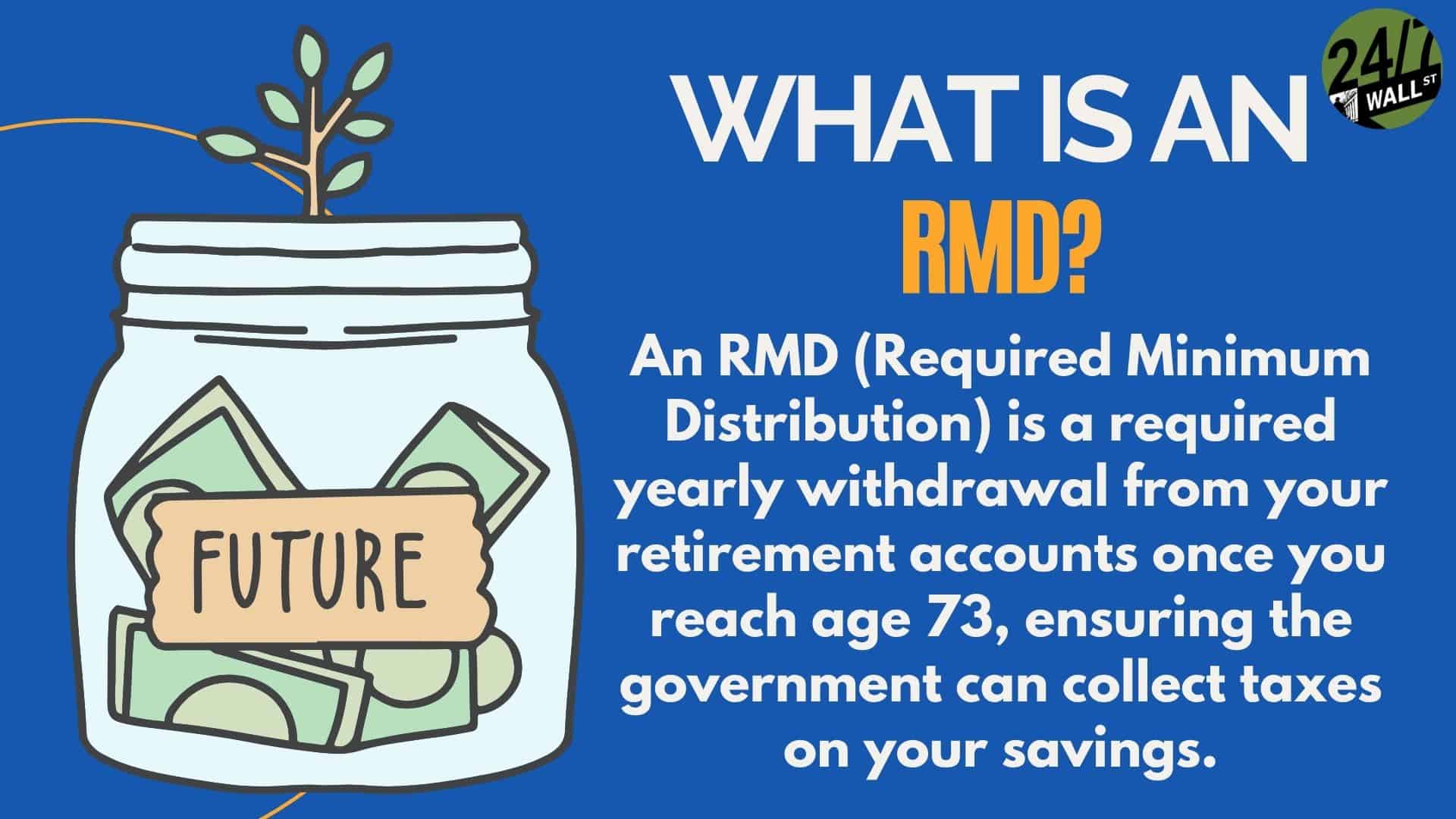
Once you reach age 73, you are legally required to take Required Minimum Distributions (RMDs), ensuring the government can collect taxes on money that has grown tax-deferred for decades. Whether you are already past that threshold or approaching it, understanding how your RMD is calculated is essential, and so is reviewing the calculation with a qualified financial advisor.
The IRS uses a formula that factors in your total account balances, your age, your life expectancy, and, in some cases, your beneficiary’s life expectancy. The core calculation is straightforward: divide your prior year-end account balance by your life expectancy factor from the IRS Uniform Lifetime Table.
At age 73, that factor is 26.5. So if your account balance was $250,000 as of December 31 of the prior year, you divide $250,000 by 26.5, arriving at an RMD of $9,433.96. A link to the full IRS Uniform Lifetime Table can help you find the factor for your specific age.
The IRS Delays RMD Final Rules Again
For those managing an inherited retirement account alongside their own RMDs, the rules have been notoriously complicated. The IRS issued Announcement 2026-7, which pushes back enforcement of strict new final regulations for certain beneficiaries until at least 2027, specifically no earlier than six months after the final regulations are formally published. In the meantime, taxpayers may use a “reasonable, good-faith interpretation” of the existing rules. If you are navigating the 10-year distribution window for an inherited IRA, this extended grace period gives you additional time to structure your withdrawal strategy.
There are Different Rules for RMDs Depending on Your Retirement Account
According to the IRS, “The RMD rules apply to all employer-sponsored retirement plans, including profit-sharing plans, 401(k) plans, 403(b) plans, and 457(b) plans. The RMD rules also apply to traditional IRAs and IRA-based plans such as SEPs, SARSEPs, and SIMPLE IRAs. The RMD rules do not apply to Roth IRAs or Designated Roth accounts while the owner is alive. However, RMD rules do apply to the beneficiaries of Roth IRA and Designated Roth accounts.”
With a traditional IRA, you must calculate the RMD for each IRA separately, though you are permitted to combine those amounts and take the total from a single IRA. With a defined contribution plan such as a 401(k), you must take separate RMDs from each plan.
On the Roth side, the rules have expanded. Roth IRA owners have never faced lifetime RMDs. Starting in 2024, SECURE 2.0 extended that same exemption to Designated Roth accounts held inside employer plans, including Roth 401(k) and Roth 403(b) accounts, so original account holders no longer face mandatory lifetime withdrawals from those accounts either. Beneficiaries of any Roth account, however, remain subject to RMD rules after the original owner dies.
There is one additional wrinkle for married account holders. If your spouse is more than 10 years younger than you and is listed as the sole beneficiary of your account, you must calculate your RMD using a Joint Life Expectancy Table instead of the standard Uniform Lifetime Table. That calculation incorporates both ages, which typically produces a longer combined life expectancy and a lower required distribution amount.
Reduce Your Tax Bill with a Qualified Charitable Distribution
You are not required to simply absorb the full tax hit from your RMD each year. If you are age 70½ or older, you can use a Qualified Charitable Distribution (QCD) to send money directly from your traditional IRA to an eligible 501(c)(3) charity. For 2026, the annual QCD limit is $111,000 per person, up from $108,000 in 2025. A married couple can each make QCDs from their own IRAs, effectively doubling that ceiling. The amount transferred counts toward satisfying your RMD for the year but is excluded entirely from your adjusted gross income (AGI), keeping you out of a higher tax bracket. To receive the tax benefit, the funds must move directly from your IRA custodian to the charity by December 31.
QCDs are particularly attractive in 2026. The One Big Beautiful Bill Act introduced new restrictions on itemized charitable deductions, including a 0.5% AGI floor and reduced benefits for top-bracket filers. Because a QCD is an above-the-line income exclusion rather than an itemized deduction, it sidesteps those new restrictions entirely.
The Surviving Spouse RMD Advantage
SECURE 2.0 created an important structural option for widows and widowers. If you are the sole surviving spouse and the sole beneficiary of your late partner’s retirement account, you can elect to be treated as the deceased participant for RMD purposes. When the deceased spouse was younger than you, this election lets you delay mandatory distributions until the year your spouse would have turned 73. Once distributions begin, you can also use the more favorable Uniform Lifetime Table rather than the Single Life Expectancy Table that typically applies to beneficiaries, which can result in meaningfully lower required withdrawals each year.
There are Key Rules to Follow with RMDs
First, RMDs begin at age 73 under current law. Under SECURE 2.0, the starting age rises to 75 for individuals who turn 73 after December 31, 2032, meaning that shift takes effect in 2033.
Second, the required beginning date is April 1 of the year after you turn 73. If you turn 73 in 2025, you have until April 1, 2026 to take your first RMD, covering the 2025 tax year. Be aware that pushing your first RMD to April of 2026 means you will also owe a second RMD by December 31, 2026 for the 2026 tax year. Taking two distributions in one calendar year can push you into a higher bracket, so many advisors recommend taking the first RMD before December 31 of the year you turn 73.
Third, missing your RMD deadline carries a stiff penalty: 25% of the amount you failed to withdraw. That figure was 50% before SECURE 2.0 reduced it. A key escape hatch exists, though. If you catch the error and take a corrective distribution within a two-year window before any IRS audit, the excise penalty drops to 10%. One important restriction applies: a corrective distribution satisfies only the previously missed amount and cannot count toward the current year’s RMD requirement.
Fourth, watch out for common calculation errors. Using the wrong year-end account balance is the most frequent mistake, and it typically results in an RMD that is too low. Verify that you are applying the correct life expectancy factor for your age, and make sure every qualifying account has been included in the calculation.
Fifth, before you begin taking RMDs, sit down with a financial advisor. A misapplied factor, an overlooked account, or a distribution that falls short of the required amount can all trigger an IRS inquiry, and the penalties make that a costly mistake to correct after the fact.
Editor’s note: This article was updated to reflect the 2026 QCD annual limit of $111,000 (up from $108,000 in 2025), SECURE 2.0’s 2024 elimination of lifetime RMDs from Designated Roth accounts in employer plans such as Roth 401(k) and Roth 403(b), and the added context that the One Big Beautiful Bill Act’s new charitable deduction restrictions make QCDs especially advantageous in 2026.












 Top Gaining Stocks
 Top Losing Stocks