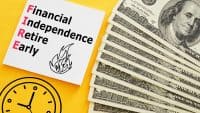
Am I really saving time by doubling my income for early retirement at 38?
For many ambitious young people aiming to retire a few years (or decades) earlier, it makes sense to “floor it” when it comes to the jobs, side gigs, and passive income streams. Undoubtedly, there’s a higher risk of burning out…

This post may contain links from our sponsors and affiliates, and Flywheel Publishing may receive compensation for actions taken through them.

For many ambitious young people aiming to retire a few years (or decades) earlier, it makes sense to “floor it” when it comes to the jobs, side gigs, and passive income streams. Undoubtedly, there’s a higher risk of burning out by putting in 12-hour days while cutting out the weekends. But if retiring early is the number-one priority, hitting the gas pedal can make sense for some prospective early retirees.
That said, I think the key is maintaining a workload that’s more about longer-term sustainability (what’s the use of overworking oneself if it’ll only end in burnout well before one has enough to hit their FIRE number?) and balance, rather than seeking to hit a financial indepedence goal ahead of schedule.
At this juncture, this Reddit user, who sounds keen on hitting their FIRE number sooner rather than later, expects it will take around six and a half years before they achieve their $1.1 million FIRE number. They’re thinking about taking on a heavier load to reduce the time to achieve $1.1 million by some years.
Of course, adding a part-time job could help beef up the income considerably and allow one to achieve financial independence in two years or so. That said, one must also factor in the higher tax bracket they’ll fall into as well as the potential for stock market volatility as Trump tariffs fuel volatility, while setting the stage for more inflation and even a recession.
Doubling income can certainly pull retirement by some years closer.
In any case, I’m certainly not against getting a part-time job to double one’s savings. But I wouldn’t be so set on a timeline, especially if the latest stock market correction is just the start of something worse. At the end of the day, volatility happens, and one should be ready to adapt, either by delaying one’s retirement date (and perhaps investing more on the way down while stock valuations are lower) or by temporarily reducing one’s lifestyle expenses.
In short, boosting one’s income while trimming away at expenditures can help one retire earlier than expected. But if stagflation ends up being in the cards, one should be prepared to set a more realistic target date. At the end of the day, markets don’t always go up. While 10% returns annually may be a realistic longer-term expectation for investors, it simply isn’t for those who are looking to retire in the medium term. The stock market had a glorious 2023 and 2024.
Brace for volatility. It could derail early retirement plans
Thus far, 2025 has been a major letdown, with tariffs and a China-U.S. trade war that could cause more gains to be wiped out. Indeed, given the magnitude of risk on the table, an early retiree, selling stocks after a sudden surge, could make a lot of sense if one’s asset allocation runs a high risk of jeopardizing one’s early retirement plans.
Of course, if there’s more flexibility with the retirement date, staying invested in equities, I believe, is the right call. Arguably, getting a second job and funneling cash into a bear market could be more rewarding than one thinks over the longer term. In any case, I’d argue that this Reddit user shouldn’t have a specific date in mind. Rather, they should go for the second job and hope for the best as they aim to retire within a specific timespan.
The bottom line
It’s nice to have your heart set on a retirement age. But given market volatility and turbulence that could see one’s nest egg ride through deeper troughs, I’d argue that it makes sense to be flexible as not to make the wrong investment decisions at the wrong time. Either way, maximizing one’s income streams seems like an even better idea if it means more cash to invest as markets fly lower for the summer.
Contact [email protected] for any questions or corrections.
Joey is a 24/7 Wall St. contributor and seasoned investment writer whose work can also be found in publications such as The Motley Fool and TipRanks. Holding a B.A.Sc in Computer Engineering from the University of British Columbia (UBC), Joey has leveraged his technical background to provide insightful stock analyses to readers.
Joey's investment philosophy is heavily influenced by Warren Buffett's value investing principles. As a dedicated Buffett disciple, Joey is committed to unearthing value in the tech sector and beyond.