Peter Thiel’s Incredible Advice for Anyone Looking to Grow Their Retirement Portfolio
At 58, Peter Thiel, now worth approximately $28 billion, knows a thing or two about success. He co-founded PayPal, Palantir Technologies, and Founders Fund, and made one of Silicon Valley's most celebrated early bets when he invested in Facebook. But…

This post may contain links from our sponsors and affiliates, and Flywheel Publishing may receive compensation for actions taken through them.
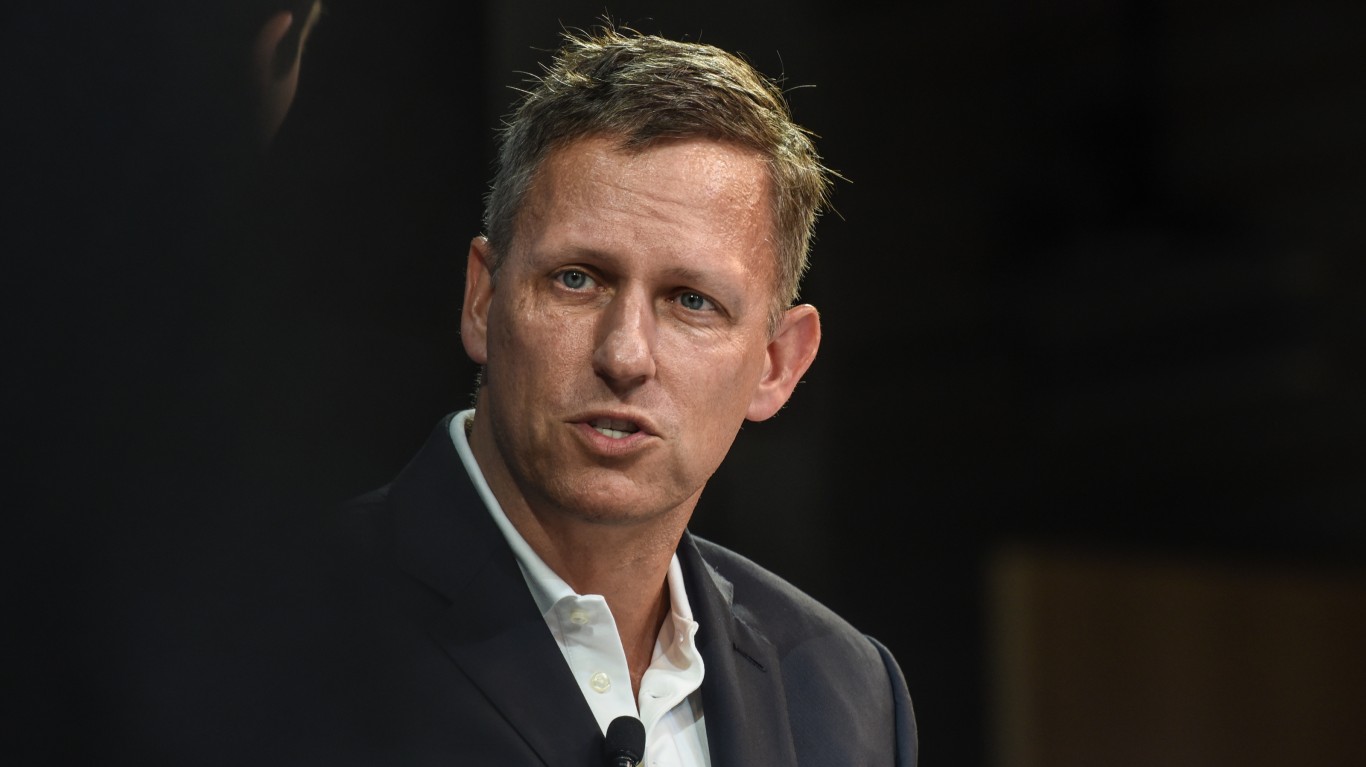
At 58, Peter Thiel, who is now worth approximately $28 billion, knows a thing or two about success. Born in Germany and raised in California, he went on to co-found PayPal (NASDAQ:PYPL | PYPL Price Prediction), Palantir Technologies, and Founders Fund, and made one of Silicon Valley’s most celebrated early bets when he invested $500,000 in a then-unknown social network called Facebook.
He is not just known for his solid contributions to technology. He is also well known for his highly effective approach to financial planning. According to a ProPublica investigation based on IRS records, Thiel grew his Roth IRA from an initial investment of under $2,000 in 1999 to more than $5 billion by 2019, making it one of the largest tax-advantaged retirement accounts ever documented.
Thiel also co-founded the Founders Fund, a venture capital firm that has backed OpenAI, Stripe, SpaceX, Anduril, Rippling, Scale AI, Cognition AI, Neuralink, and dozens more. In May 2026, Founders Fund closed a record $6 billion growth-stage fund, its largest ever, with $1.5 billion of that committed by the firm’s own partners and employees.
Portfolio Diversification is Key
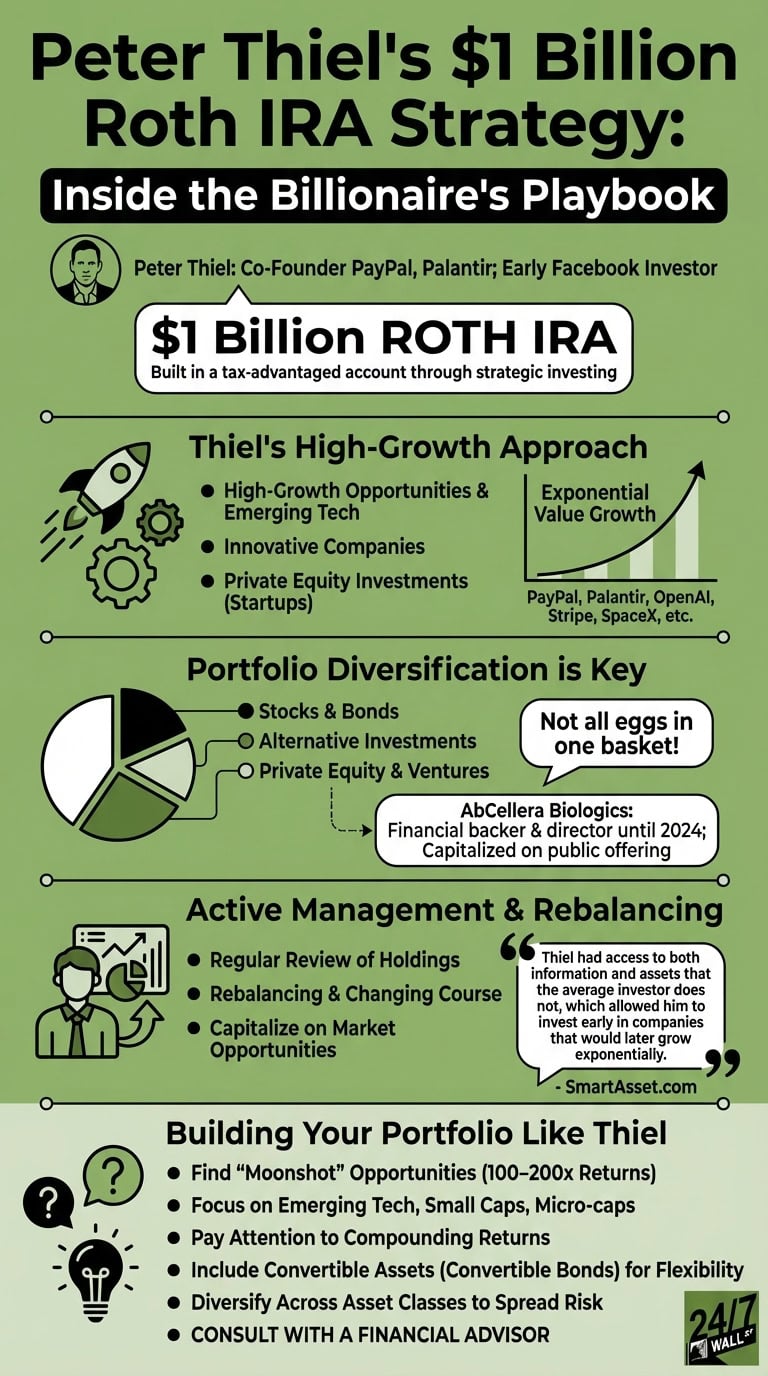
With his Roth IRA, Thiel diversified rather than concentrating everything in a single bet. He mixed stocks, bonds, and alternative investments, while keeping a sharp focus on higher-growth opportunities in emerging technologies and innovative companies. The critical structural advantage was his use of a self-directed IRA, which allowed him to hold private company shares that are simply unavailable through a standard brokerage account.
Thiel’s original maneuver was straightforward in concept, if not in access. In 1999, he purchased 1.7 million PayPal founder shares at just $0.001 per share, putting a total of roughly $1,700 into his Roth. When eBay acquired PayPal in 2002 for $1.5 billion, he kept all the proceeds inside the account and reinvested. He then used those gains to acquire a stake in the early Facebook, with that $500,000 investment also held inside the Roth. The compounding ran entirely tax-free at every step.
The multi-billionaire also included broader private equity investments in startups and ventures that were not publicly traded. When some of those private companies did go public, the returns were substantial. AbCellera Biologics is one example, where Thiel served as a financial backer and director until 2024. The Roth wrapper meant that gains on every exit stayed in the account and fueled the next round of investments without any tax drag eroding the base.
Thiel also made a point of reviewing his Roth IRA holdings regularly, rebalancing and adjusting when conditions shifted. That discipline allowed him to capitalize on new opportunities, reduce exposure where needed, and change course alongside the market rather than fighting it.
The Real Takeaway from Thiel’s Roth IRA
Replicating Thiel’s specific trades is not realistic for most investors. Very few people have access to pre-IPO founder shares priced at fractions of a penny. The structural lesson, however, translates broadly: put your highest-conviction, longest-runway bets inside the Roth, where compounding runs tax-free for decades. Gains on assets sold inside the account can be redeployed without the IRS taking a cut each time, which means the base keeps growing intact.
That logic makes the Roth a natural home for emerging technology names, small- and micro-cap companies, and earlier-stage businesses with limited analyst coverage. These positions carry real risk, but their upside tends to be asymmetric, and the Roth structure magnifies the benefit of being right. Thiel’s portfolio leapt by roughly $3 billion between 2016 and 2019 alone, according to ProPublica, as the broader tech market surged.
As Thiel argued in his book Zero to One, the tendency of financial markets to favor near-term results over long-term compounding is a structural bias that patient, conviction-driven investors can exploit. The Roth IRA is one of the few accounts where an ordinary investor can act on that insight without giving up a portion of the upside to taxes each year.
The trade-off is real. Concentrated positions amplify losses just as readily as gains. Size every position at a level you can afford to be wrong on, hold the ones that prove out, and consult a fiduciary financial advisor before restructuring any retirement account around a high-concentration strategy.
Editor’s note: This article has been updated to reflect that Thiel’s Roth IRA grew to more than $5 billion by 2019, according to ProPublica’s reporting based on IRS data, correcting an earlier figure of $1 billion. His net worth estimate has also been revised to approximately $28 billion, and the article now includes context on Founders Fund’s record $6 billion growth fund closed in May 2026, Stripe’s February 2026 valuation of $159 billion, and the mechanics of Thiel’s original 1999 PayPal founder-share purchase inside the Roth.
Contact [email protected] for any questions or corrections.
Ian Cooper is a veteran market analyst and investment strategist with more than 20 years of experience covering stocks, commodities, and macro trends. Since 1999, he has helped investors identify market opportunities using a blend of technical analysis, fundamental research, and market sentiment.
He is the creator of the ADD News Flow Strategy, which focuses on trading market reactions to major news events and investor psychology. Cooper was also among the analysts who warned about the 2008 financial crisis and major financial institution collapses ahead of the broader market.
Before joining 247 Wall St., Cooper wrote extensively for InvestorPlace and other financial publications, covering market trends, trading strategies, and investment opportunities.