Virginia Man Turns $70,000 Into $264 Million Roth IRA Buying Only Public Stocks. He Won’t Owe Another Penny of Tax. The Same Rules Apply To You
A Virginia investor built a nine-figure retirement account using nothing but public stocks any American could have bought, then converted it in a single move that permanently erased his future tax bill. The same legal structure is sitting open for…

This post may contain links from our sponsors and affiliates, and Flywheel Publishing may receive compensation for actions taken through them.
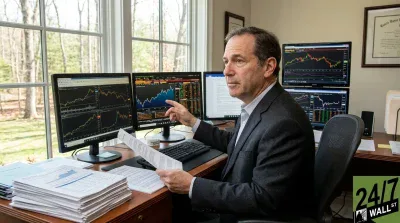
A Virginia investor named Ted Weschler turned $70,385 in 1989 into $264.4 million by year-end 2018, buying nothing but ordinary public stocks inside a retirement account any American can open. No pre-IPO shares. No insider allocations. Just picks available to anyone with a brokerage login. Because the account is now a Roth IRA, every future dollar of growth and every qualified withdrawal is permanently shielded from federal income tax. The same rules apply to your account.
How a $22,000-a-Year Analyst Built a Nine-Figure Retirement Account
Weschler began contributing to a retirement account in 1984 at age 22, earning $22,000 a year as a financial analyst at W.R. Grace. By 1989, with the balance at $70,385, he transferred the funds into a Self-Directed IRA, which freed him to choose individual public stocks rather than a preset menu of mutual funds. From there he compounded across three decades using only publicly traded securities: no private placements, no founder shares. Between 2000 and 2011 alone, his portfolio posted an average annual return of 22% after fees, a figure that makes the final account balance considerably less surprising.
When ProPublica published its 2021 investigation into mega-IRAs, Peter Thiel’s account appeared alongside Weschler’s, but Thiel’s fortune rested on early, non-public PayPal shares that drew scrutiny over valuation and access. Weschler built his balance entirely from stocks any retail investor could have purchased. In a public statement, he made the distinction explicit: “All investments in this account were public securities.”
He eventually caught Warren Buffett’s attention by winning Buffett’s charity lunch auction twice, in 2010 and in 2011, spending a combined $5.25 million with proceeds going to the Glide Foundation. He joined Berkshire Hathaway (NYSE:BRK.B) as an investment manager in 2012. Berkshire’s leadership has since changed considerably. Charlie Munger, Buffett’s longtime partner, passed away in November 2023. Buffett himself retired as CEO on December 31, 2025, handing the reins to Greg Abel while retaining his role as chairman. Todd Combs, who served as both GEICO’s CEO and a co-manager of a slice of Berkshire’s investment portfolio alongside Weschler, announced his departure in December 2025 to lead JPMorgan Chase’s new $10 billion Strategic Investment Group. Weschler has remained at Berkshire under Abel’s leadership.
The $28 Million Check That Bought Lifetime Tax-Free Status
The mechanics behind the “won’t owe another penny of tax” framing are straightforward, if dramatic. In 2012, with the account worth $131 million, Weschler converted it from a traditional IRA to a Roth IRA and paid more than $28 million in taxes on the conversion at ordinary income rates. That was a real check written to the IRS. What the payment bought was permanent: once money sits inside a Roth, all future growth and all qualified withdrawals come out federal-income-tax-free. The account has since more than doubled again, and none of that additional appreciation is taxable. The mechanism, a Roth conversion, is available to any traditional IRA holder willing to pay the tax bill up front.
The Same Rules That Applied to Weschler Apply to You
For 2026, the Roth IRA contribution limit is $7,500, up $500 from the $7,000 ceiling in 2025. Savers age 50 and older can add a $1,100 catch-up contribution, raising their annual maximum to $8,600. Notably, 2026 is the first year the IRA catch-up has risen above the original $1,000 figure, the result of SECURE 2.0 legislation that put the catch-up amount on a cost-of-living-indexed track. Direct contributions phase out between $153,000 and $168,000 of modified adjusted gross income for single and head-of-household filers, and between $242,000 and $252,000 for married couples filing jointly, per IRS Notice 2025-67.
The core benefit is simple: you fund the account with after-tax dollars, and qualified withdrawals after age 59.5 (once the account has been open at least five years) come out entirely tax-free, including every dollar of investment growth. There are no Required Minimum Distributions during the original owner’s lifetime, unlike traditional IRAs and 401(k)s that force withdrawals around age 73. A Roth can compound untouched and untaxed for as long as you live.
Consider the contrast with passive alternatives. The FDIC national average for a 12-month CD stood at 1.73% as of September 2026, and every dollar of that interest is taxable in the year it accrues. The 10-year Treasury, meanwhile, has climbed to around 5.0% in late October 2026, near its highest levels in more than two decades, after briefly touching 5.31% on October 5, its loftiest close since 2002. Even so, a Treasury note pays interest into a fully taxable account each year. Weschler’s Roth IRA compounds free of both layers of friction.
What to Actually Do
Weschler’s structural choice, a Self-Directed IRA, is available to any ordinary investor through a specialized custodian. It lets you pick individual public stocks instead of a preset fund menu. If your income sits above the 2026 phase-out, the backdoor Roth remains legal: contribute to a traditional IRA, then convert. The one trap is the pro-rata rule, which can create unexpected tax if you already hold other traditional IRA balances, so plan the sequence carefully before executing.
The other lever Weschler pulled costs nothing: he started at age 22. Contributions made in your twenties receive thirty-plus years of tax-free compounding that no amount of catch-up saving in your fifties can fully replicate.
One more feature worth knowing: Roth IRAs are favorable to heirs. Since 2020, most non-spouse beneficiaries must withdraw the full inherited balance within 10 years, but there is no annual RMD requirement during that window, and withdrawals remain tax-free if the original account met the five-year rule. A beneficiary who inherits $400,000 in a Roth IRA and leaves it untouched for nine years before withdrawing the full balance in year 10 pays zero federal income tax on the entire amount. Weschler’s balance is extraordinary, but the tax treatment is ordinary. The same rules apply, dollar for dollar, to your account.
Editor’s note: The 10-year Treasury yield figure has been updated to reflect late-October 2026 data, with the yield at approximately 5.0% after peaking at 5.31% on October 5, its highest close since 2002. The FDIC national average for a 12-month CD has been updated to the confirmed 1.73% figure from September 2026 data.
Contact [email protected] for any questions or corrections.
AJ spent 10 years writing about financial markets at The Motley Fool. His coverage centers on technology stocks and the broader macroeconomic trends, from interest rates to geopolitics, that shape where markets are headed next. AJ is drawn to the stories where big-picture economics and individual companies collide.