A $185,000 Portfolio That Covers Your Groceries, Utilities, and Phone Bill Every Month
The average American household spends about $519 a month on groceries, based on the latest BLS Consumer Expenditure Survey figure of $6,224 a year, and grocery prices are still rising: food-at-home prices were up 1.9% year over year as of…

This post may contain links from our sponsors and affiliates, and Flywheel Publishing may receive compensation for actions taken through them.

The average American household spends about $519 a month on groceries, based on the latest BLS Consumer Expenditure Survey figure of $6,224 a year, and grocery prices are still rising: food-at-home prices were up 1.9% year over year as of March 2026. Add about $280 for utilities and roughly $100 for phone and internet, plus a streaming subscription or two, and the bill clears $905 a month. A portfolio of $185,000 generating a blended yield of 6.4% throws off $11,877 a year, or roughly $990 a month. That covers a buffet-sized hole in the household budget, with about $85 left over.
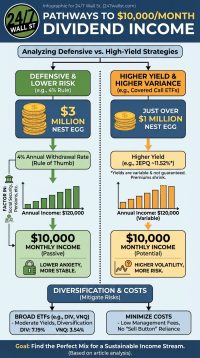
The trick is the yield. Hit it with the wrong instruments and you erode principal. Hit it conservatively and you need closer to a third of a million in capital. Here is the math at three tiers, using $12,000 a year as the round target.
Conservative Tier: 3% to 4% Yield
At a 3.7% yield, $12,000 a year requires about $324,000 in capital. This is the broad dividend-growth ETF range, anchored by funds like the Schwab U.S. Dividend Equity ETF (NYSEARCA:SCHD). SCHD holds quality payers like Bristol-Myers Squibb (4.3%), Merck (4.1%), ConocoPhillips (4.1%), and Lockheed Martin (4.1%), with an expense ratio of 0.06%. The fund has returned 229% over the past decade.
You give up income today. You gain dividend growth, principal appreciation, and diversification across healthcare, energy, telecom, and consumer staples. This is the sleep-at-night tier.
Moderate Tier: 5% to 7% Yield
At a blended 5.8% yield, $12,000 a year requires about $209,000. This is the high-dividend equity and REIT range. Two anchors:
Realty Income (NYSE:O) is a triple-net REIT that pays monthly. The current dividend is $0.2705 per share per month, with the next payment landing May 15, 2026. The yield sits at about 5%, and management has now strung together 113 consecutive quarterly increases. Portfolio occupancy sits near 99%, and the stock has gained about 18% over the past year.
Verizon (NYSE:VZ | VZ Price Prediction) yields about 5.8% and just bumped its quarterly payout to $0.7075. Free cash flow comfortably covers the dividend, and shares trade at roughly 10x forward earnings. Growth here is slow, but the income is durable.
Aggressive Tier: 8% to 10% Yield
At 10%, $12,000 a year requires only about $120,000. This is the business development company, mortgage REIT, and leveraged covered call range.
Ares Capital (NASDAQ:ARCC) is the largest publicly traded BDC. The dividend is $0.48 a quarter, unchanged since early 2023. Q1 2026 brought core EPS of $0.47 on total investment income of $763 million, with non-accruals at 2.1%. The yield is real, but the capital does the heavy lifting: shares are roughly flat over the past year, and BDC distributions tend to track interest rates rather than grow with inflation.
The Compounding Catch Most Income Investors Miss
A high current yield can look like a shortcut, but stretch the math across 20 years and the story changes. Realty Income raised its dividend roughly 5.2% year over year in early 2026. SCHD’s underlying basket has historically grown payouts faster. Ares Capital’s quarterly dividend, meanwhile, has stayed at $0.48 for three years.
Inflation makes that gap matter. CPI climbed roughly 3% from May 2025 through March 2026, which means a flat $0.48 dividend loses buying power every year. By contrast, a 3.7% yield growing 7% to 8% annually can double the income stream inside a decade. The aggressive tier maximizes today’s check; the conservative tier maximizes the check your grandchildren will cash.
What to Do Next
- Track your actual essentials, not your salary. If groceries, utilities, and phone come to $900 a month, the target is $11,000 a year, not a percentage of gross pay. The 10-year Treasury near 4.4% sets the floor for what risk-free income costs.
- Blend the tiers deliberately. A $185,000 sleeve split across SCHD, Realty Income, Verizon, and Ares Capital can land near 6% blended yield while preserving some growth. Pure aggressive is fragile; pure conservative is capital-intensive.
- Stress-test for a dividend cut. Model your monthly bills if the BDC sleeve cuts 25%. If the math still works, the portfolio is built. If not, shift weight toward the dividend-growth tier before you need the income.
Contact [email protected] for any questions or corrections.
Drew Wood has edited or ghostwritten nine books and published more than 1,500 articles on investing, business, politics, travel, world cultures, wildlife, and earth science. He holds a doctorate and four master's degrees and has nearly 30 years of college teaching experience. His travels have taken him to 25 countries, including three years living in Ukraine.