That 8% Yield on JEPI Is Actually 5.5% After Taxes: Here’s Why High Earners Should Know the Difference
On a recent episode of the Rich Habits Podcast titled “169: Our Favorite Passive Income Strategy (2026),” co-host Austin laid out the covered call ETF pitch that most yield-chasers skip: “Because JEPI uses these ELNs instead of actual listed options,…

This post may contain links from our sponsors and affiliates, and Flywheel Publishing may receive compensation for actions taken through them.

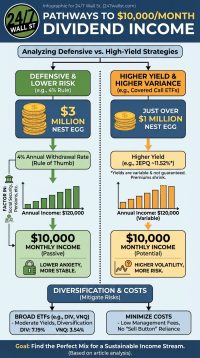
On a recent episode of the Rich Habits Podcast titled “169: Our Favorite Passive Income Strategy (2026),” co-host Austin laid out the covered call ETF pitch that most yield-chasers overlook: “Because JEPI uses these ELNs instead of actual listed options, the IRS treats virtually all of the premium income JEPI generates as ordinary income, not capital gains, not return of capital.” His follow-up is what you need to internalize before buying in a taxable account: for a high earner in the 32% federal bracket, nearly a third of every JEPI distribution goes straight to the government, turning that headline yield into roughly 5.5% after taxes.
If you own JPMorgan Equity Premium Income ETF (NYSEARCA:JEPI) in a regular brokerage account and you’re in a top tax bracket, that math quietly costs you thousands a year. The fund has grown to roughly $45 billion in assets, making it the most popular actively managed income ETF in the country, which means this tax conversation matters for a very large number of investors.
The 8% That Isn’t 8%
JEPI carries a trailing distribution yield of around 8%, backed by real monthly cash. The fund distributed $4.69 per share across all of 2025, with shares trading near $57. That payment arrives in your account every month, which feels good until you open the 1099.
A single filer earning around $220,000 sits solidly in the 32% federal bracket for 2026. Add the 3.8% Net Investment Income Tax that kicks in above $200,000 of modified adjusted gross income, and you are handing over roughly 35.8 cents of every distribution dollar before state taxes. In California or New York City, the combined rate pushes past 40%.
Put $100,000 into JEPI as a concrete example. An 8% gross yield generates about $8,000 annually. At a roughly 36% blended federal rate, you keep around $5,120, close to the 5.5% Austin mentions and that assumes no state income tax. A qualified-dividend ETF taxed at the 15% long-term capital gains rate would let you keep about $6,800 on a similar payout. The covered call structure bleeds roughly $1,700 a year per $100,000 invested straight to the IRS compared to a tax-efficient alternative.
Why ELNs Make the Tax Bill Worse
Standard listed index options can qualify for Section 1256 treatment, which splits gains 60/40 between long-term and short-term rates. JEPI routes its options exposure through equity-linked notes instead, which are structured debt instruments that deliver the covered call economics while keeping the fund’s operations cleaner. The premium comes back to shareholders as ordinary interest-style income, and the IRS taxes it accordingly.
JEPI’s managers chose this structure for practical reasons. It delivers a smoother monthly payout and allows customized risk positioning across approximately 120 hand-picked large caps from the S&P 500 rather than a mechanical index overlay. The early 2026 top holdings reflect a decidedly defensive tilt: EOG Resources, Johnson & Johnson, Ross Stores, NextEra Energy, and Howmet Aerospace each hold roughly similar weight near the top of the portfolio. The tradeoff for that flexibility and income consistency shows up at tax time.
JEPI vs. XYLD: Two Different Tradeoffs
Global X S&P 500 Covered Call ETF (NYSEARCA:XYLD) takes the opposite approach. It tracks the Cboe S&P 500 BuyWrite Index and sells at-the-money calls directly on the actual S&P 500 index. The strike sits at current market price, so any appreciation beyond that level is income the fund cannot capture. XYLD distributed $4.17 per share in 2025 on a share price now near $41, producing a trailing yield around 10%. The fund holds $3.24 billion in net assets, a fraction of JEPI’s scale.
The structural difference between the two funds matters in different market environments. JEPI sells out-of-the-money calls, leaving a buffer between today’s price and the level at which gains are capped. That buffer lets shareholders participate in modest market rallies. XYLD’s at-the-money strike surrenders essentially all upside beyond the option premium. In a flat or declining market, XYLD’s higher premium income is the more attractive feature. In a strong bull market, both funds lag well behind an uncapped index fund. Neither is designed to match the S&P 500 in a sustained rally.
The Variable That Decides It: Account Type
The factor that matters most here is not your age or your risk tolerance. It is whether you hold these funds inside an IRA, a Roth IRA, a 401(k), or a regular taxable brokerage account. Inside tax-advantaged accounts, the distinction between ordinary income and qualified dividends disappears entirely. JEPI’s yield is JEPI’s yield, full stop. In a taxable account for a 32%-bracket earner, that yield lands closer to 5.5%. At the top 37% federal bracket, combined with the NIIT, you are near 5.0% after federal taxes alone.
What To Do With This
- Pull your last 1099-DIV for any covered call ETF you own and check Box 1a (ordinary dividends) versus Box 1b (qualified dividends). For JEPI and XYLD, Box 1b is typically near zero.
- Multiply the gross distribution yield by (1 minus your marginal federal rate, plus 3.8% if you owe the NIIT) to get your true after-tax yield. Then compare that number against alternatives like municipal bond funds or qualified-dividend ETFs to see whether the trade-off makes sense for your situation.
- If the after-tax yield still looks attractive, consider moving the position into an IRA or Roth on your next rebalance. Tax-advantaged accounts are the natural home for ordinary-income generators.
Austin’s 8%-to-5.5% observation is the actual arithmetic of owning the most popular covered call ETF in the wrong account. Run your own numbers before the next monthly distribution hits.
Editor’s note: This article updates JEPI’s 2025 full-year distribution to $4.69 per share, revises the current share price to near $57 and the trailing yield to approximately 8%, adds the fund’s roughly $45 billion in assets under management, refreshes XYLD’s 2025 distribution total to $4.17 per share and its current share price to near $41, and updates JEPI’s top holdings to reflect the early 2026 portfolio composition including EOG Resources, Ross Stores, NextEra Energy, and Howmet Aerospace.
Contact [email protected] for any questions or corrections.
I've been writing about stocks and personal finance for 20+ years. I believe all great companies are tech companies in the long run, and I invest accordingly.