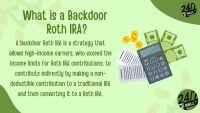
The Backdoor Roth IRA Move High Earners Use to Get $7,500 of Tax-Free Money Past the Income Cap
A 42-year-old couple posted to r/personalfinance last month asking whether they had to give up on Roth IRAs entirely. Their combined W-2 income hit $310,000, well above the 2026 phase-out, and their CPA had told them direct contributions were off…

This post may contain links from our sponsors and affiliates, and Flywheel Publishing may receive compensation for actions taken through them.

A 42-year-old couple posted to r/personalfinance last month asking whether they had to give up on Roth IRAs entirely. Their combined W-2 income hit $310,000, well above the 2026 phase-out, and their CPA had told them direct contributions were off the table.
The CPA was right about the front door. He apparently forgot to mention the back one.
Why the Income Cap Stops a $310,000 Household
For 2026, the Roth IRA contribution phase-out for married filing jointly runs from $242,000 to $252,000 of modified adjusted gross income. At $310,000, the couple is fully phased out. The traditional IRA, however, carries no income cap on contributions themselves, only on whether those contributions are deductible. That single distinction is the entire game.
The Two-Step That Sidesteps the Limit
Each spouse opens or reuses a traditional IRA and contributes $7,500 of after-tax cash. Because the household income is above the deduction threshold and both spouses are covered by a workplace plan, the contribution is non-deductible. They file Form 8606 with that year’s return to establish basis.
The next business day, each spouse converts the full traditional IRA balance to a Roth IRA. Because the contribution was already taxed and the cash has had no time to earn anything, the conversion itself produces almost no tax bill. The household just routed $15,000 of new money into Roth status that the income rules were designed to block. When each spouse turns 50, the IRA catch-up of $1,100 per person lifts the household total to $17,200 a year of fresh Roth contributions.
The Pro-Rata Trap That Quietly Ruins This for Most People
Here is where the move blows up if you skip a step. The IRS will not let you cherry-pick which dollars convert. If either spouse holds other pre-tax IRA balances on December 31 of the conversion year (a rollover IRA from an old 401(k), a SEP-IRA from a side business, a SIMPLE IRA), the conversion is taxed pro-rata across the aggregate IRA balance.
Picture a spouse with $93,000 in a rollover IRA plus the new $7,500 non-deductible contribution. Total IRA assets: $100,500. Only the small slice represented by basis converts tax-free. The rest counts as ordinary income at the household’s marginal bracket, which for $310,000 of W-2 income is 24%.
The fix is mechanical. Roll the pre-tax IRA money into the current employer’s 401(k) (most plans accept incoming rollovers) before December 31. 401(k) balances do not enter the IRA-aggregation formula, so the basis is clean and the conversion lands tax-free. The aggregation rule is per-individual, so one spouse’s old SEP-IRA does not contaminate the other spouse’s conversion.
What This Actually Compounds Into
Run the numbers on a 25-year window at a 7% return. Two spouses contributing $7,500 each every year produces roughly $948,750 of tax-free Roth wealth, none of which the direct-contribution rules would have allowed in. Catch-up dollars from age 50 onward push the total higher.
The current rate environment sharpens the case. The Fed funds rate sits at 3.75%, meaning fixed-income holdings inside the Roth are generating real yield that compounds without ever being taxed again. The national savings rate has slipped to 4% as CPI keeps grinding higher, with the index reaching 330.213 in March 2026. Tax-free compounding is one of the few levers high earners still fully control.
Three Moves to Make Before December 31
- Audit every IRA you and your spouse own. Pull statements for any rollover IRA, SEP-IRA, or SIMPLE IRA. If either spouse carries a pre-tax balance, schedule a reverse rollover into the active 401(k) well before year-end so the pro-rata rule cannot reach back and tax the conversion.
- Sequence the contribution and conversion correctly. Fund the non-deductible traditional IRA, wait a couple of business days for cash to settle, convert the full balance to Roth, and make sure your tax preparer files Form 8606. Skipping 8606 is the single most common error and it forfeits basis tracking forever.
- Get fiduciary eyes on the full plan if you also expect IRMAA exposure later. Households clearing $300,000 in W-2 income today usually face Medicare premium surcharges in retirement. A fee-only advisor modeling backdoor Roths, future Roth conversions, and RMDs typically pays for itself several times over.
Contact [email protected] for any questions or corrections.
Marc Guberti is a personal finance writer who has written for US News & World Report, Business Insider, Newsweek and other publications. He also hosts the Breakthrough Success Podcast which teaches listeners how to use content marketing to grow their businesses.