Want $4,800 in Annual Passive Income? Invest $40,000 Into These 3 High Yield Dividend Stocks
The pitch sounds clean: park $40,000 across three high-yield dividend names — Altria (NYSE: MO | MO Price Prediction), Verizon (NYSE: VZ), and Main Street Capital (NYSE: MAIN) — and collect $4,800 a year in passive income. That math requires…

This post may contain links from our sponsors and affiliates, and Flywheel Publishing may receive compensation for actions taken through them.
The pitch sounds clean: park $40,000 across three high-yield dividend names — Altria (NYSE: MO | MO Price Prediction), Verizon (NYSE: VZ), and Main Street Capital (NYSE: MAIN) — and collect $4,800 a year in passive income. That math requires a 12% blended yield, which is where dividend cuts usually live. These three stocks are legitimate income workhorses, but the honest version of this trade pays closer to $2,700 a year today. The gap between the headline and reality is the whole point of this piece.
The Scenario, In One Glance
- Capital available: $40,000, split roughly $13,333 per name
- Income target: $4,800/year (a 12% blended yield)
- Profile: Retiree or near-retiree wanting cash flow without selling shares
- Core decision: Stretch for yield, or accept what quality pays and grow it over time
Reddit’s r/dividends is full of versions of this question. Someone has a lump sum from a 401(k) rollover, an inheritance, or a home sale, and wants it to replace a paycheck immediately. The trap is treating yield as a thermostat you can dial up. Past a certain point, a 10%+ yield is the market telling you the dividend is in question.
What These Three Actually Pay Today
Altria trades around $72 with a $1.06 quarterly payout, an annualized $4.24 per share. That works out to roughly a 5.9% yield. Management raised the dividend for the 60th time in 56 years, and Q1 2026 adjusted EPS came in at $1.32 on $5.43B in revenue.
Verizon sits near $48 and just raised the quarterly dividend to $0.7075, an annualized $2.83, and a yield of around 5.9%. Free cash flow guidance of $17.5B to $18.5B covers the payout with room for the Frontier deal and the $144B debt stack.
Main Street Capital is the highest-yielding leg. The BDC pays $0.26 monthly plus a $0.30 quarterly supplemental, the 19th consecutive supplemental. At $51, that is roughly an 8.4% yield, covered by Q1 distributable net investment income of $1 per share.
Run the math: $13,333 in each produces about $785 from Altria, $784 from Verizon, and $1,124 from Main Street. Total: roughly $2,693. To reach $4,800, you need either ~$71,000 of capital at the same blended yield, or layer in something paying double digits (covered-call ETFs, mortgage REITs) and accept the NAV decay that usually comes with it.
Three Levers That Actually Move the Outcome
- Account location. Main Street’s distributions are mostly ordinary income, not qualified dividends. In a taxable brokerage at the 24% bracket (single filers over $105,700 in 2026), that $1,124 from MAIN becomes about $854 after tax. Held inside a Roth or traditional IRA, you keep the full payment. BDCs belong in tax-advantaged accounts whenever possible.
- Reinvestment versus spending. If you do not need the cash today, a DRIP on this trio compounds the income roughly 5% to 8% per year, on top of the base dividend growth rate. Altria’s payout went from $0.84 quarterly in 2019 to $1.06 today. Five more years of that trajectory, plus reinvested shares, gets a portfolio meaningfully closer to the $4,800 target without raising risk.
- Concentration risk. Three names are a thesis. Verizon was on dividend-cut watchlists during the rate-hiking cycle. Altria’s domestic cigarette volumes fell roughly 5% last quarter. One impairment can erase a year of income. If this is retirement money, three names should be a slice of a broader allocation, not the whole thing.
What To Do With This
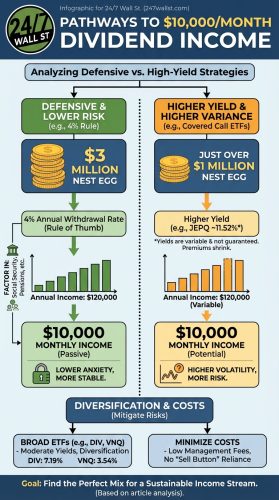
The most expensive mistake here is reaching for a 12% headline yield by replacing one of these with a covered-call ETF and treating the income as equivalent.
Quality dividend payers grow the cash; high-distribution funds often erode the principal that produces it. Start with what these three actually pay, decide whether the ~$2,700 covers what you need, and either add capital or reinvest to close the gap. Then, verify the account is the right one before the first check clears.
Contact [email protected] for any questions or corrections.
Ian Cooper is a veteran market analyst and investment strategist with more than 20 years of experience covering stocks, commodities, and macro trends. Since 1999, he has helped investors identify market opportunities using a blend of technical analysis, fundamental research, and market sentiment.
He is the creator of the ADD News Flow Strategy, which focuses on trading market reactions to major news events and investor psychology. Cooper was also among the analysts who warned about the 2008 financial crisis and major financial institution collapses ahead of the broader market.
Before joining 247 Wall St., Cooper wrote extensively for InvestorPlace and other financial publications, covering market trends, trading strategies, and investment opportunities.