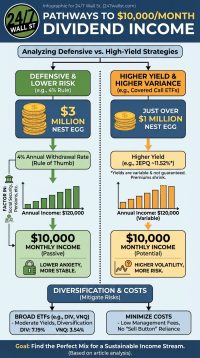
A $750,000 Portfolio That Can Reliably Produce $4,000 a Month
A $750,000 portfolio and a $4,000 monthly income target look like a clean equation, and they are: $48,000 divided by $750,000 equals 6.4%. The trick is that 6.4% is an awkward number. It sits above what most regulated utilities pay…

This post may contain links from our sponsors and affiliates, and Flywheel Publishing may receive compensation for actions taken through them.

A $750,000 portfolio and a $4,000 monthly income target look like a clean equation, and they are: $48,000 divided by $750,000 equals 6.4%. The trick is that 6.4% is an awkward number. It sits above what most regulated utilities pay and below what a pure business development company portfolio might offer. Hitting it reliably means blending, not chasing, and the composition of the blend matters more than the headline yield.
The 10-year Treasury yield now sits near 5%, so a 6.4% portfolio yield is roughly 140 basis points above that benchmark. That spread has compressed since earlier in 2026, which makes the income math somewhat tighter for new money entering the trade. Still, the goal is achievable. What follows is how five names commonly used for this job actually behave, and what happens if you lean too hard on any one of them.
The Cash Flow Engine
Two of the five holdings pay monthly, which matters when the target itself is monthly. Realty Income (NYSE:O) currently yields about 5.2%, with a $0.271 monthly payout and a track record of 674 consecutive monthly distributions. Main Street Capital (NYSE:MAIN | MAIN Price Prediction) pays a $0.265 monthly regular dividend plus a $0.30 quarterly supplemental. Together, those produce a running yield near 7.9% with supplementals included, a level that does real work in a 6.4% blended portfolio.
The three quarterly payers fill in the gap. Verizon (NYSE:VZ) yields about 5.7% at a $0.7075 quarterly rate, backed by 20 consecutive years of dividend increases. Altria (NYSE:MO) raised its quarterly payout 4.7% to $1.11 per share in August 2026, lifting the annualized yield to about 6.4%. Duke Energy (NYSE:DUK) pays $1.085 quarterly and yields about 3.6%, making it the portfolio’s stability anchor rather than its income engine.
Why 6.4% Is a Composition Problem
Equal-weighted, these five names would blend to roughly 5.8% using Main Street’s regular dividend alone, short of the 6.4% target. Counting Main Street’s supplemental distributions closes most of that gap, but supplementals are variable by design. To reach 6.4% reliably, the higher-yielding sleeves have to carry more weight, and that is where the sustainability questions start.
Verizon’s modest earnings multiple signals that the market is pricing the stock for income, not growth. Altria targets a dividend payout ratio of approximately 80% of adjusted EPS, which leaves less room for disappointment than a lower-payout business, though the company’s August 2026 increase to $1.11 per share marked its 61st dividend hike in 57 years. Main Street reported Q1 2026 net investment income of $0.93 per share and distributable net investment income of $1.00 per share, a reminder that BDC income depends on credit conditions, interest rates, and portfolio performance.
Duke and Realty Income do the steadier work. Duke’s quarterly dividend has climbed from $1.025 in 2024 to $1.085 in 2026, and the company has now maintained consecutive annual common-stock dividend payments for 100 years. Realty Income has posted 115 consecutive quarterly dividend increases and 674 consecutive monthly dividends. Neither yields enough on its own to hit 6.4%, but both reduce the portfolio’s dependence on the day a higher-yielder trims its payout.
The Growth Math Most Income Investors Skip
A 6.4% starting yield that grows 3% a year does not overtake an 8% flat yield in cumulative income over 15 years, but it does produce a higher annual income stream by about year nine. With the 10-year Treasury near 5% and inflation remaining elevated, the gap between safe and productive income has narrowed, which puts more pressure on every allocation decision. The Duke sleeve exists to help fight purchasing-power erosion over time, even if its current yield alone does not move the portfolio needle much.
Make the 6.4% Yield Survive Real Life
- Model your after-tax income, not the gross. Realty Income distributions and Main Street’s dividends are often largely ordinary income rather than qualified dividends, though final tax character can vary by year. In a 24% federal bracket, a fully ordinary $48,000 gross target would drop to about $36,480 before state taxes. If the actual spending gap is $40,000 after tax, you may not need 6.4% at all.
- Locate the tax-inefficient names in tax-advantaged accounts where possible. Main Street and Realty Income may be better candidates for an IRA or Roth because much of their income is often taxed at ordinary rates. Altria and Duke generally pay qualified dividends when IRS holding-period rules are met, so they can be more tax-efficient in a taxable account.
- Stress-test a distribution cut. Assume Verizon, Altria, or Main Street trims 20%, then recalculate the monthly income. If the portfolio still covers essential spending after a cut to one higher-yield sleeve, the allocation is more durable. If it does not, the yield is too concentrated in the fragile names.
A $750,000 portfolio can produce $4,000 a month, but the first month is not the real test. The real test is whether the income survives inflation, taxes, and the first dividend cut. With safe Treasuries now near 5%, the margin of advantage for taking on equity income risk is thinner than it was a year ago. A 6.4% target is still reachable, but it has to be built from holdings that can do different jobs: some paying more now, some growing the check over time, and some keeping the whole plan from leaning too hard on the riskiest yield.
Editor’s note: This update reflects Altria’s August 2026 dividend increase to $1.11 per share (from $1.06), Main Street Capital’s regular monthly dividend increase to $0.265 per share (from $0.26), Duke Energy’s quarterly dividend increase to $1.085 (from $1.065), and Realty Income’s updated consecutive monthly dividend count of 674. The 10-year Treasury yield figure was also updated to reflect its current level near 5%, narrowing the described spread above the benchmark from approximately 200 basis points to approximately 140 basis points.
Contact [email protected] for any questions or corrections.
Drew Wood has edited or ghostwritten nine books and published more than 1,500 articles on investing, business, politics, travel, world cultures, wildlife, and earth science. He holds a doctorate and four master's degrees and has nearly 30 years of college teaching experience. His travels have taken him to 25 countries, including three years living in Ukraine.