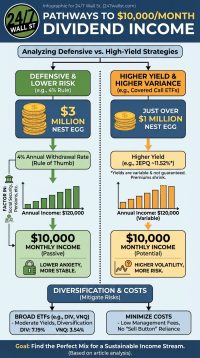
Want $4,800 in Annual Passive Income? Invest $40,000 Into These 3 High Yield Dividend Stocks
The pitch sounds simple. Put $40,000 to work, collect $4,800 a year, never sell a share. The arithmetic behind that promise is less friendly. Generating $4,800 on $40,000 requires a 12% blended yield, and that is roughly double what mature…

This post may contain links from our sponsors and affiliates, and Flywheel Publishing may receive compensation for actions taken through them.

The pitch sounds simple. Put $40,000 to work, collect $4,800 a year, never sell a share. The arithmetic behind that promise is less friendly. Generating $4,800 on $40,000 requires a 12% blended yield, and that is roughly double what mature dividend payers like Altria, Verizon, and Main Street Capital actually pay today after a strong run in income stocks.
This article walks through what an investor would really earn from Altria (NYSE: MO | MO Price Prediction), Verizon (NYSE: VZ), and Main Street Capital (NYSE: MAIN), why the headline number is a stretch, and how to think about chasing yield without buying trouble.
The setup, in plain English
You have $40,000 and want a monthly cash flow without selling principal. Splitting the money three ways gives roughly $13,333 per name, which is enough diversification to avoid single-stock disaster but concentrated enough for the income to feel real.
Here is what $13,333 actually buys at recent prices:
- Altria shares are around $74 with an annualized payout of $4.24 per share, a yield near 5.7%.
- Verizon trades near $48 with a declared quarterly dividend of $0.7075, and a yield near 5.9%.
- Main Street Capital sits around $50 with $0.26 monthly plus a $0.30 quarterly supplemental, putting the combined yield near 8.7%.
Spread evenly, the portfolio throws off roughly $2,700 a year, a blended yield close to 7%. That is real money on real risk, but it is not $4,800. Anyone selling you that number today is either using stale prices or quietly swapping in a covered-call ETF with NAV decay baked in.
Why yield alone is the wrong target
Income stocks have rallied hard. Altria is up 33% over the past year, and Verizon is up about 20%. When prices rise faster than payouts, yields compress. A stock advertising 12% today usually signals a broken thesis. Verizon itself was on dividend watch a few years ago before the payout survived a heavy capex cycle.
Tax treatment matters too. Altria and Verizon dividends are qualified, taxed at long-term capital gains rates. Main Street Capital is a Business Development Company, so most of its distribution is ordinary income, taxed at your marginal bracket, which for many households is 22% or 24%. That argues for holding BDCs inside an IRA or Roth rather than a taxable brokerage account.
What each name actually does in the portfolio
Altria Group is a cash machine, with 60 dividend increases over the past 56 years and a forward P/E of roughly 13. The risk is secular: domestic cigarette volumes keep declining, and domestic cigarette volumes continue to decline. Buyers are renting a slow-melting ice cube, paying you to wait.
Verizon is the stability anchor. Wireless service revenue continues to grow sequentially, but a heavy debt load caps growth and keeps the multiple low at about 12 times earnings.
Main Street Capital is the yield kicker. Q1 2026 distributable net investment income of $1 slightly underearned the $1.08 paid in dividends and supplementals, a warning that supplementals are not guaranteed. The 19th consecutive supplemental signals management confidence, though supplementals remain discretionary.
The takeaways worth acting on
Three things matter more than the headline number.
- First, set a realistic yield expectation: 6% to 7% is achievable from quality names today, and reaching for 12% almost always means accepting either capital decay or distribution cuts.
- Second, put the BDC inside a Roth IRA if you can; the ordinary-income tax drag on MAIN is the silent killer of after-tax returns.
- Third, reinvest distributions during accumulation and only flip to cash payouts when you actually need the income. Compounding $2,700 a year for a decade meaningfully changes the ending balance. Chasing a phantom $4,800 today rarely does.
Contact [email protected] for any questions or corrections.
Ian Cooper is a veteran market analyst and investment strategist with more than 20 years of experience covering stocks, commodities, and macro trends. Since 1999, he has helped investors identify market opportunities using a blend of technical analysis, fundamental research, and market sentiment.
He is the creator of the ADD News Flow Strategy, which focuses on trading market reactions to major news events and investor psychology. Cooper was also among the analysts who warned about the 2008 financial crisis and major financial institution collapses ahead of the broader market.
Before joining 247 Wall St., Cooper wrote extensively for InvestorPlace and other financial publications, covering market trends, trading strategies, and investment opportunities.