How a $500,000 Position in Senior Loan ETFs Can Generate $35,000 a Year With Floating-Rate Protection
A $500,000 position generating a 7% blended yield produces $35,000 in annual income, or about $2,917 per month. That is the arithmetic behind the headline and the same calculation a 62-year-old retiree might use when evaluating how much of a…


A $500,000 position generating a 7% blended yield produces $35,000 in annual income, or about $2,917 per month. That is the arithmetic behind the headline and the same calculation a 62-year-old retiree might use when evaluating how much of a portfolio to allocate to floating-rate credit. Senior bank loans generate income from loans whose interest payments adjust with short-term rates, making them distinct from traditional fixed-rate bonds. In an environment where the 10-year Treasury yields roughly 4.5% and inflation remains elevated, many income investors view floating-rate loans as a way to maintain income potential while reducing interest-rate sensitivity.
The Income Target and the Capital It Requires
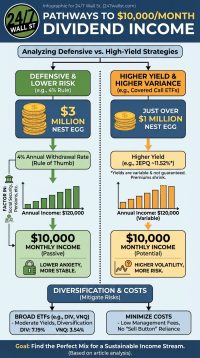
The core equation does not change: income target divided by yield equals capital required. For $35,000 of annual income, the capital needed scales directly with whatever yield you accept.
- At 3.5%, you need $1,000,000 invested.
- At 7.0%, you need $500,000 invested.
- At 12.0%, you need roughly $291,667 invested.
The 7% line is where senior loan ETFs, floating-rate mutual funds, and business development companies (BDCs) currently sit. That is also where most retirees first meet a real tradeoff between current income and principal stability.
Conservative Tier: 3% to 4% Yield
This is the dividend-growth and broad-market range. $35,000 divided by 0.035 equals $1,000,000 of capital. The instruments here are diversified equity index funds, dividend aristocrat ETFs, and high-quality corporate bond funds. Distributions grow over time, principal tends to appreciate, and inflation gets absorbed by both rising payouts and capital gains. The cost is upfront: you need twice the capital of the moderate tier to clear the same $35,000.
Moderate Tier: 5% to 7% Yield, Where Senior Loans Live
This is the tier the headline targets. $35,000 divided by 0.07 equals $500,000. Senior bank loans, syndicated leveraged loans, preferred shares, and certain covered-call equity income funds populate this range. Senior loans specifically are below-investment-grade corporate debt (typically BB to B credit) with coupons that reset every 30 to 90 days against SOFR or prime, which currently anchors near the 3.75% Fed funds upper bound.
Three vehicles map cleanly to this tier. Blackstone Senior Floating Rate 2027 Term Fund (NYSE:BSL) is a closed-end fund with a 2027 termination date, which gives investors a defined wind-down path. For BDC-style exposure inside the same yield band, Invesco Senior Loan ETF (NYSEARCA:BKLN) and SPDR Blackstone Senior Loan ETF (NYSEARCA:SRLN) both run SEC yields near 7.5%, broadly diversified across hundreds of loans.
Aggressive Tier: 8% to 14% Yield
Going higher means leaning on BDCs, mortgage REITs, and leveraged covered-call funds. Blackstone Secured Lending Fund (NYSE:BXSL | BXSL Price Prediction) reported a Q1 2026 dividend of $0.77 per share against a NAV near $26, an 11.7% annualized yield on net asset value. Ares Capital (NASDAQ:ARCC), the largest publicly traded BDC, pays $0.48 quarterly, or $1.92 annually.
At those yields, $35,000 of income requires closer to $300,000 of capital. The cost shows up in principal: BXSL is down roughly 16% over the past year, ARCC is down about 5%, and non-accruals have crept up at both. High current yield, lower total return.
Current Income vs. Future Income
A high yield can be appealing, but current income and long-term income growth are not the same thing. A 3.5% yield growing at 8% annually doubles its income stream in roughly nine years, while a higher-yield investment with little or no distribution growth may generate more cash upfront but less growth over time. For a 62-year-old with a 25-year investment horizon, a lower-yield, dividend-growth strategy can ultimately produce more cumulative income despite the smaller initial payout. Senior loans address a different objective. Their floating-rate structure can help protect income when interest rates remain elevated, providing current cash flow and reduced rate sensitivity while longer-term compounding strategies develop.
What to Do With This Math
- Cap senior-loan exposure at 15% to 20% of the portfolio. The 2009 default cycle saw 5% to 8% default rates in this asset class, and prices behaved like equities, not bonds.
- Compare 10-year total return (not just yield) between a 3.5% dividend-growth fund and a 10%+ BDC. The growth fund frequently produces more cumulative income once dividend increases compound.
- Model the tax drag. BDC and senior-loan distributions are largely ordinary income, which lands harder in a high bracket than qualified dividends or municipal coupons.


Contact [email protected] for any questions or corrections.
Drew Wood has edited or ghostwritten nine books and published more than 1,500 articles on investing, business, politics, travel, world cultures, wildlife, and earth science. He holds a doctorate and four master's degrees and has nearly 30 years of college teaching experience. His travels have taken him to 25 countries, including three years living in Ukraine.