US Private Credit Surges to Record $1.8 Trillion as BDCs Fill $350 Billion Financing Gap
Prior to 2008, some of the more popular US banking institutions included: Lehman Brothers Bear Stearns Wachovia Bank Washington Mutual Merrill-Lynch IndyMac As depicted in the 2015 movie, The Long Short, the unsustainable subprime mortgage bubble wound up causing a…


Prior to 2008, some of the more popular US banking institutions included:
- Lehman Brothers
- Bear Stearns
- Wachovia Bank
- Washington Mutual
- Merrill-Lynch
- IndyMac
As depicted in the 2015 movie, The Long Short, the unsustainable subprime mortgage bubble wound up causing a banking industry meltdown. All of the banks in the list above despite decades of successful operations, were caught flatfooted and insolvent when the crash hit. The federal government was forced to trigger TARP (Troubled Asset Relief Program) which helped to shore up the balance sheets of the largest institutions. The leftover banks were steered towards the TARP recipients for acquisition, with Bear Stearns most notably being acquired by JP Morgan Chase at a fire-sale price of $2 per share.
Unsurprisingly, turning around operations to remove red ink from balance sheets became the imperative of all of these new consolidated banks. For example, Brian Moynihan of Bank of America, which acquired Merrill-Lynch, issued a directive for brokers to close out accounts smaller than $200,000. An unforeseen casualty of the bank consolidations were the small and medium sized businesses that had been relying on the Washington Mutuals, et al. for their revolving credit lines, their inventory finance, and a panoply of other debt finance services.
With millions of medium and small businesses suddenly stuck without financing options, Business Development Companies (BDCs) emerged to fill the gap, which has subsequently created a sizable standalone BDC category estimated to be over $350 billion and part of the larger $1.8 trillion private credit sector. As BDCs are registered with the SEC, they are treated comparably to REITs and thus, shareholders receive 90% of BDC profits. The five BDC examples below give a good example of the demand strength in the sector and the boost to entrepreneurship and business creation and the yields each offers investors.
WhiteHorse Finance, Inc.

WhiteHorse Finance, Inc. (NASDAQ: WHF)
Yield: 17.66%
WhiteHorse Finance, Inc. is a Business Development Company that finances lower and mid-tier companies with growth capital in the form of senior secured notes or first lien notes. Headquartered in Miami, FL, WhiteHorse typically originates its debt underwritings in the $25 million to $50 million range for US companies in the $50 million to $350 million enterprise value category. It has deployed its $642 million portfolio to finance $2.78 billion across 260 transactions since going public in 2012.
Goldman Sachs BDC, Inc.
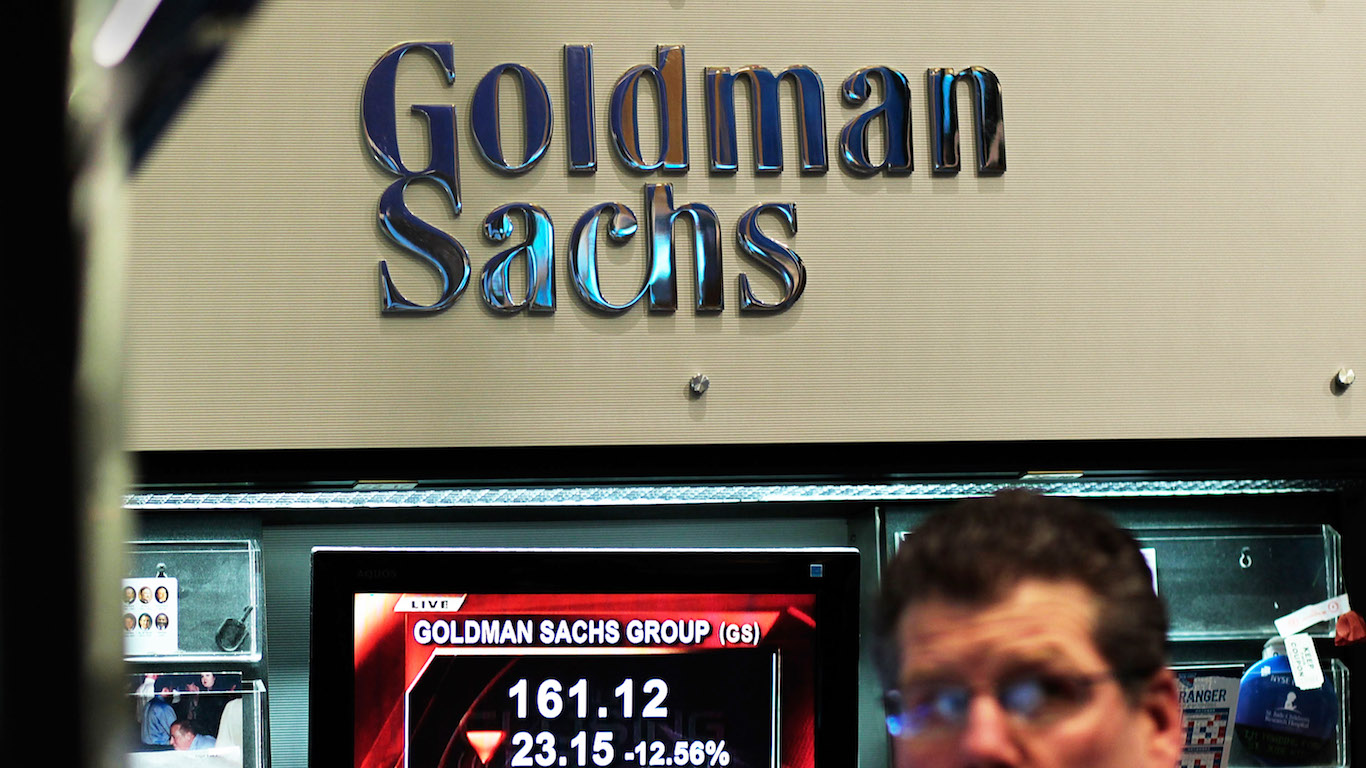
Goldman Sachs BDC, Inc.(NYSE: GSBD)
Yield: 14.13%
The lucrative profits that well financed firms can avail themselves of in the BDC space have caused some of the aforementioned larger banks to get a foothold into it as well, after abandoning it years ago. Goldman Sachs is one of them.
MSNBC’s Jim Cramer described Goldman Sachs recently as a firm with “a thirst that can’t be slaked without more deals.” Journalist Matt Taibbi dubbed Goldman Sachs, the prestigious (some would say nefarious) investment bank with the nickname, “Great Vampire Squid” due to it being “wrapped around the face of humanity, relentlessly jamming its blood funnel into anything that smells like money” and its omnipresent shadow on any financial platform where money can be made. The self-descriptive Goldman Sachs BDC, Inc. represents the Goldman Sachs BDC footprint.
Stellus Capital Investment Corporation

Stellus Capital Investment Corporation (NYSE: SCM)
Yield: 11.47%
Participating in both the private corporate debt and equity markets, Houston, TX headquartered Stellus Capital Investment Corp. finances deals for American and Canadian companies with EBITDA between $5 million and $50 million. With a $3.4 billion AUM warchest, Stellus has invested over $9.8 billion across 350+ investments since beginning over 20 years ago. The company currently has over 100 financings currently active.
Carlyle Secured Lending, Inc.

Stock: Carlyle Secured Lending, Inc. (NASDAQ: CGBD)
Yield: 12.93%
Best known for its involvement with its aerospace and defense industry investments, NY based Carlyle Group has stakes in a number of other financial platforms. With a multi billion portfolio, Carlyle Secured Lending, Inc. is Carlyle Group’s entry into the BDC arena.
Golub Capital BDC Inc.

Golub Capital BDC Inc. (NASDAQ: GBDC)
Yield: 10.65%
Golub Capital BDC Inc. has an unbroken award winning decade-long streak in process, with its 2024 Lender of the Year win. In 2023, Golub Capital won all three Lender of the Year, Senior Lender of the Year, and BDC Manager of the Year in the Americas awards from Private Debt Investor (PDI), and has won 24 PDI awards since 2013. Its latest acknowledgement came this year from Newsweek, which listed Golub Capital BDC in its “America’s Greatest Midsize Workplaces” rankings.
Contact [email protected] for any questions or corrections.
After 15 years on Wall Street with 7 of them as Director of Corporate and Municipal Bond Trading for a NYSE member firm, I started my own project and corporate finance consultancy. Much of the work involves writing business plans, presentations, white papers and marketing materials for companies seeking budgetary allocations for spinoffs and new initiatives or for raising capital for expansion or startup companies and entrepreneurs. On financial topics, I have been published under my own byline at The Motley Fool, 247wallst.com, DealFlow Events’ Healthcare Services Investment Newsletter and The Microcap Newsletter, among others. Additionally, I have done freelance ghostwriting writing and editing for several financial websites, such as Seeking Alpha and Shmoop Financial. I have also written and been published on a variety of other topics from music, audiophile sound and film to musical instrument history, martial arts, and current events. Publications include Copper Magazine, Fidelity (Germany), Blasting News, Inside Kung-Fu, and other periodicals.