Medicare Still Won’t Buy Your Hearing Aids, and They Run Up to $7,000
A 68-year-old walks out of an audiologist’s office with a quote for a mid-range pair of hearing aids: $5,800. She is on Original Medicare and assumed the fitting and the devices would be covered, or at least partly. Neither is.…

This post may contain links from our sponsors and affiliates, and Flywheel Publishing may receive compensation for actions taken through them.

A 68-year-old walks out of an audiologist’s office with a quote for a mid-range pair of hearing aids: $5,800. She is on Original Medicare and assumed the fitting and the devices would be covered, or at least partly. Neither is. The full bill is hers.
This is the most expensive routine gap in Medicare, and the one enrollees discover latest. If you are on Original Medicare and your hearing has slipped, plan on the entire cost coming out of pocket. If you are on a Medicare Advantage plan with a “hearing benefit,” that benefit almost certainly does not cover what the marketing implied.
What Original Medicare Pays For, and What It Doesn’t
Original Medicare excludes hearing aids and exams for fitting hearing aids. Part B covers diagnostic hearing and balance exams when a doctor or other health care provider orders them to find out whether medical treatment is needed. Since 2023, Medicare also allows one audiologist visit every 12 months without a provider order for certain non-acute hearing conditions, but that exception does not cover hearing aids or exams for fitting hearing aids. Know which kind of appointment is on the schedule before you go.
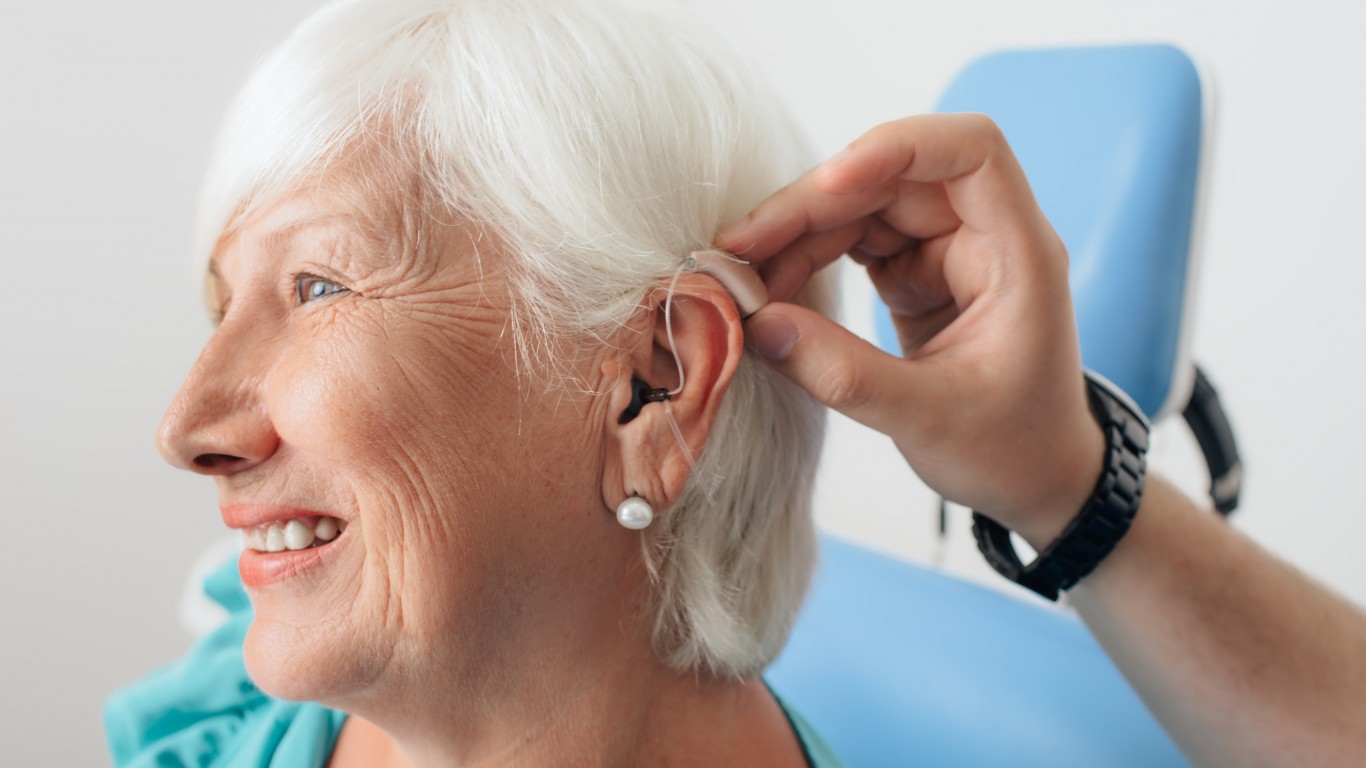
Once the diagnostic test is over, you are on your own for the devices. A mid-range prescription pair from an audiologist runs roughly $4,000 to $7,000 (market estimate, varies by brand, technology tier, and bundled service). Premium pairs go higher. There is no Medicare reimbursement, no deductible to clear, no coinsurance to negotiate. The check is written in full.
The Math Against the Rest of Your Healthcare Budget
To put that bill in scale: in 2026 Q1, per capita disposable income ran $68,359 and the personal savings rate sat at 3.7%, down from 5.2% a year earlier. A $5,000 device purchase eats a meaningful share of a year’s savings for a typical household. Healthcare already absorbs roughly 17% of all personal consumption spending, and hearing aids sit entirely outside the insured portion of that budget for Original Medicare enrollees. The standard 2026 Part B premium and cost-sharing structure buy a great deal of medical coverage. Hearing aids are not in the basket.
Medicare Advantage Hearing Benefits: Read the Allowance, Not the Brochure
Most Medicare Advantage plans advertise hearing coverage. Behind the headline, the benefit is usually a fixed allowance, typically a few hundred to a few thousand dollars per ear toward a hearing aid copayment, paired with a required exam from an in-network provider. One 2026 plan from Independent Health, for example, lists a modest annual allowance per ear and an evaluation copay, performed through a contracted vendor.
Two things to flag before you treat that as “covered”:
- The allowance does not float to retail prices. If the device is $3,500 and the allowance is $1,000 per ear, you owe the rest.
- You usually must buy through the plan’s contracted hearing network. Walking into the local audiologist you already trust often voids the benefit.
A reader weighing Advantage during open enrollment should treat the hearing line as a coupon of a specific dollar size, tied to a specific vendor, not as coverage.
OTC Hearing Aids: The Lower-Cost Path
Since the FDA approved over-the-counter hearing aids for adults with perceived mild to moderate hearing loss, the price floor has dropped sharply. OTC pairs commonly run a few hundred to a low four-figure price, with some tested models running higher. For a Medicare beneficiary with mild loss and no medical complication, OTC keeps the bill in three or low four figures instead of five.
OTC fits the most common case: age-related high-frequency loss in someone who would otherwise put off the purchase entirely. Skip OTC for moderate-to-severe loss, single-sided deafness, or any audiogram showing asymmetry that warrants a medical workup.
What to Do
- If you are on Original Medicare and considering aids, ask whether your hearing exam will be billed as a covered diagnostic audiology service or as a non-covered hearing-aid fitting exam. Part B covers eligible diagnostic hearing exams subject to the deductible and 20% coinsurance, and Medicare now allows one audiologist visit every 12 months without an order for certain non-acute hearing conditions. The devices themselves, and exams for fitting them, remain excluded.
- If your loss is mild and your audiogram is symmetric, price OTC devices in the $300 to $1,500 range before booking a prescription fitting at an audiologist.
- If you are shopping a Medicare Advantage plan during open enrollment, ask the plan for the exact allowance per ear, the contracted hearing vendor, and the average member out-of-pocket after the allowance. A plan promising hearing coverage that pays $250 per ear is not solving a $5,000 problem.
Figures reflect 2026 plan-year Medicare rules. Hearing aid price ranges are market estimates and vary by brand, technology tier, and provider.
Contact [email protected] for any questions or corrections.
Drew Wood has edited or ghostwritten nine books and published more than 1,500 articles on investing, business, politics, travel, world cultures, wildlife, and earth science. He holds a doctorate and four master's degrees and has nearly 30 years of college teaching experience. His travels have taken him to 25 countries, including three years living in Ukraine.