You Don’t Need a Powerball Jackpot To Build A $5,000 Monthly Dividend Paycheck
The latest Powerball jackpot stood at roughly $269 million, with a cash option of about $120.5 million before taxes. That would solve all your financial problems, but the odds are not great: roughly 1 in 292 million. If your goal…

This post may contain links from our sponsors and affiliates, and Flywheel Publishing may receive compensation for actions taken through them.

The latest Powerball jackpot stood at roughly $269 million, with a cash option of about $120.5 million before taxes. That would solve all your financial problems, but the odds are not great: roughly 1 in 292 million. If your goal is simply to create a $5,000 monthly dividend paycheck, however, a Powerball win is the financial equivalent of using a bulldozer to plant a flower garden.
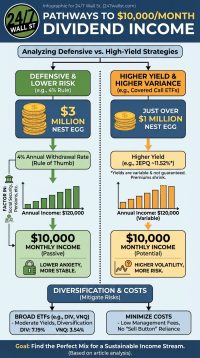
At a 5% portfolio yield, generating $5,000 a month requires about $1.2 million in invested assets. At higher yields, the required capital falls, though the risks generally rise alongside the income. No strategy can make the lottery a good bet, financially, but a well-constructed portfolio can realistically produce a monthly cash flow that will make you feel like you hit the jackpot. Here are a few ways investors attempt to do it.
The capital required
Income target divided by yield equals capital needed. Run the equation at four realistic levels:
- 3.5% yield (conservative): $60,000 divided by 0.035 equals roughly $1,714,000. Dividend Kings, broad dividend-equity funds, blue-chip staples and insurers cluster here. You trade current yield for compounding raises and principal appreciation.
- 5% yield (moderate): $60,000 divided by 0.05 equals $1,200,000. Net-lease REITs, regulated utilities, and quality preferred shares sit at this level. Dividend growth slows; income stays durable.
- 7% yield (high): $60,000 divided by 0.07 equals roughly $857,000. Covered-call equity ETFs, midstream pipelines, and select telecoms operate here. Capital appreciation becomes uneven.
- 10% yield (aggressive): $60,000 divided by 0.10 equals $600,000. Mortgage REITs, business development companies, leveraged option-income funds, and high-yield bond funds. Distributions get cut, principal often erodes, and you spend the asset as much as live off it.
Building the capital
Few people arrive with $600,000, let alone $1.7 million. That capital gets built through payroll deferrals, IRAs, dividend reinvestment, and decades of patience. The national savings rate is only 3.7%, so a deliberate plan beats the average household by definition.
A saver putting away $500 a month at an 8% blended return reaches the high-yield tier by their early 60s. A thousand a month closes in on the conservative tier. Two thousand a month gets there a decade sooner. The hard part is starting and not stopping.
How compounding accelerates
The first $100 in annual dividends feels like a rounding error. Five years of contributions and reinvested payouts turn it into $500. Another five and it is $1,000. Reinvested dividends buy more shares, which pay more dividends, which buy more shares. Getting from $5,000 to $20,000 in annual income takes far less time than getting from $100 to $1,000.
Yield versus growth over twenty years
Two investors, same $300,000 portfolio. Investor A buys a 10% yield that never grows and collects $30,000 a year, in flat nominal dollars, indefinitely. Investor B buys a 3.5% yield growing 8% annually: $10,500 in year one, but the income roughly doubles every nine years. By year ten, Investor B collects around $22,000. By year twenty, north of $48,000, while Investor A remains at $30,000 in dollars that roughly 4% headline PCE inflation has steadily eroded.
What the market pays now
- Dividend-growth core: Johnson & Johnson (NYSE:JNJ | JNJ Price Prediction) yields about 2.2% with 64 straight years of dividend increases. Procter & Gamble (NYSE:PG) yields roughly 2.9% and has paid dividends every year since 1890.
- Moderate-yield equity and REITs: Realty Income (NYSE:O) pays monthly, yields about 5.2%, and just declared its 114th consecutive quarterly increase. Verizon yields around 5.8% backed by $21.5 billion-plus in free cash flow guidance.
- Higher-yield equity: Altria (NYSE:MO) yields close to 5.9%, with a quarterly payout that stepped from $1.02 to $1.06 in late 2025.
- Inflation protection: The Schwab U.S. TIPS ETF charges a 0.03% expense ratio and tracks a real-yield curve currently near 2.1% on the ten-year TIPS, useful as ballast against rising prices.
- Cash benchmark: The national average 12-month CD pays just 1.7%, which is why income investors accept equity risk.
Starting with… or without… capital
Some investors arrive with $1 million from inheritance, a business sale, real estate exit, or vested stock comp. For everyone else, the path is unglamorous: maximize the employer match, fund the IRA, buy quality income at fair prices, reinvest every distribution, and let time work.
Get Started Today
Here are three things you can do today to get the ball rolling:
- Model your actual spending rather than your salary, because you may need to replace less than $60,000
- Compare the ten-year total return of a dividend-growth fund against a high-yield fund to see compounding in action
- If you are within five years of retirement, run the tax math on each tier in your bracket.
Powerball winners get rich overnight. Most dividend investors get there the slower way: one contribution, one reinvested dividend, and one year at a time.
Contact [email protected] for any questions or corrections.
Drew Wood has edited or ghostwritten nine books and published more than 1,500 articles on investing, business, politics, travel, world cultures, wildlife, and earth science. He holds a doctorate and four master's degrees and has nearly 30 years of college teaching experience. His travels have taken him to 25 countries, including three years living in Ukraine.