Your Rich BFF Says Gen Z Should Think Twice Before Buying a House, and the Numbers Back Her Up
A Zillow expert sat down with Your Rich BFF and ran the numbers on homeownership in America's biggest cities, and the results will make most twenty-somethings seriously rethink the advice they grew up hearing.

This post may contain links from our sponsors and affiliates, and Flywheel Publishing may receive compensation for actions taken through them.
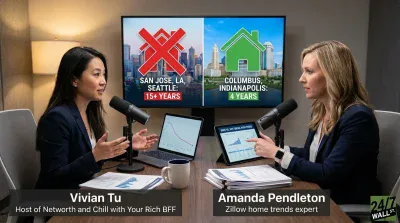
On a recent episode of Networth and Chill with Your Rich BFF, host Vivian Tu sat down with Zillow home trends expert Amanda Pendleton to pressure-test one of the most repeated pieces of financial advice given to twenty-somethings: buy a house as soon as you can. Pendleton’s blunt read on the numbers: “In LA, we’re talking 17 years before you break even. In Seattle, it’s almost 20 years. In San Diego, 24 years. Here in New York, it’s 12 and a half years.”
The stakes for a Gen Z buyer are concrete. If you sign a mortgage in a market where the break-even horizon is 17 or 20 years and you move for a job, a partner, or a lifestyle change in year six, you don’t just miss out on appreciation. You eat closing costs, agent commissions, property taxes, insurance, mortgage interest, and maintenance without ever crossing the line where owning beats renting.
The Math Is Uglier Than Most Buyers Realize
Tu and Pendleton are right. Zillow’s analysis pegs the nationwide break-even at about 6 years. That single figure hides an enormous spread. In the country’s most expensive metros, home prices have decoupled from rents to the point where the arithmetic of ownership stops working.
Pendleton spells it out: “in San Francisco and San Jose, you never break even. Renting still wins out after a 30-year time horizon.” In the Bay Area, a renter who invests the money they would have used for a down payment ends up roughly $564,000 ahead of a buyer after 30 years. That is the entire cost of a starter home in most of the country, sitting in a brokerage account, because the buyer chose the wrong zip code.
The mechanic is straightforward. Break-even analysis compares the total cost of owning (down payment opportunity cost, mortgage interest, taxes, insurance, maintenance, transaction costs) against the total cost of renting the same shelter over the same period. When home prices are 40 or 50 times annual rent, the buyer’s carrying costs are so much higher than the rent bill that appreciation cannot catch up in a reasonable timeframe. That gap has widened as the 10-year Treasury yield sits near 4.7%, keeping 30-year mortgage rates well above what any Gen Z buyer’s parents paid.
Market conditions reinforce the caution. The Case-Shiller National Home Price Index hit 335 in May 2026, a fresh high, while existing home sales are stuck at a soft 4.09 million annualized rate. Prices are elevated, transaction volume is thin, and consumer sentiment is at 49.5, near recessionary territory. This is a market that punishes buyers who overpay.
Your Zip Code Rewrites the Answer
One factor swamps every other consideration. Pendleton identifies the winners: Columbus, Indianapolis, Memphis, and Buffalo, where buyers break even in just 4 years. She calls buying in those metros a “slam dunk” and “absolutely the best financial decision.”
State economics data explain why. Ohio’s cost-of-living index sits near 93, Indiana at 93, Tennessee at 92, all well below the national average of 100. Incomes in those states are lower in nominal terms, but real purchasing power holds up. Compare that to California’s cost-of-living index near 111 or New York’s near 108, where a higher paycheck evaporates into rent, taxes, and an oversized mortgage.
A 27-year-old in Indianapolis putting 10% down on a modest home is roughly at break-even before their next job change. A 27-year-old in San Jose making the same move never gets there, and the opportunity cost on the down payment compounds against them every year they stay.
What to Do Before You Sign
Tu’s framing is the right one. She wants listeners to make “an educated decision about whether or not you want to buy or rent. Not some advice your parents” gave you, not an outdated rule of thumb. Three concrete steps:
- Pull your market’s break-even number. Zillow, the New York Times rent-vs-buy calculator, and NerdWallet all publish city-level break-even horizons. If yours reads 15 years and you cannot realistically commit to staying that long, the math has already answered the question.
- Price the opportunity cost of your down payment. Take the amount you would put down, assume a 7% long-run equity return, and compare that projected balance to your expected home equity at year 10. If the brokerage account wins, renting is the trade.
- Recalculate every time rates move. With the 10-year Treasury near cycle highs, a one-percentage-point shift in mortgage rates can move the break-even line by years. Rerun the numbers before you make an offer.
Buying a home is a math problem before it is a milestone, and in a handful of coastal cities the math never resolves in the buyer’s favor.
Contact [email protected] for any questions or corrections.
I am a long time investor and student of business, and believe finding good companies that can become great investments is the best game on earth. After 20 years of writing and researching the public markets it is clear that individuals have never had more tools and information to take control of their financial lives. From ETFs and $0 commissions to cryptos and prediction markets there has never been a greater democratization of access to investing.
I write to help people understand the investments available to them so they can make the best choice for their portfolio, whether they're starting out or looking for income in retirement.