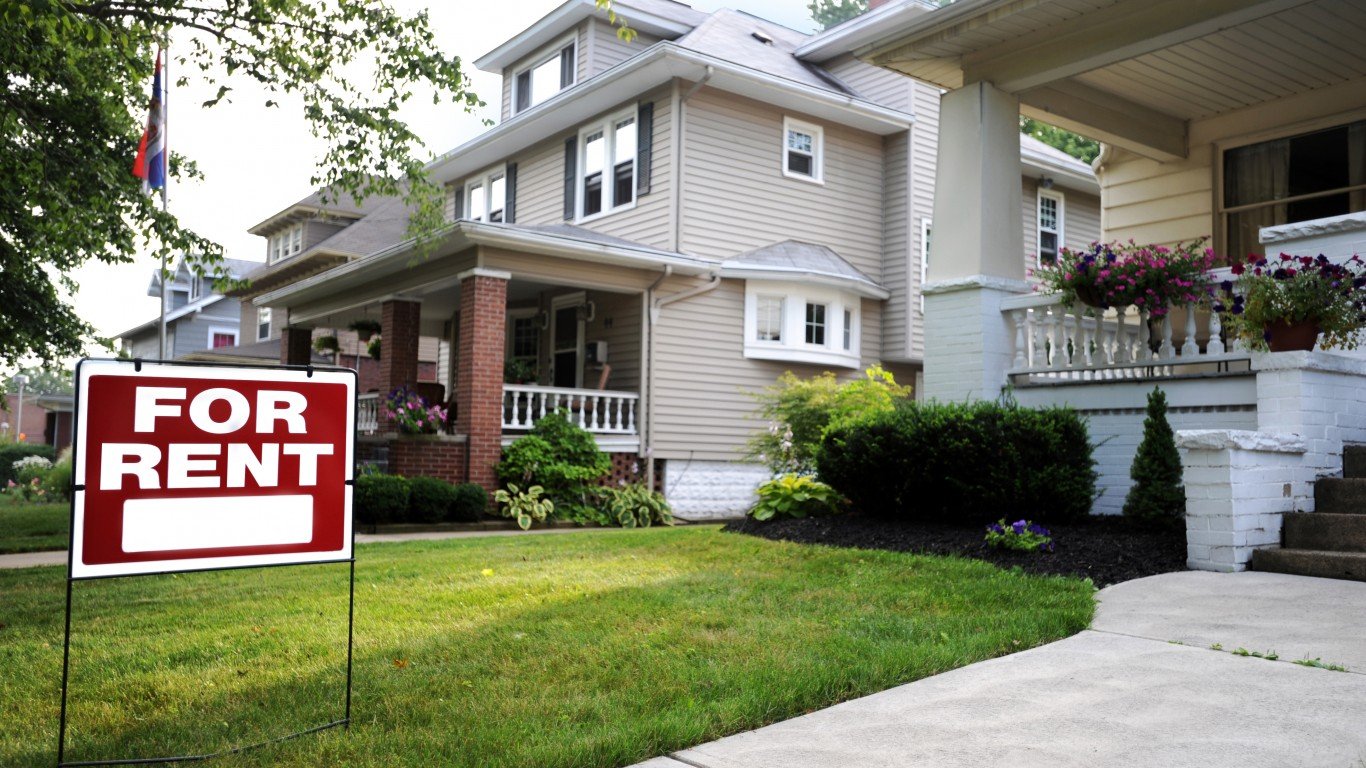
Why a Dividend Portfolio That Pays Your Rent May Beat Homeownership by $500,000 Over 20 Years
Paying $2,000 a month in rent is often described as throwing money away. Homeownership, by contrast, is treated as the only reliable path to wealth. Yet under the right conditions, a dividend portfolio large enough to cover your rent can…

This post may contain links from our sponsors and affiliates, and Flywheel Publishing may receive compensation for actions taken through them.

Paying $2,000 a month in rent is often described as throwing money away. Homeownership, by contrast, is treated as the only reliable path to wealth. Yet under the right conditions, a dividend portfolio large enough to cover your rent can leave you with greater flexibility and, in some cases, a larger net worth than owning a home. The portfolio generates income without tying your capital to a single property, allowing you to relocate for a better job, move closer to family, or take advantage of lower-cost markets without the transaction costs and friction that come with selling a house.
The math begins with a simple equation: annual rent divided by portfolio yield equals the capital required to cover the expense. A renter paying $2,000 per month faces an annual housing cost of $24,000. That is the income target the portfolio must replace.
The Opportunity Cost of a Down Payment
The standard argument is that renters throw money away because they never build equity. Homeowners do build equity, but they also commit capital that could have been invested elsewhere. A buyer who puts 20% down on a $600,000 home commits $120,000 to home equity. That money may participate in future home appreciation, but it is no longer available for other investments.
If the same $120,000 were invested in a dividend-growth portfolio yielding 3.5%, it would generate roughly $4,200 in income during the first year, with the potential for both the income stream and principal value to grow over time. Mortgage interest adds another layer of cost. While homeowners build equity with part of each payment, a substantial portion goes toward financing costs that never come back.
The Costs Beyond the Mortgage
The mortgage payment is only the beginning. Property taxes, homeowners insurance, repairs, maintenance, landscaping, appliance replacement, and HOA fees can add thousands of dollars per year to the true cost of ownership. Financial planners often recommend setting aside 1% to 2% of a home’s value annually for maintenance alone.
There is also a cost that rarely appears on a spreadsheet: time. Every leaking faucet, broken appliance, aging roof, and overgrown yard must either be handled personally or paid for separately. Homeowners spend money, time, or some combination of both to keep a property functioning.
Renters are not simply paying for a place to live. In many cases, rent bundles maintenance, repairs, landscaping, snow removal, and professional management into a single monthly payment. Depending on the property, it may also include amenities such as swimming pools, fitness centers, tennis courts, pickleball courts, clubhouses, and security services that would be costly to replicate as a homeowner.
Flexibility Has a Dollar Value
A homeowner who wants or needs to relocate often faces significant transaction costs. Realtor commissions, closing costs, moving expenses, and the time required to market and sell a property can easily reach tens of thousands of dollars.
On a $700,000 home sale, total selling costs can approach $35,000 to $50,000. A renter may face little more than moving expenses and a notice requirement. That flexibility has value not only when pursuing a higher-paying opportunity, but also when responding to circumstances beyond one’s control. Job transfers, layoffs, family emergencies, and caregiving responsibilities can all require a move on short notice. A homeowner may have to sell into an unfavorable market or carry two housing payments during the transition. A renter can often adapt much more quickly.
The value of flexibility is particularly apparent for younger professionals and remote workers. Someone in their twenties or thirties may not know where they ultimately want to settle. Renting makes it easier to spend a few years in different cities, move closer to friends or family, or test a new region before making a long-term commitment. That freedom can be financially valuable, but it can also improve quality of life by allowing people to align their housing decisions with changing careers, relationships, and priorities.
Over a 20-year career, the ability to relocate quickly for a better job, a lower-cost city, a family need, or a changing lifestyle can create opportunities that are difficult to quantify but potentially worth far more than many people realize.
Ownership Does Not Mean Complete Control
Many buyers assume that ownership means total freedom. In practice, a homeowner often answers to a different set of authorities. HOA boards may regulate paint colors and exterior changes. Insurance companies can require costly repairs or roof replacements. Mortgage lenders may impose restrictions on certain improvements, while local governments can reassess property values and increase tax bills.
Unexpected costs can arrive without warning. Special assessments, new regulations, insurance requirements, or short-term rental restrictions can materially affect the economics of ownership. The deed provides rights, but it does not eliminate outside influence.
Three Ways to Fund the Rent Check
Conservative tier (3% to 4% yield). $24,000 divided by 0.035 equals roughly $686,000 in capital. This is the dividend growth lane: blue-chip aristocrats and broad dividend ETFs. Johnson & Johnson (NYSE:JNJ | JNJ Price Prediction) just hiked its dividend to $1.34 a quarter, marking 64 consecutive years of increases. P&G (NYSE:PG) just notched its 70th consecutive annual increase and has paid dividends since 1890. Schwab U.S. Dividend Equity ETF (NYSEARCA:SCHD) gives you a diversified version of the same idea for a 0.06% expense ratio across $71.6 billion in assets.
Moderate tier (5% to 7% yield). $24,000 divided by 0.06 equals roughly $400,000. This is REITs, preferreds, and covered-call funds. Realty Income (NYSE:O) yields 5.4%, pays monthly, and has now declared 670 consecutive monthly dividends. AbbVie (NYSE:ABBV) sits at the high end of pharma yields and has lifted its quarterly payout from $0.40 in 2013 to $1.73 today.
Aggressive tier (8% to 14% yield). $24,000 divided by 0.10 equals roughly $240,000. Leveraged covered-call ETFs, business development companies, mortgage REITs, and high-yield bond funds live here. The headline yield is real. So is the principal erosion.
Why the Boring Tier Usually Wins
JNJ’s quarterly dividend was $0.25 in 1999. It is $1.34 today. A renter who bought enough JNJ in 2016 to cover rent then would have watched both the dividend and the share price (up 164% over 10 years) outrun their landlord. SCHD did even better, returning 229% over the same decade. ABBV returned 444%. A 12% yield fund with no growth pays the same $24,000 in year one and roughly $24,000 in year twenty, minus whatever the NAV bleeds.
Three Things to Do This Week
- Add up your true annual housing cost (mortgage interest, taxes, insurance, maintenance, HOA, opportunity cost on the down payment) and compare it to local rent, not just your principal-and-interest payment.
- Pull the 10-year total return of a 3.5%-yield dividend grower against a 10%-yield covered-call fund. The compounding gap is the entire argument.
- If your career or family situation could plausibly require a move in the next five years, price the realtor commission and closing costs you would pay and weigh that against a year of rent.
A house produces shelter. A dividend portfolio produces shelter and the option to walk away.
Contact [email protected] for any questions or corrections.
Drew Wood has edited or ghostwritten nine books and published more than 1,500 articles on investing, business, politics, travel, world cultures, wildlife, and earth science. He holds a doctorate and four master's degrees and has nearly 30 years of college teaching experience. His travels have taken him to 25 countries, including three years living in Ukraine.