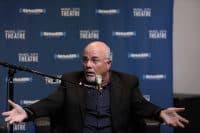
A 21 Year Old Called Dave Ramsey’s Show Owing $184,000 on Three Cars He Never Drove
A 21-year-old in Houston signed three car loans for his father and ended up carrying $184,000 in debt on vehicles he has never once driven. What the Ramsey hosts told him next reveals exactly how badly cosigning for family can…

This post may contain links from our sponsors and affiliates, and Flywheel Publishing may receive compensation for actions taken through them.

On Monday’s Ramsey Show, a caller named John, 21 years old and living in Houston, said he earns $4,500 a month, roughly $75,000 a year with overtime. Then he laid out the debt. $184,000 across three vehicles, all in his name. A GMC Sierra 1500 with $62,000 owed against a truck worth about $42,000. A Chevy Tahoe with 80,000 miles and $76,000 still on the note, worth about $45,000. And a third car with $12,000 of negative equity. One loan carries 18% interest. The other two sit at 8%.
He does not drive any of them. His father asked him to sign, promising the loans would be transferred into the father’s name, then never made the switch. The father is now missing payments while chasing foreign exchange trades and caring for a mother with dementia.
Jade Warshaw and Dr. John Deloney hosted the episode while Dave Ramsey was off. Ramsey had already primed the argument. Five days earlier he told a different caller: "Car payments are the siren song of the middle class. If you want to be middle class or below the rest of your life, keep a stinking car payment." The next day he offered the math: "If you invest $100 a month from age 25 to age 65, you’ll have $1,176,000. So if you have a $500 car payment from age 25 to age 65 because car payments are normalized, that’s a five million dollar car you’re driving."
Why the Hosts’ Advice Was Right
Warshaw and Deloney told John the same thing the math would tell him: sell all three vehicles and take personal loans from a credit union to cover the negative equity gap. That advice is right because the alternative is worse in ways young borrowers rarely see coming.
Consider the Tahoe alone. He owes $76,000 on a vehicle worth roughly $45,000. A private-party sale converts that loan into a smaller, unsecured personal loan for the gap. The interest rate on an unsecured loan will sting, but the principal is dramatically smaller and stops shrinking every time an odometer clicks.
The 18% loan is the emergency inside the emergency. On a balance in the $60,000 range, interest at that rate accrues faster than a $4,500-a-month earner can chip away at principal. Every month the vehicle sits, the loan balance moves in the wrong direction faster than the resale value.
Why Stopping Payments Backfires
The instinct of most 21-year-olds in this situation is to stop paying and let the lender take the car back. Deloney walked through why that path is a trap. When a vehicle is repossessed and sold at auction, the borrower stays legally responsible for the deficiency, meaning the gap between what the auction fetches and what the loan balance was.
Deloney’s own example: a car with $12,000 of negative equity might auction for $20,000 while the borrower owes $40,000 or $50,000. The borrower now owns nothing, has a repossession on their credit report, and still owes tens of thousands. The CFPB’s 2025 consumer complaint report noted that monthly complaints about vehicle repossessions rose 124% compared to the prior two-year monthly average, and the most common thread is exactly this: borrowers surprised by deficiency balances after their car is gone.
Selling private-party and covering the shortfall with a personal loan is uglier in the short term and cheaper in every term after that.
Cosigning Puts the Credit File on the Line
John is legally on three loans he did not benefit from. His father drives the cars and has stopped paying. On the same August 19 show, Ramsey told a caller whose father had taken her money: "You do not honor your parents’ misbehavior. When the Bible says to honor your parents, it’s honoring the office of father, the office of mother. You can honor the position of father but say, I cannot do financial transactions with you anymore because I can’t trust you."
The credit reports do not care who was driving. The CFPB has repeatedly emphasized that credit records are built to assess the risk of the individuals listed on the application. If John’s name is on the note, John’s score takes the damage from every missed payment, and John is the one a lender will sue for a deficiency.
A Five-Step Path Out of $184,000 in Car Debt
- Pull the payoff quote and current interest rate for every loan in writing. The 18% loan gets sold first; interest at that level compounds faster than income can catch it.
- List each vehicle on a private-party market at a realistic price, not the KBB retail number. The goal is to shrink the loan, not maximize sale price.
- Apply for a personal loan at a credit union for the total negative equity gap before any sale closes. Knowing the gap loan is approved turns this from panic into a plan.
- Take the keys back. The cosigned borrower must control the collateral until it is sold, because one more missed payment lands on his credit file, not the driver’s.
- Never sign for a family member’s loan again. If a relative’s credit cannot qualify them, the loan is telling you something the relative will not.
Ramsey’s "five million dollar car" line is a rhetorical flourish built on a compounding assumption. The point underneath it is durable: a car payment is a decision to route money away from every other financial goal you have, for as long as the note lasts. John’s version of that decision was made for him at 21, on three vehicles at once. The exit is expensive. Staying is more expensive.
Contact [email protected] for any questions or corrections.
Jake has been been working in financial media for almost 15 years. He focuses on all things personal finance for 24/7 Wall St. with high hopes to educate and entertain. Most recently, Jake spent 12 years working various roles at The Motley Fool. He started copy editing fool.com content, worked on premium and marketing campaigns, and helped launch The Ascent, a personal finance brand.
His work has been featured on platforms like MSN, Yahoo Finance, USA Today, and more. He's written about credit cards, social security, ETFs, savings accounts, and just about anything else you can imagine when thinking about money. Jake love to cook, play golf, and tell people he's never had a cavity. (It's true!)