“You Need to Be in a Wild Panic”: Dave Ramsey to Couple With $220,000 in Student Loans
A caller with a broken-down car thought he had a $3,500 problem until Dave Ramsey pointed out the six-figure crisis hiding behind his savings account balance.

This post may contain links from our sponsors and affiliates, and Flywheel Publishing may receive compensation for actions taken through them.

On a recent The Ramsey Show segment, a caller mentioned he had just relocated for his “first big boy job” when his wife’s car began falling apart. A $3,500 repair quote on a vehicle worth barely more than that sum quickly opened the door to a much bigger conversation.
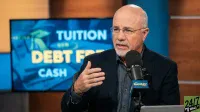
When Dave Ramsey pressed on the couple’s finances, the caller admitted, “I have $220,000 worth of debt and no money, student debt, and we have $71,000 [in cash].” Ramsey’s reaction was blunt: “You have 200,000 freaking dollars in student loan debt. You need to be in a wild panic.“
The Broken Car Is the Tip of the Iceberg
The wife bought the car in 2020 for $11,000, and it’s now worth roughly $6,000 to $7,000. The mechanic quoted $3,500 to fix it. Sinking that repair cost into a car at that market value is a losing trade: real cash spent restoring a depreciating asset that could fail again next month.
Ramsey suggested selling the broken car as-is for $3,000 to $4,000, adding a little cash, and buying a replacement in the $5,000 to $6,000 range. As he put it: “We’re gonna buy her a $5,000 or $6,000 car after we sell this car for $3,000 or $4,000 as it sits. And we’re gonna put a little bit of money into it and get her a little bit better hoopty that’s gonna last a little bit longer.”
Why Sitting on $71K in Savings Can Cost Them Thousands
The bigger issue is the $71,000 parked in savings alongside $220,000 in student loan debt. If their loans carry an average rate of 7%, that balance accrues roughly $15,400 in interest over a year if left untouched. Meanwhile, $70,000 sitting in a high-yield savings account at today’s top rates of around 4% to 4.5% earns roughly $2,800 to $3,150 over that same year. Holding cash for a 4% yield when the debt is accruing at 7% costs the household the difference every single day.
That gap is exactly what Ramsey and co-host Jade Warshaw were flagging. Warshaw put it plainly: “If you’ve got that kind of cash sitting around, that’s money that could be used to pay off debt.” Ramsey added: “We teach people not to be sitting on $70,000 while they got $200,000 owed to Sallie Mae.”
One Number Determines Whether Dave Ramsey’s Advice Is Right
The single factor that determines whether Ramsey’s aggressive stance fits your situation is the interest rate on the debt. Federal Direct loans for the 2025-26 academic year carry fixed rates from 6.39% for undergraduate borrowers up to 8.94% for PLUS loans, according to Federal Student Aid data. For a borrower whose loans fall anywhere in that band while cash sits earning 4% in a savings account, holding a large idle balance is a guaranteed loss on a net-interest basis.
Two exceptions can change the calculus. First, if a portion of the balance is subsidized at a rate below what a savings account pays, or if loan forgiveness benefits are tied to keeping payments low, directing every dollar toward principal can be the wrong move. Second, wiping out cash reserves entirely creates its own danger: a layoff or emergency with no liquidity forces borrowing at far higher rates. The FINRA Foundation’s 2024 National Financial Capability Study found only 46% of adults have three months of expenses saved, down from 53% in 2021, underscoring just how quickly financial cushions can disappear.
Key Takeaways
The couple does not need to spend $3,500 repairing an unreliable car, nor should they use the new job as an excuse to finance a better one. A modest replacement vehicle, a clearly defined emergency fund, and a plan to direct the remaining cash toward the highest-interest loans are the priorities. Some of the $71,000 in savings could be applied to the $220,000 in debt right now, with every dollar put to work rather than left earning a fraction of what the loans cost.
Editor’s note: This article was updated to reflect current 2025-26 federal student loan interest rates (6.39% for undergraduates, up to 8.94% for PLUS borrowers) and the latest top high-yield savings account APYs of 4% to 4.5%, sharpening the net-interest comparison at the heart of Ramsey’s advice.
Contact [email protected] for any questions or corrections.
Thomas Richmond is a financial writer and content strategist with 5+ years of experience covering stocks and financial markets. He has published over 500 articles focused on individual stock analysis, helping investors better understand business fundamentals, stock valuations, and long-term opportunities.
Thomas previously served as a Content Lead at TIKR, a stock research platform, where he helped scale the company’s blog to hundreds of articles per month and contributed to a weekly newsletter reaching more than 100,000 investors.
Outside of work, Thomas enjoys weight lifting and soccer.